






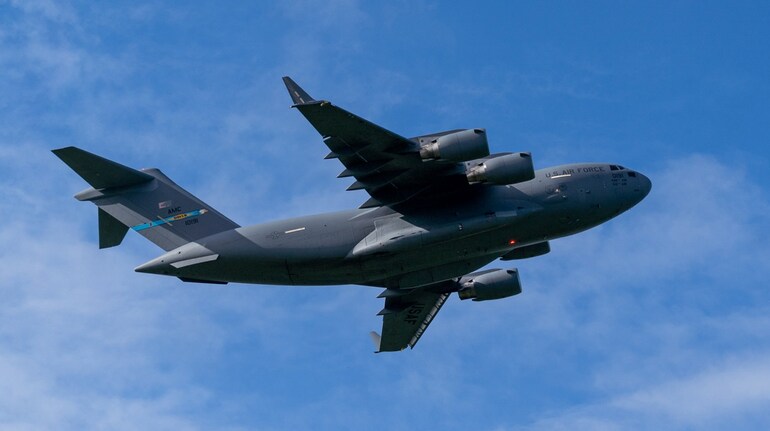

The United States has begun a significant redeployment of military assets toward the Middle East as tensions with Iran intensify following mass unrest inside the Islamic Republic and growing fears of a wider regional conflict.
American media reports say Washington has reinforced its United States Central Command with fighter jets, missile defence systems and a major naval strike group. The moves come at a time when President Donald Trump is sending mixed signals, publicly expressing hope that force can be avoided while privately pressing advisers for military options.
The redeployments underscore how volatile the situation has become, even as diplomatic messaging continues.
Trump signals restraint at Davos, warns force remains an option
Speaking at the World Economic Forum in Davos, Trump said he hoped military action against Iran would not be necessary. He claimed that US pressure had forced Tehran to pause the planned executions of protesters arrested during the unrest.
“I hope it’s permanent,” Trump said when asked about the reported halt in executions.
He later added that there was “no plan for executions,” suggesting his threats had produced results without the need for force.
However, Trump also made clear that military options had not been taken off the table. Speaking separately to NewsNation, he warned that any assassination threats from Iran would be met with overwhelming retaliation.
The dual messaging has added to uncertainty in Washington and across the region.
US military build-up across the Middle East
Despite Trump’s public remarks, the Pentagon has accelerated its military posture in the region.
According to reports, the US Air Force redeployed 12 F-15E Strike Eagle fighter jets from the United Kingdom to bases in Jordan in mid-January. These aircraft were accompanied by KC-135 aerial refuelling planes and C-130 transport aircraft, significantly boosting operational reach.
The F-15E has previously been used by both the US and Israel to counter Iranian drone and missile threats during earlier regional escalations.
At sea, the aircraft carrier USS Abraham Lincoln has been repositioned from the Indo-Pacific toward the Middle East. The carrier, equipped with F-35C and F/A-18 fighter jets, reportedly transited the Strait of Malacca with its transponder switched off, a move typically associated with heightened security conditions.
Once fully deployed, the carrier strike group is expected to operate in the Arabian Sea or Persian Gulf, giving Washington expanded strike and power projection capabilities.
Missile defences strengthened as strike options grow
Alongside air and naval assets, the US has reinforced its air and missile defences across the region.
According to reports, additional THAAD and Patriot missile defence systems have been deployed in Israel, Qatar and Jordan. These systems are designed to intercept ballistic missiles, cruise missiles and drones, reflecting concerns about potential Iranian retaliation.
Taken together, the deployments provide Washington with the capability to conduct swift and wide-ranging strikes against Iranian targets if ordered.
Unrest inside Iran raises stakes
The military escalation comes against the backdrop of severe internal unrest in Iran.
Despite internet shutdowns and restrictions on satellite communications, reports from international agencies indicate that the crackdown has been deadly. A Reuters report quoted an unnamed Iranian official as confirming that around 5,000 people, including 500 members of the security forces, have been killed.
Graphic accounts of torture, disappearances and mass arrests continue to emerge, adding pressure on the Trump administration to respond.
Trump earlier suggested that assurances from Tehran had led him to pause planned military action. A CNN report said he had called off strikes after receiving guarantees that executions would be halted.
Iran warns of full-scale retaliation
Iran has issued stern warnings against any US or Israeli strike.
Foreign Minister Seyyed Abbas Araghchi, writing in The Wall Street Journal, said Iran would not show restraint if attacked again.
“Unlike the restraint Iran showed in June 2025,” he wrote, “its armed forces would respond with full force.”
Araghchi accused Israel of pushing Washington toward confrontation and warned that any major conflict would be longer and more destructive than Israeli leaders were suggesting.
Iranian officials have also warned that US bases and allied assets across the region would be targeted if military action is launched.
Israel moves into high alert mode
Israel has responded to the escalating situation by raising alert levels across its military and civilian agencies.
Israeli media outlet Haaretz reported that the Israel Defence Forces are treating the possibility of a US strike on Iran as serious, despite the absence of public signals from Washington.
Emergency services, police and fire departments have begun preparations for multiple scenarios. Israel’s air defence network has been placed on high alert amid fears that Iran could retaliate indirectly through missile attacks or proxy groups.
IDF Chief of Staff Lt Gen Eyal Zamir said the military was prepared for any threat.
“In the face of the scope of the multi-front threats to the State of Israel, the Home Front Command stands on defence, is trained, competent and on high alert,” Zamir said.
Will the US actually strike Iran?
Trump’s shifting posture has injected uncertainty into decision-making on all sides.
According to officials cited by The Wall Street Journal, the US president has repeatedly pressed his advisers for “decisive” military options. These range from limited strikes on Islamic Revolutionary Guard Corps targets to broader operations designed to pressure or destabilise the Iranian regime.
At the same time, Trump has shown a willingness to pause action if he believes concessions are being made.
A Western military official told Reuters earlier that unpredictability is often used deliberately by the Trump administration as part of its strategy.
As of January 22, no strike had been authorised. Reports suggest that a major attack would require additional deployments, including B-2 bombers and larger numbers of F-35 stealth aircraft, which have not yet moved into the region.
A narrow window with high risk
While no final decision has been made, the scale of the US military build-up, combined with Israel’s heightened readiness and Iran’s warnings, suggests the situation remains highly volatile.
Trump’s approach appears to blend coercive pressure with tactical pauses. Whether that balance holds, or tips into open conflict, remains uncertain. For now, the window for escalation remains open, and a sudden strike cannot be ruled out.
Discover the latest Business News, Sensex, and Nifty updates. Obtain Personal Finance insights, tax queries, and expert opinions on Moneycontrol or download the Moneycontrol App to stay updated!
Find the best of Al News in one place, specially curated for you every weekend.
Stay on top of the latest tech trends and biggest startup news.





