






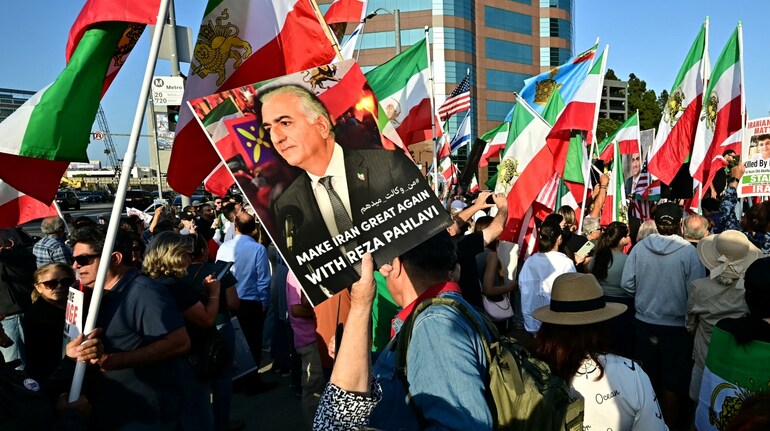

Iran’s protests show no sign of fading. What began last month as demonstrations over rising prices and a deepening economic crisis has steadily transformed into wider anti-government unrest. In several cities, protesters have been heard chanting slogans such as “Death to the dictator,” a reference to Supreme Leader Ayatollah Ali Khamenei, and “Long live the shah,” invoking Iran’s former monarch Mohammad Reza Pahlavi.
As the protests intensified, Iran experienced a nationwide internet blackout on Thursday, January 8. The disruption came amid renewed calls for demonstrations by Reza Pahlavi, who is often referred to by supporters as the “Crown Prince” and is a prominent figure in Iran’s fragmented opposition movement.
Who is Reza Pahlavi?
Reza Pahlavi, 65, is the eldest son of Mohammad Reza Pahlavi and Empress Farah Pahlavi. He has lived in exile for decades, primarily in the United States. Once the crown prince of Iran’s pro-Western monarchy, his life changed dramatically after the 1979 revolution that overthrew the shah and led to the establishment of the Islamic Republic.
In 1978, at the age of 17, Pahlavi left Iran for military training at Reese Air Force Base in Texas. Months later, the revolution forced his family into exile. After moving through several countries, the family eventually settled abroad. Mohammad Reza Pahlavi died of cancer in Egypt in 1980. Years later, Reza Pahlavi symbolically declared himself shah during a ceremony in Cairo. “In a way, I’m king-elect,” he told The Washington Post in a 1989 interview.
Since then, Pahlavi has positioned himself as an advocate for regime change through peaceful means. He has repeatedly said he does not seek power for himself but wants to help Iranians decide their future. Speaking to USA Today, he said he hoped to act as a “catalyst” for democracy and envisioned a “successful campaign of nonviolent civil disobedience” followed by a referendum.
According to his official website, Pahlavi travels widely to meet lawmakers, policymakers and activists, speaking about “the plight of Iranians under the Islamic regime” and calling for “the establishment of a secular democracy in Iran.” In a recent opinion piece for The Washington Post, he wrote, “The Islamic Republic has exhausted its legitimacy, and after almost 47 years, the country wants to be free.”
Calls for fresh protests
This week, Pahlavi urged Iranians to take to the streets at 8 pm local time on Thursday and Friday. Witnesses told the Associated Press that as the hour approached, chants echoed across parts of Tehran, including “Death to the dictator!” and “Death to the Islamic Republic!” Some protesters even shouted, “This is the last battle! Pahlavi will return!”
Thousands were reportedly on the streets before communications were cut. “Iranians demanded their freedom tonight. In response, the regime in Iran has cut all lines of communication,” Pahlavi said. “It has shut down the Internet. It has cut landlines. It may even attempt to jam satellite signals.”
Violent clashes between protesters and security forces have been deadly. At least 42 people have been killed and more than 2,270 detained, the Associated Press reported, citing the US-based Human Rights Activists News Agency.
Will the US support Pahlavi?
As unrest grows, questions have emerged about whether the United States would support Pahlavi if the current regime weakens. US President Donald Trump has issued strong warnings to Tehran, saying Washington could intervene if protesters are targeted.
“They’re doing very poorly. And I have let them know that if they start killing people which they tend to do during their riots if they do it, we’re going to hit them very hard,” Trump said on Thursday.
Despite this rhetoric, Trump has stopped short of endorsing Pahlavi. He declined to meet him, calling him a “nice person” but suggesting it would be inappropriate. “I think that we should let everybody go out there and see who emerges,” Trump said on The Hugh Hewitt Show podcast. “I’m not sure necessarily that it would be an appropriate thing to do.”
Pahlavi, for his part, welcomed Trump’s comments. “I want to thank the leader of the free world, President Trump, for reiterating his promise to hold the regime to account,” he wrote in a social media post. He also urged European leaders to act. “It is time for others, including European leaders, to follow his lead, break their silence, and act more decisively in support of the people of Iran.”
As protests continue and the regime tightens controls, Reza Pahlavi remains a symbolic rallying point for some demonstrators. Whether that symbolism translates into real political change remains uncertain.
Discover the latest Business News, Sensex, and Nifty updates. Obtain Personal Finance insights, tax queries, and expert opinions on Moneycontrol or download the Moneycontrol App to stay updated!
Find the best of Al News in one place, specially curated for you every weekend.
Stay on top of the latest tech trends and biggest startup news.





