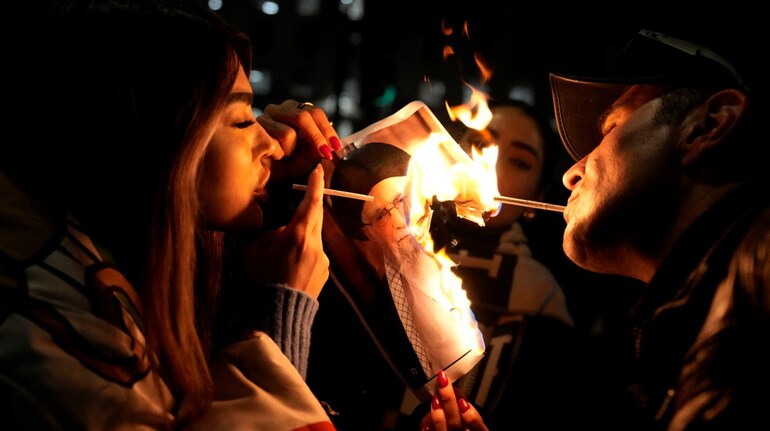

Iran’s clerical leadership under Ayatollah Ali Khamenei has intensified its crackdown as nationwide protests entered their third week, leaving the country cut off from the outside world. With reports suggesting that more than 500 people have been killed and thousands arrested, the regime has moved aggressively to silence dissent by imposing sweeping internet restrictions, including what experts describe as a deliberate attempt to disable Elon Musk’s Starlink satellite internet service.
The unrest has now continued for 18 days, spreading to at least 280 locations across Iran. Protesters are demanding the fall of the theocratic regime amid worsening economic conditions and growing anger over Khamenei’s policies, including Iran’s support for militant groups abroad while ordinary citizens struggle at home. Slogans calling for the return of Crown Prince Reza Pahlavi have also surfaced, even in conservative strongholds.
On January 8, the Iranian authorities imposed a near-total internet blackout, plunging a country of nearly 80 million people into digital darkness. During this shutdown, Starlink emerged as a rare communication lifeline, allowing protesters to send images and videos to the outside world. The satellite service had played a similar role during the 2022 Mahsa Amini protests, and its use in Iran has reportedly increased since then.
That lifeline, however, now appears to have been deliberately cut. According to reports by Iran Wire, around 30 percent of Starlink’s uplink and downlink traffic was initially disrupted, before the outage rapidly escalated to more than 80 percent. “Despite reports that tens of thousands of Starlink units are operating inside Iran, the blackout has also reached satellite connections,” Iran Wire reported.
Amir Rashidi, director of digital rights and security at the Miaan Group, said he observed a sharp deterioration in connectivity. He told Iran Wire that since Thursday he had seen “around a 30% loss in packets sent by Starlink devices,” a figure that later surged to nearly 80 percent.
Experts believe the Iranian regime activated a military-grade “kill switch” to jam Starlink satellites. Rashidi said such interference goes beyond conventional methods. “I have been monitoring and researching access to the internet for the past 20 years, and I have never seen such a thing in my life,” he told TechRadar. He added that the technology involved was highly sophisticated and “likely supplied to the government by Russia or China, if not developed domestically.”
Journalist Simon Migliano, research head at Top10VPN(dot)com, told Forbes that “Iran's current nationwide blackout is a blunt instrument intended to crush dissent.” He added that this “kill switch” comes at an enormous cost, draining “$1.56 million from Iran's economy every single hour the internet is down.”
The Times of Israel reported that since Iran’s 12-day war with Israel last year, the regime has increasingly disrupted GPS signals, leading to localised shutdowns that have effectively “killed” Starlink in high-priority areas. Israeli journalist Emily Schrader said Starlink connectivity had been “completely jammed,” consistent with “military-grade, high-power microwave jamming,” possibly of Chinese origin. She warned that such blanket interference could also cripple mobile communications nationwide and pose health risks to civilians.
Starlink operates through low-Earth orbit satellites that connect directly to user terminals on the ground, bypassing local telecom networks. This makes it especially valuable during government-imposed shutdowns. Recent estimates cited by the Associated Press suggest that between 40,000 and 50,000 people in Iran use Starlink, despite its ban.
After its conflict with Israel and the US, Iran passed an anti-espionage law banning Starlink and other unauthorised satellite services. Personal use can lead to prison sentences of up to two years, while links to espionage may even attract the death penalty.
The blackout has unfolded alongside growing pressure from Washington. US President Donald Trump said on Sunday that he planned to speak to Elon Musk about restoring internet access in Iran. “We may get the internet going if that's possible... He [Elon]'s very good at that kind of thing, he's got very good company,” Trump said.
Trump has repeatedly warned the Khamenei regime of possible action, saying the US was “locked and loaded and ready to go” if peaceful protesters were killed. “You better not start shooting because we'll start shooting too,” he said, adding that Iran’s leaders had been warned “very strongly” that they would “have to pay hell.”
As protests continue despite deadly repression, Iran’s decision to jam Starlink has cut off one of the last channels connecting its people to the world. With 80 million citizens effectively in the dark, attention is now focused on whether international pressure, including Trump’s outreach to Musk, can restore that connection and blunt the regime’s tightening grip.
Discover the latest Business News, Sensex, and Nifty updates. Obtain Personal Finance insights, tax queries, and expert opinions on Moneycontrol or download the Moneycontrol App to stay updated!
Find the best of Al News in one place, specially curated for you every weekend.
Stay on top of the latest tech trends and biggest startup news.