
The operation that led to the capture of Nicolás Maduro did not begin with airstrikes or commandos. It began quietly, months earlier, when a small team of Central Intelligence Agency officers slipped into Venezuela to do what American intelligence had not been able to do for years: track the daily movements of the country’s heavily guarded leader.
Operating without diplomatic cover and under constant risk of detection, the officers moved discreetly through Caracas, collecting granular intelligence on Maduro’s routines. Over time, and with help from a human source close to the president, the agency assembled a remarkably detailed portrait of his habits, locations and security patterns.
That intelligence would become the backbone of what the Trump administration later called Operation Absolute Resolve — the most audacious US military raid in years, the New York Times reported.
Intelligence first, force second
By late fall, US officials say they knew where Maduro slept, how often he changed locations and which compounds he favoured. Stealth drones flying undetected over Caracas filled in the final gaps. According to General Dan Caine, chairman of the Joint Chiefs of Staff, the intelligence reached an extraordinary level of precision.
“We knew where he moved, what he ate, even what pets he kept,” General Caine said.
That knowledge made it possible to plan a raid that would avoid the mistakes of past US interventions in Latin America — messy, prolonged operations that often resulted in civilian casualties or political blowback.
Rehearsing the impossible
The military component of the operation was handed to Army Delta Force, which spent weeks rehearsing the mission inside a full-scale replica of Maduro’s compound built by the Joint Special Operations Command in Kentucky.
Operators practiced breaching steel doors, navigating tight hallways and extracting a high-value target under fire. The goal was speed: reach the target, secure him and leave before Venezuelan forces could mount a coordinated response.
Timing was everything. Maduro rotated among multiple locations, sometimes without advance warning. US planners often did not know where he would sleep until late in the evening. The raid could only proceed once intelligence confirmed his presence at the chosen site.
A narrow window opens
President Donald Trump authorised the military to proceed as early as December 25, leaving the final timing to Pentagon planners. Weather delays pushed the operation back several days. Officials waited for a narrow window when conditions aligned — clear skies, reduced civilian presence and confirmation of Maduro’s location.
The holiday period helped. Venezuelan government officials and military personnel were on leave, reducing the risk of resistance.
At 10.46 pm Friday, Trump gave the final go-ahead.
Darkness over Caracas
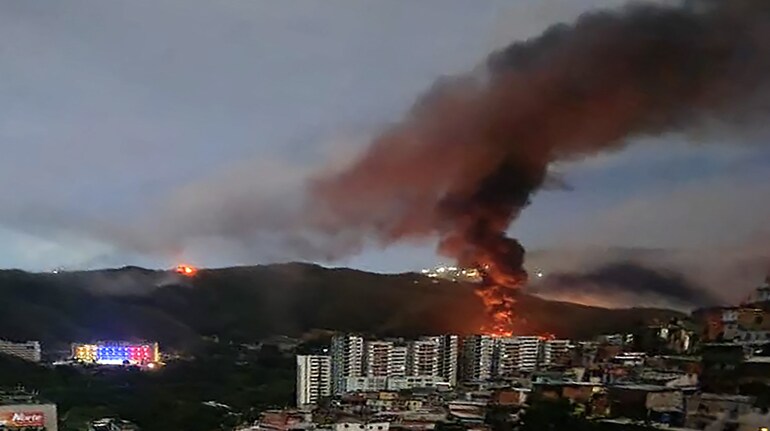
The operation began not with helicopters, but with a cyberattack. US forces cut power across large parts of Caracas, plunging the city into darkness and masking the approach of aircraft.
More than 150 US aircraft took part, including drones, fighter jets, bombers and search-and-rescue helicopters, launching from multiple bases and naval vessels. Warplanes struck Venezuelan radar sites and air defence systems, clearing a path for the helicopters carrying Delta Force operators.
Despite those strikes, US helicopters came under fire as they approached Maduro’s compound. One aircraft was hit, and several American troops were injured, though none were killed.
The capture
At approximately 2.01 am local time, helicopters from the 160th Special Operations Aviation Regiment — known as the Night Stalkers — set down at the compound. Delta Force operators moved rapidly through the building.
According to US officials, it took just three minutes after breaching the door to reach Maduro. He and his wife attempted to flee into a reinforced safe room but were intercepted before they could secure it.
Within five minutes, Maduro was in US custody.
An FBI hostage negotiator was on hand in case the Venezuelan leader refused to surrender. He did not.
Watching from Florida
As the raid unfolded, Trump followed the operation in real time from a secure room at Mar-a-Lago, watching live video feeds relayed from overhead aircraft.
“I watched it literally like I was watching television,” the president later said.
By 4.29 am, Mr. Maduro and his wife were airborne, transferred first to the USS Iwo Jima in the Caribbean, then to Guantánamo Bay. From there, an FBI aircraft flew them to New York, where Maduro is expected to face federal drug-trafficking and weapons charges.
Precision — and unanswered questions
US officials describe the operation as tactically flawless. But it has already triggered intense debate over its legality, justification and long-term consequences.
Trump has framed the raid as a strike against drug trafficking. He has also declared that the United States is now effectively in charge of Venezuela and intends to rebuild its oil industry — statements that go far beyond the limited objectives previously described to US Congress.
For now, Operation Absolute Resolve stands as a rare example of a swift, successful US extraction mission. Whether it proves to be a strategic turning point — or the opening chapter of a deeper entanglement — remains an open question.
Discover the latest Business News, Sensex, and Nifty updates. Obtain Personal Finance insights, tax queries, and expert opinions on Moneycontrol or download the Moneycontrol App to stay updated!
Find the best of Al News in one place, specially curated for you every weekend.
Stay on top of the latest tech trends and biggest startup news.