
India and France are set to add fresh strategic weight to their partnership as Prime Minister Narendra Modi hosts French President Emmanuel Macron in Mumbai today. The visit signals a shift from symbolism to substance, with defence manufacturing and artificial intelligence expected to dominate the agenda.
While Paris has long been one of New Delhi’s most dependable defence partners, today’s engagements underline a new phase that blends advanced weapons, joint production and innovation ecosystems. From high-end air-to-ground munitions to AI-driven collaboration, the Modi-Macron talks are positioned to deepen both military capability and industrial cooperation, reinforcing France’s role in India’s push for strategic autonomy.
This is Macron’s fourth visit to India, but his first to Mumbai. According to the official programme, the two leaders will hold bilateral discussions at Lok Bhavan at 3.15 pm, followed by the inauguration of the India-France Year of Innovation 2026 at 5.15 pm. The event will bring together business leaders, start-ups, researchers and innovators from both countries. After the Mumbai leg, Macron, accompanied by Brigitte Macron, will travel to New Delhi to attend the India AI Impact Summit 2026.
Hammer missiles, decoded
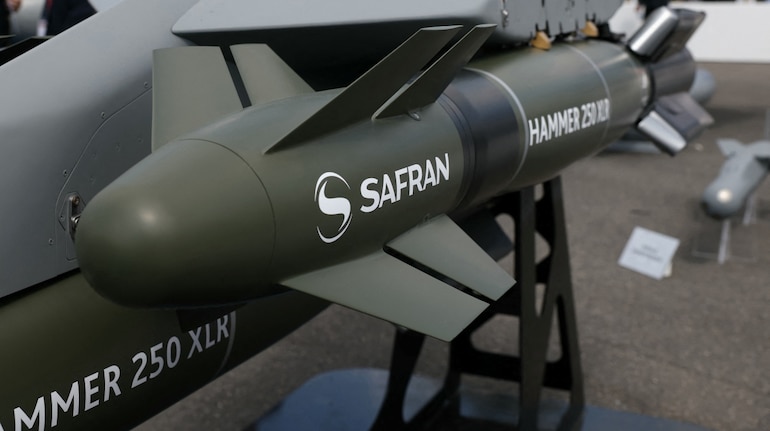
Beyond the expected focus on Rafale fighter jets, India and France are likely to sign a memorandum of understanding for the joint production of Hammer missiles. Hammer stands for Highly Agile Modular Munition Extended Range and is formally known by its French designation AASM Hammer, or Armement Air-Sol Modulaire.
Developed by Safran Electronics & Defence, Hammer is not a single missile but a modular kit that transforms conventional unguided bombs into precision-guided weapons. It consists of a nose-mounted guidance unit for navigation and targeting, and a tail-mounted range extension kit equipped with a solid-fuel rocket booster and manoeuvrable winglets.
First showcased at the Paris Air Show in 2007, the system was renamed Hammer in 2011 and is classified as a medium-range air-to-ground weapon. Often described as a glide bomb, it can strike targets up to 70 km away and can be fitted on standard bomb bodies of 250 kg, 500 kg and 1,000 kg.
Known for its high accuracy and fire-and-forget capability, the Hammer system can engage both stationary and moving targets and is designed to operate effectively in mountainous terrain and against fortified structures. Its controlled angle of impact allows for either penetrating or glancing strikes, depending on mission requirements. The weapon was excluded from India’s 2016 Rafale deal due to cost considerations.
Hammer in Indian combat use
The Hammer weapons system came into sharp focus during Operation Sindoor last May, launched by India in retaliation for the Pahalgam terror attack. As part of the operation, Indian forces struck 21 terror camps across nine locations.
Among the precision munitions used were Hammer systems mounted on Dassault Rafale jets. Indian military officials later said the weapon’s autonomous guidance and resistance to electronic jamming made it ideal for destroying hardened targets, including terror infrastructure linked to Jaish-e-Mohammed and Lashkar-e-Taiba in Pakistan.
Made in India Hammer
A key outcome of the Modi-Macron meeting in Mumbai will be the signing of an MoU between Bharat Electronics Limited and Safran Electronics & Defence to set up a joint venture for indigenous production of Hammer missiles. The proposed private limited company is expected to be located in Pune.
BEL has informed stock exchanges that the joint venture will operate a Centre of Excellence and serve as a technology and teaming partner for manufacturing, supply, maintenance and repair of the Hammer guidance kits. The missiles produced by the JV will be used on Rafale-M aircraft for the Indian Navy. The partners may also decide to supply the system to other domestic users.
According to a report by The Print, the level of indigenisation is expected to rise progressively to around 60 percent, with key sub-assemblies, electronics and mechanical components manufactured in India. The move aligns closely with the government’s Make in India programme, reducing dependence on overseas suppliers and improving turnaround times for the armed forces.
Rafale and other defence deals
The Hammer joint production plan comes alongside discussions on a potential multibillion-dollar deal for 114 additional Rafale fighter jets. In parallel, Defence Minister Rajnath Singh and his French counterpart Catherine Vautrin will take part in the sixth India-France Annual Defence Dialogue in Bengaluru. During the dialogue, they will witness the virtual inauguration of the H125 Light Utility Helicopter final assembly line set up by Tata Airbus.
France has emerged as one of India’s most trusted defence partners over the years, supplying platforms and systems ranging from Mirage-2000 and Rafale jets to Scorpene submarines, Alize anti-submarine aircraft, Milan anti-tank missiles, air surveillance radars and engines for the Dhruv advanced light helicopter built by Hindustan Aeronautics Limited.
As Modi and Macron engage in Mumbai, the emphasis is clear. The India-France partnership is no longer limited to buyer-seller dynamics. It is evolving into a deeper strategic and industrial alliance built around co-development, co-production and shared technological ambition.
Discover the latest Business News, Sensex, and Nifty updates. Obtain Personal Finance insights, tax queries, and expert opinions on Moneycontrol or download the Moneycontrol App to stay updated!
Find the best of Al News in one place, specially curated for you every weekend.
Stay on top of the latest tech trends and biggest startup news.