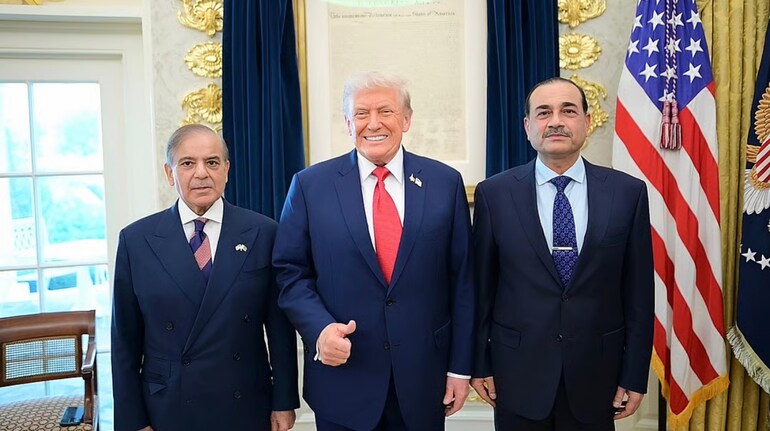
Pakistan's fluid foreign policy and global double-dealing have left it in flux as the US and Israel rained missiles on Iran over the weekend, triggering a dangerous escalation across West Asia.
Since the attack, Pakistan’s Prime Minister Shehbaz Sharif paid condolences to Iran following the death of Iran’s Supreme Leader Ayatollah Ali Khamenei. However, he did not openly call out the US or condemn the strikes carried out against Iran.
Pakistan has long walked a diplomatic tightrope between Iran, Saudi Arabia and the US. In the wake of recent US–Israel strikes on Iran, this balancing act has sparked sharp questions domestically as public opinion diverges from the stance taken by Field Marshal Asim Munir and the Shehbaz Sharif government.
Nearly 20 percent of Pakistan's population comprises Shia Muslims, one of the largest Shia populations outside Iran. While ties between Iran and Pakistan have witnessed ups and downs, the overall relationship has remained largely cordial and strategic.
At the same time, Pakistan has doubled down on efforts to rebuild ties with the US since Donald Trump assumed office last year. It has strategically hedged itself as an “American ally,” especially since Operation Sindoor, with Sharif and Munir often signalling deference to the US President.
Thus, while Pakistan seeks to remain in Washington’s good books, the actions of the Trump administration are causing discomfort and anger at home.
The public reality check
Anger has been growing among the Shia population in Pakistan over America’s strikes in Iran, which led to the killing of Khamenei.
His death sparked massive Shia protests from Karachi to Gilgit-Baltistan. Security forces imposed curfews in sensitive areas and invoked Section 144 nationwide to curb gatherings. Religious leaders reportedly pressured the government to cut ties with the United States and reconsider aspects of its foreign policy.
At least 22 people were killed and more than 120 were injured as violent clashes broke out between protesters and security forces in Karachi and parts of northern Pakistan on Sunday. The unrest erupted after demonstrators supportive of Iran allegedly attempted to storm the United States Consulate in Karachi. Protests also included the burning of US diplomatic facilities.
This is not the first time Pakistan’s outreach to Trump has sparked domestic backlash. The Sharif government previously faced criticism after deciding to join the US-led Board of Peace for Gaza. Opposition leaders, religious groups such as Jamaat-e-Islami, and sections of the public accused the government of compromising Palestinian self-determination and aligning with a Trump initiative perceived as lacking legitimacy.
Pakistan at crossroads
Over the weekend, Sharif chaired multiple high-level security meetings with Army Chief Asim Munir, intelligence heads, and senior military commanders to assess the deteriorating national and regional security environment, according to CNN-News18.
Munir convened a closed-door huddle at General Headquarters in Rawalpindi, focusing on internal and external threats. He also contacted the chiefs of the air force and navy, directing all forces to remain on high alert.
Officials said discussions centred on three urgent questions: how to manage the fallout of the Iran crisis, how to navigate tensions with Afghanistan, and how to contain widespread Shia protests across Pakistan.
Analysts warn that unrest in Iran’s Sistan and Baluchestan province could embolden separatist sentiment in Pakistan’s Balochistan, reviving calls for a “Greater Balochistan,” a scenario that would pose a major challenge to the military establishment.
With the Sharif-led government already grappling with economic strain and political polarisation following the ouster of former Prime Minister Imran Khan, the Iran crisis risks compounding challenges at home and abroad.
If Islamabad is eventually forced to take a clearer side in the escalating regional conflict, the disconnect between public opinion and leadership strategy could deepen domestic instability.
Discover the latest Business News, Sensex, and Nifty updates. Obtain Personal Finance insights, tax queries, and expert opinions on Moneycontrol or download the Moneycontrol App to stay updated!
Find the best of Al News in one place, specially curated for you every weekend.
Stay on top of the latest tech trends and biggest startup news.