






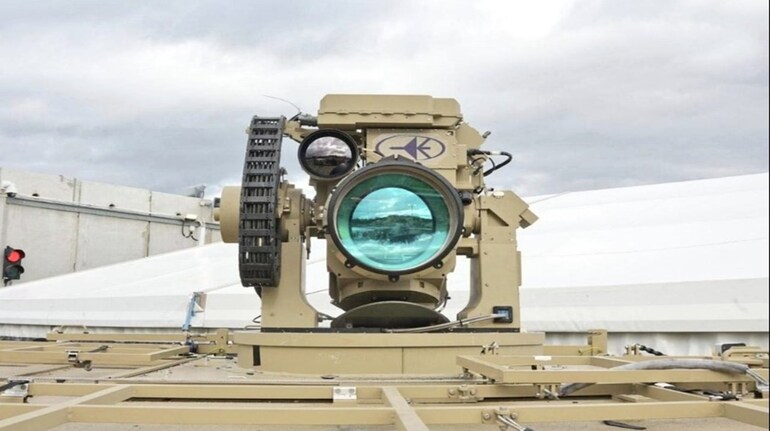

Israel’s Defence Ministry has announced the first operational deployment of the Iron Beam laser defence system, saying it was used to intercept a large wave of missiles fired by Hezbollah from Lebanon late on Sunday night.
The escalation came a day after the killing of Iran’s Supreme Leader Ayatollah Ali Khamenei and several top leaders in Tehran.
The Israel War Room released a video showcasing the capabilities of the Iron Beam, described as Tel Aviv’s “new era of warfare” defence system. This also marked the "first-ever use" of the system in live combat.
The video showed the laser-based defence system striking incoming projectiles in mid-air, eliminating the threats before impact. The interceptions lowered the danger to Israeli population centres and showcased the system’s capacity to respond to high-volume, intense barrages.
Who developed Iron Beam?
Israeli defence majors Rafael Advanced Defense Systems and Elbit Systems developed the Iron Beam for over a decade.
The Iron Beam was officially declared operational in September 2025. After its reported combat success this week, Israel signed fresh contracts worth more than $500 million to ramp up production.
Unlike the Iron Dome, which relies on costly interceptor missiles, Iron Beam uses a high-energy laser powered by a continuous energy source. This means it can theoretically fire without limit, provided sufficient power is available.
How does Iron Beam work?
The system is not meant to replace Israel’s existing air defence network but to operate alongside it. It is designed primarily to intercept smaller and short-range threats.
The key components of an Iron Beam battery include an air defence radar, a command and control (C2) unit, and two high-energy laser (HEL) systems.
According to reports, the system employs dual lasers to deliver the necessary energy required to overcome atmospheric disruptions.
⚡HISTORIC: For the first time ever, Israel used the Iron Beam to intercept rockets fired by Hezbollah. pic.twitter.com/DU63REU22k— Israel War Room (@IsraelWarRoom) March 2, 2026
It concentrates the laser beams on an area roughly the size of a coin to physically eliminate the target.
Unlike conventional interceptor missiles, the laser-based platform draws on a continuous energy supply. If sufficient power is available, it does not face the risk of depleting ammunition. Israeli officials have called the technology a potential “game-changer” in countering rocket and drone attacks.
However, the system has constraints. Laser weapons can be less effective in poor visibility conditions — including heavy cloud cover, dust or other adverse weather — which may weaken or disperse the beam and reduce its effectiveness.
Rafael and the IMOD unveiled the upgraded Iron Beam 450 Laser Director at the Paris Air Show in June 2025.
Discover the latest Business News, Sensex, and Nifty updates. Obtain Personal Finance insights, tax queries, and expert opinions on Moneycontrol or download the Moneycontrol App to stay updated!
Find the best of Al News in one place, specially curated for you every weekend.
Stay on top of the latest tech trends and biggest startup news.





