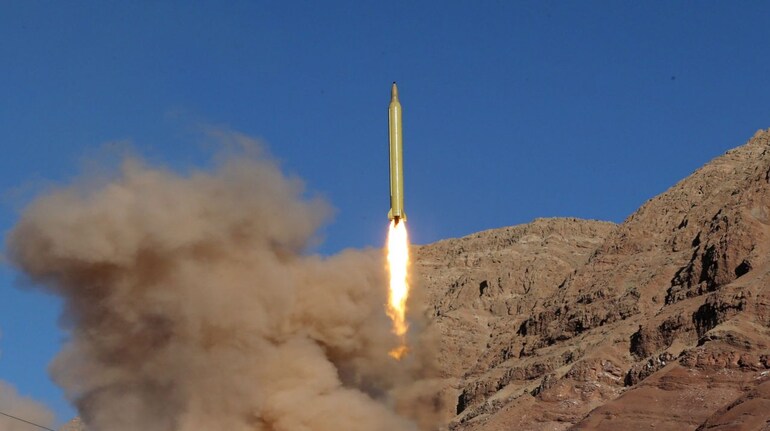

As Israel pressed ahead with Operation Lion's Roar, targeting Iran’s nuclear and military facilities, Tehran retaliated with a wave of missile fire.
According to the Israel Defence Forces, Iran launched around 150 ballistic missiles at Israel in two separate barrages on Saturday, as reported by The Times of Israel. Iranian forces also deployed a newly developed ballistic missile named after former General Qassem Soleimani, who was killed in 2020 on the orders of US President Donald Trump.
What are ballistic missiles?
Ballistic missiles are weapons designed to carry one or more warheads to a pre-set target along a ballistic trajectory. They are powered and guided during the initial launch phase. After that, they follow a largely unpowered path, arcing high into the atmosphere before descending toward their target under the force of gravity.
How fast do they travel?
Ballistic missiles move at extremely high speeds, often measured in Mach, or multiples of the speed of sound. Intercontinental ballistic missiles can exceed Mach 20. Short-range ballistic missiles travel at supersonic speeds, meaning faster than Mach 1, or about 1,225 km per hour. Longer-range systems can achieve hypersonic speeds, above Mach 5, which is over 6,000 km per hour.
Ballistic missiles vs cruise missiles and drones
Ballistic missiles are launched high into the atmosphere and follow a steep, arcing path, making them suitable for long-range or strategic targets. Cruise missiles, by contrast, fly at lower altitudes like unmanned aircraft and remain guided throughout their journey, enabling precision strikes over medium to long distances. Drones, or unmanned aerial vehicles, are slower, can be remotely or autonomously controlled, and are often used for surveillance or targeted attacks, with the ability to loiter over an area before striking.
How long would they take to reach Israel from Iran?
Ballistic missiles fired from Iran could reach Israel in roughly 12 minutes, given their high-speed, arcing flight path.
Cruise missiles, which travel at subsonic speeds, could take around two hours to cover the same distance, depending on their launch platform.
Long-range drones could take about nine hours, reflecting their slower speeds despite extended operational range.
Hypersonic missiles: A new challenge
Iran has also unveiled hypersonic systems such as the Fattah-1, reportedly capable of travelling between Mach 13 and Mach 15, or roughly 16,000 to 18,500 km per hour. With a claimed range of about 1,400 km, such missiles could potentially reach Israel in under seven minutes, posing a serious challenge to air defence systems like the Iron Dome.
Can they be intercepted?
Although ballistic missiles vary in range, they operate on the same basic principle. Because they travel high into the atmosphere, early warning radar systems can detect their launch and project their likely impact point. This enables the defending country to launch anti-ballistic interceptors.
During the final phase of flight, a ballistic missile descends rapidly under gravity, with its engines no longer active. While this limits manoeuvrability, it does not make interception impossible. With accurate tracking and timing, anti-missile systems can still engage and destroy them mid-air.
Discover the latest Business News, Sensex, and Nifty updates. Obtain Personal Finance insights, tax queries, and expert opinions on Moneycontrol or download the Moneycontrol App to stay updated!
Find the best of Al News in one place, specially curated for you every weekend.
Stay on top of the latest tech trends and biggest startup news.