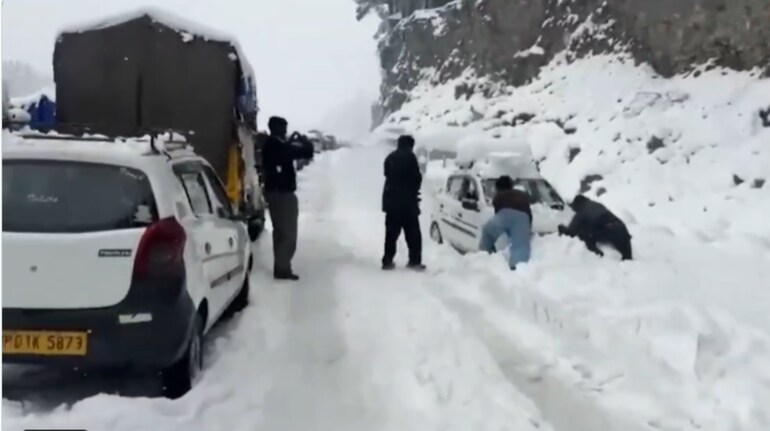

Climate change does not mean the end of cold days. It means a shift in long-term patterns. Individual storms, even severe ones, sit on top of a steadily warming baseline driven by fossil-fuel emissions.
That’s why scientists consistently push back when cold snaps are used to question climate science. A single storm says little about long-term climate trends. What matters is how often extreme events occur, how intense they become, and how the atmosphere behaves overall, the New York Times reported.
A warmer atmosphere holds more moisture
One of the clearest links between climate change and winter storms is moisture. As the atmosphere warms, it can hold more water vapour. When temperatures drop low enough, that extra moisture doesn’t disappear — it falls as heavier precipitation.
In winter, that can mean more intense snowstorms. In marginal conditions, it can mean sleet, freezing rain, or rapid swings between rain and snow, all of which increase disruption and risk.
The Arctic’s role in extreme cold
This week’s frigid weather was driven by shifts in the polar jet stream, a high-altitude current that usually keeps cold air locked near the Arctic. Scientists have observed that the Arctic is warming nearly four times faster than the rest of the planet, a phenomenon known as Arctic amplification.
There is growing evidence that this rapid warming may weaken or distort the jet stream, allowing cold Arctic air to plunge south more often. However, researchers are careful here: while the Arctic clearly influences global weather, the exact link between warming there and specific jet-stream behaviour is still being studied.
In other words, the relationship is complex, but it is not imaginary.
Why winter storms fuel misinformation
Major weather events often become magnets for climate misinformation. Political figures — including Donald Trump — have repeatedly suggested that extreme cold undermines the idea of global warming. Scientists say this misunderstands how climate works.
Extreme cold and extreme heat are not opposites in a warming world. In fact, climate change can destabilise weather systems, making both more likely in different places and at different times.
The energy grid question
Severe winter weather also revives claims that renewable energy is unreliable. Wind turbines and solar panels are often blamed when blackouts occur.
But evidence from recent research points elsewhere. After the catastrophic Texas winter storm in 2021, detailed studies showed that frozen natural-gas infrastructure — not renewables — caused the majority of power failures. Gas pipelines and wellheads were simply not winterised.
More recent research suggests that grids with higher shares of renewables may actually be more resilient during extreme weather, particularly when they are paired with storage and modern grid management.
What this means going forward
Climate change does not eliminate winter. It changes how winter behaves.
Heavier snowfall, sharper temperature swings, and more disruptive storms are consistent with a warming planet. As background conditions shift, the atmosphere becomes more volatile, not more predictable.
Understanding that difference matters — because responding to climate risks requires preparation, not denial. Cold weather will continue. The challenge is that, in a warming world, it may arrive in more intense and damaging forms than before.
Discover the latest Business News, Sensex, and Nifty updates. Obtain Personal Finance insights, tax queries, and expert opinions on Moneycontrol or download the Moneycontrol App to stay updated!
Find the best of Al News in one place, specially curated for you every weekend.
Stay on top of the latest tech trends and biggest startup news.