






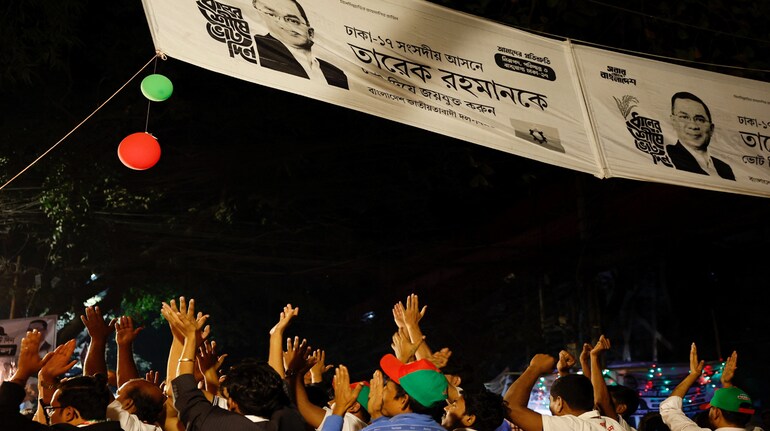
The BNP is on course for a decisive victory, positioning Tarique Rahman — who returned to Bangladesh in December last year after more than 17 years in self-imposed exile — to become the country’s first male prime minister in 35 years. For a party that had boycotted the previous election and spent much of the past two decades in opposition, the scale of its comeback in the first national poll after Hasina’s ouster has been striking.
Multiple counts showed the BNP comfortably crossing the majority threshold of 151 seats in the 300-member Jatiya Sangsad. Provisional results showed Rahman winning both seats he contested — Dhaka-17 and Bogura-6. According to the latest figures released by the EC, the BNP and its allies secured 209 seats.
The party adopted a notably restrained tone after the scale of its victory became apparent, saying that “no celebratory procession or rally shall be organised” and instead urging special prayers at mosques, temples, churches and pagodas across the country.
Among the first to congratulate Rahman were Indian Prime Minister Narendra Modi, Pakistan Prime Minister Shehbaz Sharif and the US Embassy in Dhaka, with Washington describing the outcome as a “historic victory.”
With the Awami League excluded from the race and its traditional voter base dispersed, many of those voters shifted towards the BNP rather than Jamaat, further consolidating Rahman’s position. The BNP’s manifesto — centred on employment generation, protecting marginalised households and ensuring fair prices for farmers — also resonated with voters seeking stability after prolonged unrest.
By winning 209 seats, surpassing its 2001 tally of 193, the BNP has not only returned to power but firmly reasserted its central role in Bangladeshi politics after years marked by boycott, fragmentation and organisational decline.
Jamaat-e-Islami: rebranding efforts fall short
Jamaat-e-Islami entered the election with an unusual opening. After decades on the political fringes — marked by deregistration, prosecutions under the International Crimes Tribunal and sustained isolation — the party re-emerged following the 2024 uprising.
It sought a visible shift in tone, speaking of building a new Bangladesh by taking “women and men” together, pledging minority rights, promising accountability and emphasising a departure from earlier hardline rhetoric. Leading an 11-party alliance that included the NCP and other right-leaning groups, Jamaat hoped to translate its role in the anti-Hasina protests into parliamentary gains.
Early campaign signals suggested organisational momentum, particularly before the BNP’s election machinery fully mobilised. However, that initial advantage proved difficult to maintain. Voter groups Jamaat had hoped to consolidate — including young voters, women and minorities — ultimately gravitated in large numbers towards the BNP. Even Awami League supporters who chose to vote largely shifted to the BNP rather than Jamaat.
Despite its reformist messaging, scepticism among key voter blocs persisted. According to the latest EC results, Jamaat-e-Islami and its allies won 68 seats. Jamaat chief Shafiqur Rahman conceded defeat, while saying the party was “not satisfied” with aspects of the process.
Even so, Jamaat is set to emerge as the main opposition party in parliament — a position it has never held before.
NCP: from protest prominence to electoral collapse
If the BNP’s win was emphatic and Jamaat’s performance disappointing, the result for the NCP was stark. Led by activists who played a central role in toppling Hasina’s government in 2024, the party entered the election with visibility and momentum as part of the Jamaat-led alliance.
However, its electoral showing failed to match its prominence. Local media reported that the NCP won just six of the 30 seats it contested, a sharp setback for a group many had expected to emerge as a major new force in national politics.
Several factors contributed to the poor result. The student-led coalition that united against Hasina struggled to remain cohesive once it transitioned from protest politics to electoral competition. Its organisational capacity was limited compared with the BNP’s extensive machinery. As campaigning progressed, many young and first-time voters shifted to the BNP, viewing it as the only party capable of delivering stability and governance after months of turmoil.
Conclusion
The first national election since Sheikh Hasina’s fall has fundamentally reshaped Bangladesh’s political landscape. The BNP has returned to power on the back of Tarique Rahman’s comeback, Jamaat-e-Islami’s rebranding push failed to deliver the gains it sought, and the youth-driven forces that helped bring down the previous government have suffered the most severe electoral setback.
Discover the latest Business News, Sensex, and Nifty updates. Obtain Personal Finance insights, tax queries, and expert opinions on Moneycontrol or download the Moneycontrol App to stay updated!
Find the best of Al News in one place, specially curated for you every weekend.
Stay on top of the latest tech trends and biggest startup news.




