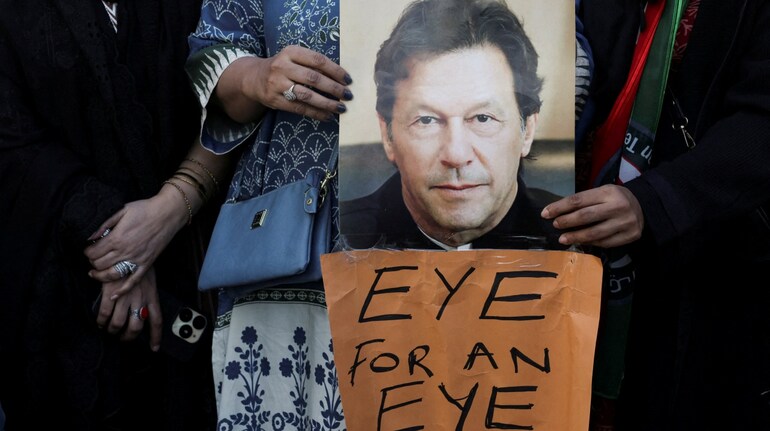

Pakistan’s handling of jailed former prime minister Imran Khan has triggered a fresh political and legal crisis, after his medical reports were formally submitted to the country’s top court even as nationwide protests entered their fifth day.
According to top sources cited by CNN-News18, Pakistan’s Attorney General Mansoor Usman Awan submitted Khan’s medical assessment to Supreme Court of Pakistan Chief Justice Justice Yahya Afridi during a meeting in his chambers.
The submission follows a February 12 Supreme Court order on Khan’s medical treatment, with a fresh verdict now expected based on the latest findings.
What the medical report says
Sources told CNN-News18 that the medical findings indicate Khan’s vital signs are normal for his age. However, the report confirms a serious problem with his eyesight.
As per ophthalmological tests presented to the court, one eye is functioning at 6/6 vision, while the other is operating at only 67 percent to 72 percent capacity. The report states that while his eyes are “working fine,” he requires proper treatment and specialised medical care.
These findings contradict repeated government claims that there is no serious medical concern, reinforcing allegations that Khan’s health issues have been downplayed while he remains incarcerated at Adiala Jail.
Protests choke Pakistan’s infrastructure
The medical submission comes amid escalating protests by supporters of Khan and his party, Pakistan Tehreek-e-Insaf. Demonstrations entered their fifth consecutive day, with protesters demanding Khan’s immediate release or transfer to a hospital.
PTI supporters have accused the Shehbaz Sharif-led government and what they describe as a “rogue military regime” under army chief Asim Munir of being responsible for Khan’s medical crisis.
The scale of the unrest has severely disrupted daily life across Pakistan. Major highways and bridges have been blocked in multiple cities, with reports indicating that nearly 50 percent of the country’s trade and communication networks have been affected.
Key routes connecting Khyber Pakhtunkhwa with Islamabad and Punjab remain cut off. Protests have paralysed cities including Peshawar, Dera Ismail Khan, Rahim Yar Khan, Swabi, Mianwali and Abbottabad. The Attock Bridge has emerged as a major flashpoint.
PTI rejects government-led medical examination
The Pakistan government said Khan was examined by a team of doctors on February 15 after concerns over his eyesight. However, the PTI rejected the examination outright.
Earlier, on February 12, a PTI lawyer visited Khan on Supreme Court orders to assess his living conditions. According to that report, Khan complained of losing nearly 85 percent vision in his right eye.
The court subsequently ordered a detailed medical examination before February 16. Sources told CNN-News18 that a medical team examined Khan for about an hour and collected blood samples.
“The medical examination went on for an hour and the team left after collecting blood samples,” the sources said.
Dispute over hospital transfer
Last month, Khan was taken to the Pakistan Institute of Medical Sciences in Islamabad, where a procedure was performed on his eye. Despite this, he later complained of further vision loss.
Government figures indicated on February 14 that Khan would be shifted to a hospital. Instead, doctors were sent to Adiala Jail, a move that intensified criticism and mistrust.
PTI said the examination was unacceptable without the presence of Khan’s family and personal doctors. The party described the government’s approach as deliberate and misleading.
“Pakistan Tehreek-e-Insaf categorically rejects the recent conduct of the government and jail administration regarding the medical examination of former prime minister Imran Khan’s eye in Adiala Jail. The government’s claim that a message was sent to the party leadership to arrive at the jail at the time of the examination is, in fact, a crude attempt to divert attention from the core issue,” the PTI said in a post on X.
“This matter was never about the presence or absence of the party leadership. In such sensitive and delicate medical matters, the constitutional, moral, and legal right to make decisions belongs to Imran Khan’s family. And the family cannot make an informed decision until Imran Khan’s personal doctors are present during the examination. Therefore, inviting the party leadership symbolically has neither any moral rationale nor any legal justification,” it added.
A widening legitimacy crisis
Khan has been in custody since August 5, 2023, following his arrest from his Lahore residence after a corruption conviction. He remains imprisoned at the high-security Adiala Jail in Rawalpindi.
As the Supreme Court weighs the medical findings, Pakistan faces a deepening crisis. The government’s handling of Khan’s health has not only triggered legal scrutiny but also fuelled nationwide unrest, exposing serious questions about transparency, accountability, and the treatment of political prisoners in the country.
The court’s next decision is expected to determine whether Khan remains in jail or is shifted to a hospital. Either way, the episode has already intensified Pakistan’s political instability and further eroded trust in the Sharif government’s handling of dissent.
Discover the latest Business News, Sensex, and Nifty updates. Obtain Personal Finance insights, tax queries, and expert opinions on Moneycontrol or download the Moneycontrol App to stay updated!
Find the best of Al News in one place, specially curated for you every weekend.
Stay on top of the latest tech trends and biggest startup news.