






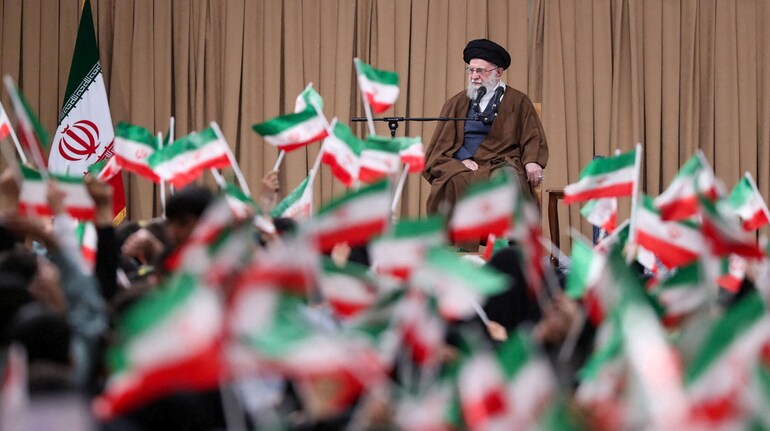
Iran’s deepening unrest has exposed a widening strategic gap between Washington and Tel Aviv, even as both increase pressure on Tehran. While the United States appears focused on leveraging the crisis to force Iran back to the nuclear negotiating table, Israel sees the moment as a rare opportunity to remove the Islamic Republic’s leadership altogether, former diplomat Anil Trigunayat told Moneycontrol.
A regime under its gravest pressure in years
Trigunayat described Iran’s current crisis as one of the most serious challenges the regime has faced in decades, driven by a toxic mix of economic collapse, political discontent and social unrest.
“There is no doubt that the economic problem is a very serious problem that has moved into a social, economic and political crisis,” he said, noting that the turmoil has been building for over a decade due to sanctions, corruption and mismanagement.
High inflation and currency devaluation have widened the protest base beyond the urban poor. “The devaluation of the currency brought the bazaaris and the middle class into the picture,” Trigunayat explained, adding that short-term subsidies and “patchwork solutions” have failed to restore confidence.
As a result, public anger has increasingly shifted from economic grievances to questions about the regime’s ability to govern. “People are beginning to feel that the regime is unable to cope up with the economic crisis that is there,” he said.
External pressure and the US–Israel calculus
Trigunayat said the unrest is being actively shaped by external actors, particularly the United States and Israel, though with very different end goals.
“These protests are also being engineered to a great extent by the United States and Israel, who have been prodding the people to go ahead and protest,” he said, pointing to explicit warnings issued to Tehran against using force.
Israeli rhetoric, however, goes further. “The Israeli Prime Minister has been calling upon people to throw the regime,” Trigunayat noted, arguing that Israel sees the turmoil as a historic chance to eliminate a hostile leadership it considers irredeemable.
By contrast, Washington’s approach remains more transactional.
“Essentially, the United States also wants the regime to come back to the table and discuss that nuclear deal on their own terms,” Trigunayat said, suggesting that instability is being used as leverage rather than a pathway to regime collapse.
Trump’s warnings: Pressure or consolidation?
US President Donald Trump’s public warnings to Iran over the treatment of protesters have added another layer of complexity. Trigunayat cautioned that such rhetoric may backfire by strengthening hardliners rather than weakening them.
“When mobocracy happens and the mob is on the streets, they are looking at very immediate solutions,” he said, warning that external threats can push societies into polarisation.
He noted that Trump has also subtly shifted tone, acknowledging that some deaths occurred due to stampedes rather than direct state violence. “That gives some kind of leeway, in my view, to the regime to change,” Trigunayat said.
The risk, however, is consolidation at the top. “Hardliners will be more united,” he warned, arguing that external pressure often allows entrenched power centres to justify crackdowns in the name of sovereignty.
Israel’s regime-change ambition
Trigunayat was blunt about Israel’s strategic calculus. “The ambitions of Israel are very different,” he said. “It is seeing it as a great opportunity to take away a leadership which is… basically wasted.”
He argued that Israel will continue to push for destabilisation regardless of US caution, describing the Iran-Israel standoff as a clash driven by what he called a “mad syndrome” on both sides.
This divergence explains why Washington may still prefer a weakened but intact regime willing to negotiate, while Israel appears prepared to risk chaos if it results in Tehran’s collapse.
Survival, fracture or power shift?
Despite the intensity of the crisis, Trigunayat believes the regime still retains coercive capacity, particularly through the Revolutionary Guards and Basij.
“A lot will depend upon how the Revolutionary Guards and the Basijis behave,” he said, warning that mass killings would fundamentally alter the trajectory.
He outlined a possible scenario where power shifts internally rather than collapses outright. “If that happens, political power may move out of the Supreme Leader and more towards the parliament and the president,” he said, describing it as a potential breather rather than transformation.
Still, he cautioned that sanctions remain the structural root of Iran’s fragility. “These sanctions, which have been going on for 40 years, have weakened the economic base and structures,” he said.
Why this matters beyond Iran
Trigunayat stressed that the crisis is already being watched closely by global powers emboldened by recent US actions elsewhere. “The United States is very emboldened after the Venezuela strikes,” he said, adding that oil seizures and maritime enforcement increase pressure on Iran.
At the same time, Tehran is not isolated. “China and Russia are supporting Iran openly,” he noted, pointing to joint naval exercises and growing strategic coordination.
Yet even with external backing, the next few days remain decisive. “The situation is still volatile and in flux,” Trigunayat said. “Things could go either way.”
His assessment, however, is cautious rather than alarmist. “Most likely, it appears that the regime this time will survive,” he said — though significantly weakened and under far greater international and domestic scrutiny.
Why it matters
The US–Israel divide over Iran is shaping more than geopolitics — it could impact energy markets, trade routes, and regional stability. Trigunayat highlights how Washington’s nuclear leverage and Israel’s regime-change ambitions pull the crisis in different directions.
Discover the latest Business News, Sensex, and Nifty updates. Obtain Personal Finance insights, tax queries, and expert opinions on Moneycontrol or download the Moneycontrol App to stay updated!
Find the best of Al News in one place, specially curated for you every weekend.
Stay on top of the latest tech trends and biggest startup news.




