






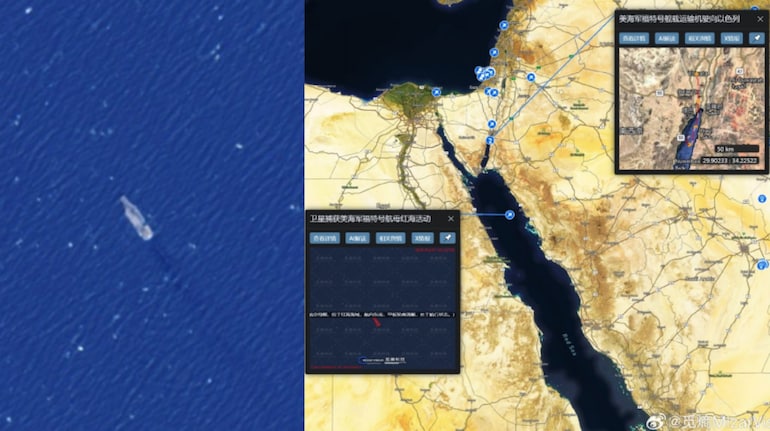

A Chinese artificial intelligence startup has drawn global attention after publishing detailed satellite imagery of United States military deployments across the Middle East, raising questions about how rapidly evolving commercial technology could reshape modern warfare.
According to an analysis by researcher Shanaka Anselm Perera, the company MizarVision has been releasing high-resolution satellite images that map US military assets across the region. The images reportedly show American bases, naval groups and air defence systems, all labelled and geolocated using artificial intelligence.
Perera wrote that the imagery is “labelled. Geolocated. AI-annotated. Updated in near-realtime,” and has been circulated on social media by accounts linked to the People's Liberation Army as well as Chinese state media outlets.
Satellite images of US deployments
The first major release reportedly appeared on February 20, days before the US military launched Operation Epic Fury in the region. According to the analysis, the images showed aircraft movements to Israel’s Ovda Airbase along with fighter deployments in Saudi Arabia and Qatar, as well as naval activity in the Arabian Sea.
By March 1, the releases had expanded to include detailed imagery of US installations in Jordan, Kuwait, Bahrain and the United Arab Emirates. Perera said the AI analysis identified aircraft types, missile defence systems and troop concentrations.
“One release catalogued approximately 2,500 individual US military assets across the region,” the analysis noted.
Where the data comes from
According to the report, the imagery comes from two main sources. One is China’s Jilin-1 satellite constellation, operated by Chang Guang Satellite Technology. The network includes more than 100 commercial Earth observation satellites capable of producing sub-metre resolution imagery.
Such imagery is detailed enough to identify aircraft on airfields and distinguish between missile defence systems such as THAAD and Patriot missile system, according to the analysis.
The second source consists of commercially available satellite data from Western companies such as Maxar Technologies and Airbus Defence and Space.
MizarVision aggregates these images and processes them using its own artificial intelligence models, which automatically identify military equipment and locations. The system then republishes the images with detailed labels that transform raw satellite photographs into what analysts describe as operational intelligence products.
Pentagon response and concerns
The Pentagon has downplayed the images as “open-source,” but Perera argues that the significance lies not in the images themselves but in the automated analysis.
“The value of MizarVision’s output is not the raw satellite image,” he wrote. “The value is the AI processing layer that converts terabytes of imagery into labelled, searchable, cross-referenced intelligence products at a speed and scale that previously required the resources of a national intelligence agency.”
Perera warned that such information could potentially be accessed by hostile actors online. He noted that the imagery is publicly shared on social media, where Iran’s Islamic Revolutionary Guard Corps networks could theoretically view it.
“No direct evidence confirms classified data transmission from Beijing to Tehran,” he wrote. “But the distinction between ‘classified’ and ‘publicly shared AI-processed satellite intelligence identifying every US military asset in the Middle East by type, location, and configuration’ is a distinction without a meaningful difference to a provincial IRGC commander selecting his next target.”
A new form of intelligence warfare
Analysts say the development reflects a broader shift in how intelligence is gathered and shared. During the Russia–Ukraine War, commercial satellite imagery from companies such as Maxar was widely used by Ukraine and its Western partners to expose Russian troop movements.
Perera argues that China may now be using a similar model in reverse.
“The precedent is set. Commercial satellite intelligence is now a weapon of great-power competition deployed through AI startups with plausible commercial deniability,” he wrote.
Despite having fewer than 200 employees, MizarVision has demonstrated how commercially available satellite data and artificial intelligence can be combined to map military assets across an entire theatre of war.
“The next war will not begin with a missile launch,” Perera wrote. “It will begin with an AI model labelling every target from orbit.”
Discover the latest Business News, Sensex, and Nifty updates. Obtain Personal Finance insights, tax queries, and expert opinions on Moneycontrol or download the Moneycontrol App to stay updated!
Find the best of Al News in one place, specially curated for you every weekend.
Stay on top of the latest tech trends and biggest startup news.





