






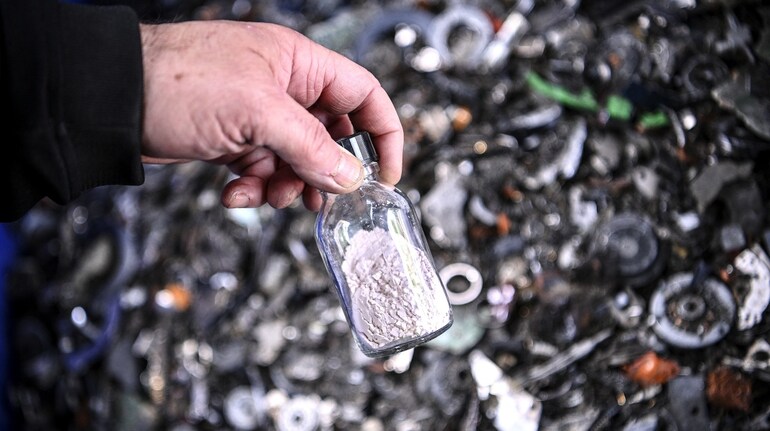

Finance Minister Nirmala Sitharaman on Sunday announced a major push to strengthen India’s rare earth ecosystem by proposing the creation of dedicated rare earth corridors across four mineral-rich states. The proposed corridors will span Odisha, Kerala, Andhra Pradesh and Tamil Nadu, and are aimed at boosting mining, processing, research and downstream manufacturing.
“A scheme for rare earth permanent magnets was launched in November 2025. We now propose to support the mineral-rich states of Odisha, Kerala, Andhra Pradesh and Tamil Nadu to establish dedicated rare earth corridors to promote mining, processing, research and manufacturing,” Sitharaman said while presenting the Union Budget 2026 in Parliament.
The initiative is being seen as a strategic shift in India’s long-term industrial and geopolitical planning. Rare earth elements are critical inputs for electric vehicles, renewable energy technologies, semiconductors, consumer electronics and advanced defence systems. At present, China dominates the global rare earth supply chain, particularly in processing, giving it outsized influence over critical industries worldwide.
China controls over 90 per cent of global rare earth elements processing. Rare earths comprise 17 metals, including neodymium, dysprosium and lanthanum, which are essential for permanent magnets used in wind turbines, electric vehicles and defence technologies.
Past assessments have shown that India lost ground to China in the rare earth race not due to a lack of reserves, but because of weak processing capacity, limited private sector participation and inconsistent policy support. The new corridor-based approach seeks to correct these structural gaps by building integrated hubs that link extraction with refining, manufacturing and applied research.
The timing of the move is significant. Rising US-China tensions, export restrictions imposed by Beijing and recurring supply disruptions have pushed countries to urgently diversify critical mineral sources. Against this backdrop, India’s focus on building end-to-end domestic capability and encouraging state-level specialisation is aimed at reducing strategic dependence on China.
The corridor model is also designed to attract private investment and global partnerships. By clustering mining operations with processing units, research institutions and manufacturing hubs, the government aims to lower costs, accelerate technology transfer and help Indian firms move up the value chain instead of remaining raw material suppliers.
In addition, the emphasis on permanent magnets builds on India’s November 2025 policy push to localise production of key components used in electric vehicles and renewable energy systems. This aligns with broader national goals under Make in India to strengthen manufacturing, improve supply chain resilience and position India as a reliable alternative hub in the global rare earth ecosystem.
Discover the latest Business News, Sensex, and Nifty updates. Obtain Personal Finance insights, tax queries, and expert opinions on Moneycontrol or download the Moneycontrol App to stay updated!
Find the best of Al News in one place, specially curated for you every weekend.
Stay on top of the latest tech trends and biggest startup news.





