
The police siege of the Karachi Press Club on Monday marked more than just crowd control. It became the latest symbol of Pakistan’s rapid descent into authoritarian rule, where dissent is criminalised, protests are choked off with containers and buses, and the military-backed state moves with open contempt for civil liberties.
As journalists, lawyers and human rights activists gathered to protest the sentencing of lawyer-activist Imaan Mazari and her husband, Advocate Hadi Ali Chattha, authorities responded by sealing roads across Karachi’s city centre. Containers were placed at Fawara Chowk, YMCA, Sarwar Shaheed Road and Zainab Market Cut, paralysing traffic and preventing many protesters from reaching the venue.
The message was unmistakable. Even peaceful protest at Pakistan’s most prominent press club would not be tolerated.
“This is shameful and dangerous for democracy,” protesters said, accusing the state of criminalising dissent while shielding itself from scrutiny.
Why the Mazari Case has become a flashpoint
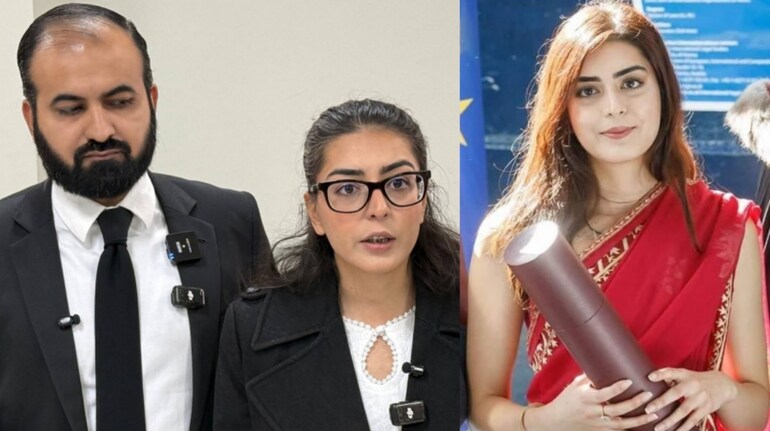
At the heart of the outrage lies the case of Imaan Zainab Mazari-Hazir, one of Pakistan’s most prominent human rights lawyers, and her husband Hadi Ali Chattha.
The couple were arrested on Friday in Islamabad while travelling to court for a hearing related to social media posts critical of the state. They were placed in separate vehicles and taken to undisclosed locations.
“Fascism at its peak. Emasculated men in power must be so pleased with this achievement!” Mazari wrote on X after their arrest.
Within 24 hours, an anti-terrorism court sent them on judicial remand. The following day, a district and sessions court convicted them and sentenced them to a combined 17 years in prison over posts on X that authorities labelled “anti-state”.
The case stems from an August cybercrime complaint registered by the National Cyber Crime Investigation Agency under the Prevention of Electronic Crimes Act 2016.
Criminalising speech under PECA
The court convicted the couple under three sections of PECA:
The sentences of five years, ten years and two years were ordered to run concurrently.
According to the court, the posts accused the Pakistani state of enforced disappearances, criticised the armed forces, and portrayed Pakistan as a “terrorist state”. The judge claimed the content damaged public trust in state institutions and aligned with banned groups such as the BLA, TTP and the Pashtun Tahafuz Movement.
Mazari refused to recant.
“Truth seems overwhelmingly difficult in this country,” she told the court. “But we knew that when we got into this work, we’re ready to face that. We will not back down.”
Who is Imaan Mazari and why the state fears her
Born in Islamabad in 1994, Mazari is the daughter of former human rights minister Dr Shireen Mazari and renowned paediatrician Dr Tabish Hazir. Educated at the University of Edinburgh, she has built her career defending Pakistan’s most marginalised.
Her work includes cases of enforced disappearances of ethnic Baloch persons, legal defence of activist Mahrang Baloch, journalists targeted by the state, minorities accused of blasphemy, and Afghans facing mass crackdowns.
She has repeatedly confronted Pakistan’s military establishment head-on. In 2023, she was arrested after reportedly calling the military “terrorists” at a Pashtun Tahafuz Movement rally.
That history explains why her prosecution is widely viewed not as law enforcement, but as retaliation.
Press Club protest and the state’s panic response
The Karachi Press Club protest brought together the Human Rights Commission of Pakistan, journalist unions, lawyers and civil society figures.
HRCP Chairperson Asad Iqbal Butt said the road closures were designed to sabotage peaceful protest.
“Due to the closure of roads, people across different communities were unable to reach here, but somehow we managed to get here, and it is our success. Despite government road closures, people reached the KPC,” he told Express Tribune.
“We need to raise our voices because this can happen to us as well. We are raising our voices for ourselves.”
Referring to PECA, Butt said, “When the Peca law was introduced, it was said it was for enemies of the country. We warned it would be used against human rights activists and political workers. Now time has proved us right.”
Senior journalist Shahzeb Jillani called the convictions a farce.
“It is very clear from the manner in which the trial was conducted. It has made a mockery of justice. To give somebody 10 years’ imprisonment over a tweet should not happen.”
“This is not restricted to any political party. This affects every citizen in the country.”
Asim Munir and the rise of a czar-state
The Mazari case cannot be separated from the broader power structure in Pakistan today. Real authority lies not with elected officials, but with Army Chief General Asim Munir, under whose watch dissent has been redefined as sedition.
Earlier this month, Pakistan’s military spokesperson Lieutenant General Ahmed Sharif Chaudhry publicly singled out Mazari at a press conference.
“They operate under the guise of democracy and human rights to promote terrorism,” he said, sharing one of her posts while warning of “hidden elements”.
This was not a legal argument. It was a signal.
Under Munir’s command, the military has stopped pretending to be a silent stakeholder. It now openly defines the boundaries of acceptable speech, activism and journalism, while civilian governments act as enforcement arms.
A broader pattern of repression
Mazari’s arrest follows mass crackdowns on journalists, political workers and lawyers. Islamabad’s legal community has launched a three-day strike, boycotting courts and banning police entry into court premises.
Human rights groups including Amnesty International and the HRCP say the case meets the threshold of arbitrary detention and political persecution.
The UN Special Rapporteur on human rights defenders has already warned that cases against Mazari “appear to reflect an arbitrary use of the legal system to harass and intimidate”.
Yet the state has pushed ahead regardless.
What This Case Really Represents
The blocking of roads to the Karachi Press Club, the criminalisation of tweets, and the swift sentencing of a human rights lawyer all point to the same reality.
Pakistan is no longer merely shrinking democratic space. It is enforcing obedience.
Under Asim Munir, the state is behaving less like a constitutional republic and more like a garrison regime where the military decides who may speak, who may protest, and who must be silenced.
Mazari remains defiant.
“We’re not the first people who will be unlawfully incarcerated in this country,” she said. “We will keep fighting.”
For now, the state is fighting back harder. And it is doing so without shame.
Discover the latest Business News, Sensex, and Nifty updates. Obtain Personal Finance insights, tax queries, and expert opinions on Moneycontrol or download the Moneycontrol App to stay updated!





Find the best of Al News in one place, specially curated for you every weekend.
Stay on top of the latest tech trends and biggest startup news.