






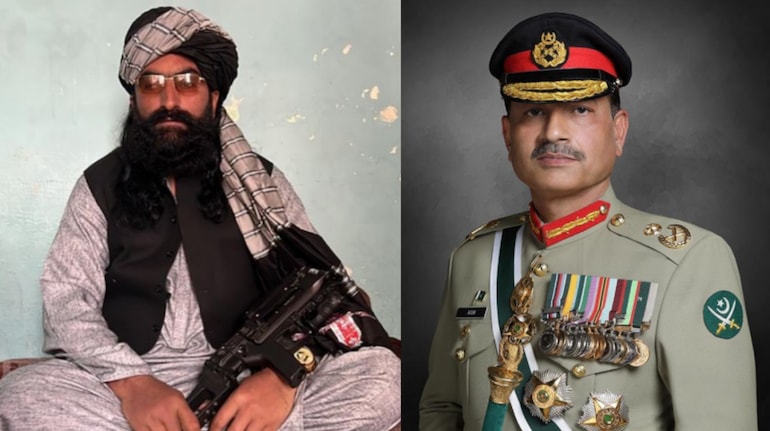

Pakistan’s military establishment is showing visible cracks as the conflict with Afghanistan intensifies. Army chief General Asim Munir has reportedly lashed out at his own generals, questioning their competence and failure to eliminate what he described as “enemy no.1.” The frustration is telling. For years, Pakistan nurtured militant ecosystems as strategic assets. Today, those very networks have turned inward, exposing the blowback of a policy long built on proxies and plausible deniability.
At the centre of this storm is Noor Wali Mehsud, the chief of Tehreek-e-Taliban Pakistan. Once operating in the shadows, Mehsud has now emerged as Pakistan’s most persistent internal security threat. His rise is not accidental. It is rooted in the very infrastructure Pakistan once enabled.
Who is Noor Wali Mehsud
Noor Wali Mehsud is the chief of Tehreek-e-Taliban Pakistan, widely regarded as the most dangerous militant organisation targeting the Pakistani state today.
He hails from South Waziristan, a region that has historically been a hotbed of militancy and a launchpad for jihadist networks. Mehsud took over the TTP leadership in 2018 after the death of his predecessor Mullah Fazlullah.
Unlike earlier leaders who relied heavily on brute force, Mehsud is seen as a more strategic and organisationally focused commander. Reports suggest he prioritised restructuring the TTP, rebuilding its fractured factions, and strengthening its operational coherence.
He is also believed to be the author of the group’s internal “code of conduct,” aimed at centralising authority and reducing infighting among militant factions.
How Mehsud rebuilt the TTP
When Mehsud took charge in June 2018, the TTP was weakened by internal divisions and sustained military pressure from Pakistan.
However, under his leadership, the group underwent a significant revival. He managed to unify splinter factions, re-establish command structures, and expand the group’s operational footprint.
More importantly, Mehsud shifted the group’s strategy. Instead of sporadic attacks, the TTP began carrying out coordinated and sustained assaults on Pakistani security forces.
The return of the Taliban to power in Afghanistan in 2021 further strengthened Mehsud’s position. With safe havens across the border, the TTP gained strategic depth, allowing it to plan and execute attacks with greater confidence.
For Pakistan, this has translated into a steady rise in cross-border attacks, ambushes, and targeted killings.
Why Pakistan sees him as ‘enemy no.1’
For the Pakistani military, Noor Wali Mehsud represents more than just a militant leader. He symbolises the failure of its long-standing strategy of using non-state actors as tools of foreign policy.
Under Mehsud, the TTP has become more organised, more resilient, and more lethal. It has directly targeted Pakistani military installations, police forces, and intelligence networks.
His ability to unify factions and operate from Afghan territory has made him extremely difficult to eliminate.
This explains why Asim Munir’s frustration has spilled into the open. Despite repeated operations and cross-border strikes, Pakistan has failed to neutralise Mehsud.
The inability to eliminate him has not only exposed operational weaknesses but also raised questions about the military’s overall strategy.
Safe havens and the Afghanistan factor
One of the biggest challenges for Pakistan is Mehsud’s presence in Afghanistan.
Islamabad has repeatedly accused the Taliban government of providing shelter to TTP leaders, a claim Kabul has denied.
However, the reality remains that the porous border and complex tribal networks make it extremely difficult for Pakistan to carry out targeted operations without escalating tensions with Afghanistan.
This has turned the conflict into a larger geopolitical crisis, with Pakistan striking Afghan territory while simultaneously struggling to contain internal attacks.
Blowback of Pakistan’s past policies
The rise of Noor Wali Mehsud is, in many ways, a case of strategic blowback. For decades, Pakistan differentiated between “good” and “bad” militants, supporting some groups while fighting others. That distinction has now collapsed. Groups once seen as assets have evolved into independent actors with their own agendas.
Mehsud’s TTP is a product of that ecosystem. It understands Pakistan’s security structure, exploits its weaknesses, and operates with a level of sophistication that reflects years of institutional exposure.
A growing headache for Pakistan
Today, Noor Wali Mehsud is not just a militant leader. He is the face of a resurgent insurgency that Pakistan has struggled to contain.
His ability to survive, regroup, and strike repeatedly has made him Pakistan’s most wanted target. Yet, despite being labelled “enemy no.1,” he remains elusive.
For Asim Munir and the Pakistani military, this is more than a tactical failure. It is a strategic crisis.
Because the longer Mehsud remains at large, the clearer it becomes that Pakistan is now confronting the consequences of a policy it once believed it could control.
Discover the latest Business News, Sensex, and Nifty updates. Obtain Personal Finance insights, tax queries, and expert opinions on Moneycontrol or download the Moneycontrol App to stay updated!
Find the best of Al News in one place, specially curated for you every weekend.
Stay on top of the latest tech trends and biggest startup news.










