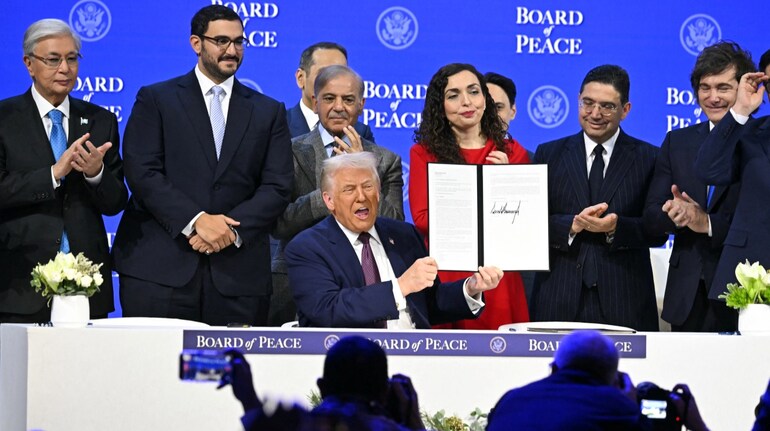

US President Donald Trump has unveiled what he calls the Board of Peace, a new international body that he claims can succeed where the United Nations has failed.
The announcement has triggered debate across diplomatic circles. Is this an attempt to reform global peace-making, or a direct challenge to the authority of the UN?
Trump insists it is the former. Critics are not convinced.
Trump’s core argument against the UN
Trump has long been sceptical of multilateral institutions, especially the United Nations. While announcing the Board of Peace, he openly questioned the UN’s effectiveness.
“The UN just hasn’t been very helpful. I’m a big fan of the UN’s potential, but it has never lived up to its potential,” Trump told reporters.
He went further, suggesting that the UN failed in areas where he believes he succeeded personally.
“The UN should have settled every one of the wars that I settled. I never went to them. I never even thought to go to them.”
At the same time, Trump stopped short of calling for the UN’s abolition.
“Still, you’ve got to let the UN continue, because the potential is so great,” he added.
This dual messaging has fuelled confusion over whether the Board of Peace is meant to complement the UN or quietly sideline it.
What exactly is the Board of Peace?
The Board of Peace was formally unveiled at the World Economic Forum in Davos, although Trump first floated the idea in September.
It is directly linked to Trump’s Gaza ceasefire and reconstruction initiative, but its ambitions go far beyond that single conflict.
According to its charter, the board is intended to function as a standing forum of selected states responsible for mediating conflicts, funding post-war reconstruction, and coordinating security guarantees.
Trump is designated as chairman, with sweeping powers over membership and direction. Participation reportedly requires financial contributions, with funds initially earmarked for rebuilding Gaza.
The charter states that the board will undertake “peace-building functions in accordance with international law ”.
It also argues that “durable peace requires pragmatic judgement, common-sense solutions, and the courage to depart from approaches and institutions that have too often failed”, calling for “a more nimble and effective international peace-building body.” ”.
While the UN Security Council authorised a limited mandate for such a board in November, that approval is valid only until 2027 and applies solely to the Gaza conflict. Trump’s version expands far beyond that scope.
Who has joined and who has stayed away?
Roughly two dozen countries have agreed to participate, including Israel, Saudi Arabia, United Arab Emirates, Egypt, Turkey, and Belarus.
Others that have agreed include Bahrain, Jordan, Qatar, Hungary, Armenia, Azerbaijan, Morocco, Pakistan, Indonesia, Kosovo, Uzbekistan, Kazakhstan, Paraguay and Vietnam.
Canada has said it has agreed “in principle” but is still reviewing the details.
Several key powers have either declined or expressed reservations. Britain has said it is not joining for now. UK Foreign Secretary Yvette Cooper cited concerns about Russia’s inclusion, and London has refused to attend the signing ceremony.
France, Norway and Sweden have also declined. France’s refusal prompted Trump to threaten economic retaliation.
“Did he say that? Well, nobody wants him because he will be out of office very soon. I’ll put a 200 per cent tariff on his wines and champagnes, and he’ll join, but he doesn’t have to join,” Trump said.
Italy’s economy minister Giancarlo Giorgetti said joining would violate Italy’s constitution.
Notably, apart from the United States, no permanent member of the UN Security Council has agreed to join the board so far.
Russia, China and Ukraine complicate the picture
Neither Russia nor China has confirmed participation.
Ukraine is still weighing its response. President Volodymyr Zelenskyy said it was difficult to imagine sitting on a board with Russia after four years of war.
Pope Leo, the first US pontiff and a critic of some Trump policies, has been invited and is evaluating the proposal, according to the Vatican.
Can the Board of Peace replace the UN?
Most experts say no.
Annalena Baerbock, president of the UN General Assembly, warned against undermining the institution.
“The United Nations was the only institution with the moral and legal ability to bring together every nation, big or small,” she said.
“And if we question that … we fall back into very, very dark times.”
A commentary in The Guardian argued that Security Council members were misled into approving a limited mandate and warned that any body including Vladimir Putin was unlikely to halt the war in Ukraine. It described the board as a potential vanity project.
“Joining the board, on the other hand, involves undermining the UN, submission to Trump’s will and acquiescence in his vision of the future of world governance an imperial court where vassal states pay cash and vie for the ear of the orange emperor,” the piece concluded.
Another analysis in The Conversation suggested the board could be linked to Trump’s long-standing desire for a Nobel Peace Prize and warned it may offer financial opportunities for Trump’s allies, likening it to a corporate version of the UN with Trump at the centre.
What former US diplomats say
Retired US Ambassador Robert Wood, who served under both Republican and Democratic administrations, expressed scepticism.
“If Trump is trying to replace the Security Council with a Board of Peace dealing with issues beyond Gaza, I don’t think there’s going to be a lot of interest,” Wood said.
“What I would say to UN member states, including the United States: let’s try to work together to make the United Nations a better instrument. It really is the best instrument we have, given all its warts.”
He added that creating a parallel body in a deeply divided world was unlikely to succeed.
How the UN is responding
The UN has so far avoided public confrontation.
A spokesperson for UN Secretary-General António Guterres said he “believes member states are free to associate in different groups”.
Deputy UN spokesperson Farhan Haq added, “The United Nations will continue with its mandated work.”
Privately, however, concerns are growing.
“It’s a ‘Trump United Nations’ that ignores the fundamentals of the UN charter,” one diplomat said. Three other Western diplomats warned that the initiative could weaken the UN if it proceeds.
Where India stands and why it matters
India has not yet taken a public position on joining the Board of Peace, and that hesitation is significant.
For New Delhi, the decision involves balancing strategic ties with Washington against long-standing support for multilateralism and the UN system. India has consistently argued for reforming the UN, particularly the Security Council, rather than bypassing it.
There are also practical concerns. The board’s pay-to-play structure, where permanent membership can be secured for $1 billion, raises questions about equity and legitimacy. India has traditionally opposed systems that privilege wealth over representation.
Additionally, the presence of countries like Pakistan on the board complicates the calculus for New Delhi, especially given India’s preference for conflict resolution through established international frameworks.
For now, India appears to be watching carefully rather than rushing in.
So is Trump replacing the UN?
Trump insists he is not dismantling the UN, but the structure and rhetoric surrounding the Board of Peace suggest a clear challenge to the existing global order.
By placing himself at the centre, demanding financial buy-in, and threatening economic retaliation against sceptics, Trump is offering a vision of global governance that is more transactional, personalised and US-centric.
Whether the Board of Peace becomes a serious diplomatic instrument or remains a limited, controversial experiment will depend less on Trump’s ambition and more on whether major powers choose to legitimise it.
Discover the latest Business News, Sensex, and Nifty updates. Obtain Personal Finance insights, tax queries, and expert opinions on Moneycontrol or download the Moneycontrol App to stay updated!
Find the best of Al News in one place, specially curated for you every weekend.
Stay on top of the latest tech trends and biggest startup news.