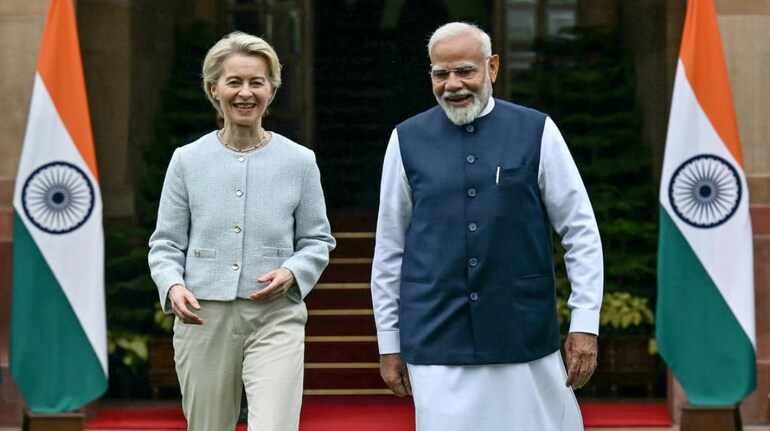

As trade tensions between India and the United States deepen under President Donald Trump, New Delhi appears closer than ever to sealing a landmark free trade agreement with the European Union. European Commission President Ursula von der Leyen said at the World Economic Forum in Davos that negotiations are nearing completion, calling the proposed pact “the mother of all deals”.
“There is still work to do. But we are on the cusp of a historic trade agreement. Some call it the mother of all deals. One that would create a market of 2 billion people, accounting for almost a quarter of global GDP,” von der Leyen said.
The timing is critical. With India–US trade talks facing repeated friction over tariffs, agriculture and market access, the EU deal offers India both economic scale and strategic balance.
Why it is called the ‘mother of all deals’
The scale of the proposed India–EU free trade agreement is unmatched. Together, India and the 27-nation EU would create a combined market of nearly 2 billion people, representing close to 25 percent of global GDP. No other trade pact currently under negotiation matches this size or economic breadth.
India’s Commerce Minister Piyush Goyal has repeatedly underlined this point. “We have done FTA deals with seven developed countries so far. This one will be the mother of all. It will cover two of the world’s most powerful economies,” Goyal said.
Beyond size, the agreement spans goods, services, technology, investment and regulatory cooperation. It aims to integrate India more deeply into European supply chains while giving EU companies greater access to one of the world’s fastest-growing major economies.
A long road now nearing the finish line
India and the EU first began FTA negotiations in 2007, but talks stalled for nearly a decade due to disagreements over tariffs, intellectual property and market access. Negotiations were revived in 2022 with fresh political momentum and have since moved at a faster pace.
According to Commerce Secretary Rajesh Agrawal, negotiators have already closed 20 of the 24 chapters. “We expect to conclude the talks and have the deal ready,” he said earlier this month, adding that progress over the next few days would be decisive.
Parallel discussions under the India–EU Trade and Technology Council have also helped narrow differences on digital rules, standards and supply-chain resilience, making the FTA far more comprehensive than earlier attempts.
Why the EU deal matters as US trade ties strain
The growing urgency behind the EU pact is closely tied to India’s difficult trade relationship with Washington. Under Trump, the US has imposed or threatened punitive tariffs, including measures linked to India’s energy ties with Russia.
Recent disputes over pulses have emerged as a fresh flashpoint. As reported by Moneycontrol, US lawmakers have pressed India to cut tariffs on American pulses, while New Delhi has made clear that protecting farmers is a red line. These frictions have slowed momentum toward any meaningful India–US trade breakthrough.
Trump’s wider tariff strategy has also unsettled Indian exporters. A 25 percent tariff threat linked to Iran trade has raised concerns for Indian basmati rice and tea exporters, underlining the unpredictability of US trade policy.
Against this backdrop, the EU offers India a more stable and rules-based partner.
What each side wants
For the European Union, the deal is central to its strategy of diversifying away from excessive dependence on China. India is seen as a trusted partner with scale, growth and geopolitical alignment.
For India, deeper access to the EU market, its second-largest trading partner, would boost exports and help domestic manufacturers move up the value chain.
Bilateral trade already stands at historic highs. Goods trade reached around €120 billion in 2024, while services trade is estimated at €60 billion, driven largely by IT and digital services. A formal FTA is expected to unlock much larger flows in clean energy, pharmaceuticals, advanced manufacturing and digital services.
The remaining sticking points
Despite optimism, sensitive issues remain unresolved. The EU continues to push for lower tariffs on automobiles, wines and spirits, areas India has traditionally protected.
India, meanwhile, wants easier movement for skilled professionals and service providers, a politically sensitive issue across EU member states. New Delhi is also seeking safeguards for agriculture, particularly dairy and grains, and clarity on the EU’s carbon border tax, which could affect exports of steel, aluminium and cement.
These challenges explain von der Leyen’s caution that “there is still work to do”.
Why the moment is strategic for India
With Trump’s tariff pressure reshaping global trade and India–US talks losing momentum, the India–EU FTA has taken on strategic significance beyond economics. It signals India’s ability to diversify trade partnerships, reduce vulnerability to unilateral tariffs and anchor itself more firmly in global supply chains.
If finalised, the pact would not only be the EU’s most significant trade deal in years but also one of India’s most consequential economic agreements ever.
At a time when protectionism is rising, the “mother of all deals” could offer India scale, stability, and strategic leverage in an increasingly fractured global trade order.
Discover the latest Business News, Sensex, and Nifty updates. Obtain Personal Finance insights, tax queries, and expert opinions on Moneycontrol or download the Moneycontrol App to stay updated!
Find the best of Al News in one place, specially curated for you every weekend.
Stay on top of the latest tech trends and biggest startup news.