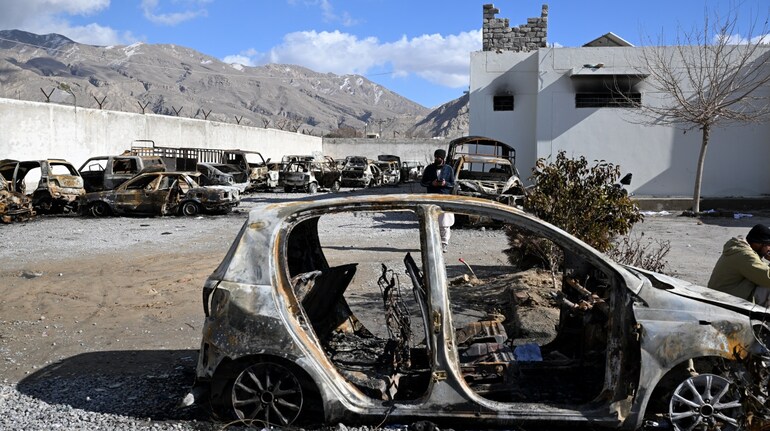

Pakistan’s restive province of Balochistan has once again been pushed into chaos, exposing deep cracks in Islamabad’s security narrative and the military’s long-standing approach to the region. Nearly 40 hours of coordinated militant violence ripped through multiple districts, killing civilians, security personnel, and militants, and forcing one of the largest counter-operations in recent years.
While Pakistan’s military rushed to blame India, the scale, coordination, and brutality of the attacks point to a far more uncomfortable reality: a decades-old insurgency fuelled by neglect, repression, and unaddressed political grievances. Under Army Chief Asim Munir, Pakistan has doubled down on force while refusing to confront the roots of unrest, leaving Balochistan trapped in a cycle of violence that its own rulers appear unable or unwilling to break.
What unfolded over 40 hours of violence
The crisis began with near-simultaneous attacks across a wide stretch of Balochistan, including Quetta, Gwadar, Mastung, Noshki, Dalbandin, Kharan, Panjgur, Tump and Pasni. Militants struck police stations, security checkpoints, training centres, banks, markets and government offices. In several towns, they briefly blocked roads and moved through populated areas before security forces launched large-scale operations involving the army, police and counterterror units.
Balochistan Chief Minister Sarfraz Bugti said the province witnessed almost 40 hours of continuous fighting as security personnel chased militants across districts. According to provincial authorities, 17 law enforcement personnel and 31 civilians were killed. Pakistan’s military claimed that 92 militants were killed on Saturday, in addition to 41 on Friday.
Bugti admitted that intelligence agencies had prior warnings. “We had intelligence reports that this kind of operation was being planned, and as a result of those, we started pre-operations a day before,” he said.
Tactics that exposed security gaps
Officials acknowledged a disturbing shift in militant tactics. Junior interior minister Talal Chaudhry said attackers deliberately blended into civilian populations before striking. “In each case, the attackers came in dressed as civilians and indiscriminately targeted ordinary people working in shops,” he said, adding that civilians were used as human shields.
In Quetta, police stations and the Police Training Centre were attacked, police vehicles torched, and Safe City surveillance cameras destroyed. “Our Safe City cameras in Quetta were also attacked. We will install CCTV cameras in eight cities to strengthen surveillance,” Bugti said.
In Gwadar, militants killed five members of a labourer family from Khuzdar. In Pasni, a suicide bomber rammed an explosive-laden vehicle into a Maritime Security Agency camp, killing one soldier. Militants also freed more than 30 prisoners from the Central Jail, abducted a deputy commissioner in Noshki, and killed tribal leader Shahid Malazai and his guards in Kharan.
Who is behind the violence
Responsibility was claimed by the banned Baloch Liberation Army, which announced a province-wide operation named Herof or “black storm.” The group seeks independence for Balochistan and accuses the Pakistani state of exploiting the province’s gas, minerals and coastline while marginalising its people.
The insurgency has grown sharper and more lethal in recent years. The BLA has attacked army and navy bases, derailed trains, taken hostages, and targeted Chinese interests linked to the China-Pakistan Economic Corridor. Civilian killings and the use of suicide bombers, including women, mark a clear escalation.
Pakistan’s familiar foreign blame game
Instead of addressing its internal crisis, Pakistan’s military quickly revived allegations of foreign involvement. In a statement, it claimed the attacks were carried out by “Indian-sponsored militants,” calling them “Fitna al-Hindustan.”
India rejected the charge outright. “We categorically reject the baseless allegations made by Pakistan, which are nothing but its usual tactics to deflect attention from its own internal failings,” said external affairs ministry spokesperson Randhir Jaiswal. “Instead of parroting frivolous claims each time there is a violent incident, it would do better to focus on addressing long-standing demands of its people in the region. Its record of suppression, brutality and violation of human rights is well known,” he added.
A crisis Pakistan refuses to confront
Despite its vast natural wealth and strategic importance, Balochistan remains Pakistan’s poorest province. Under the military’s dominance and Asim Munir’s leadership, Islamabad has relied on force, disappearances and denial rather than political engagement. The latest violence underlines a hard truth Pakistan’s generals continue to avoid: Balochistan is not a foreign conspiracy, but the consequence of decades of misrule coming home to roost.
Discover the latest Business News, Sensex, and Nifty updates. Obtain Personal Finance insights, tax queries, and expert opinions on Moneycontrol or download the Moneycontrol App to stay updated!
Find the best of Al News in one place, specially curated for you every weekend.
Stay on top of the latest tech trends and biggest startup news.