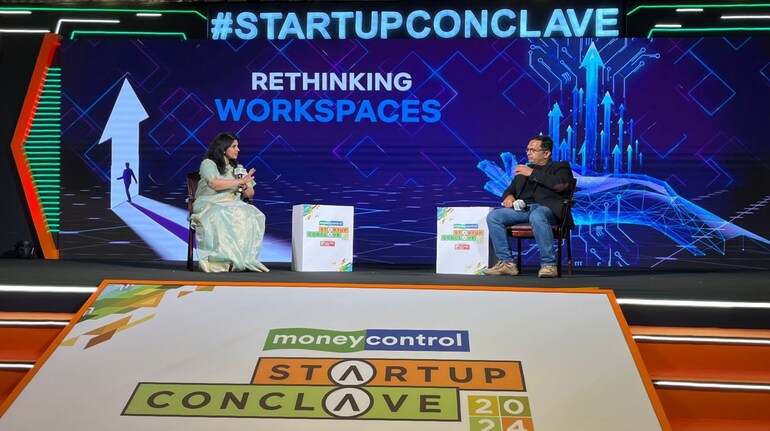
Co-working company IndiQube is seeing a significant growth in demand from midcap information technology (IT) companies, a segment that previously had a lower share of office space in major cities, co-founder Rishi Das has said.
“We are seeing a lot of growth coming from midcap companies like Persistent,” Das said at the Moneycontrol Startup Conclave in Bengaluru on August 9.
This assumes importance as certain midcap engineering, research and development (ER&D) information technology companies reported a tepid performance in the first quarter of the current financial year.
Das also said global capability centres and IT service companies are performing equally well, at a time when there is a concern that GCCs could eat into revenue of the tech firms.
A GCC is a dedicated offshore unit set up by a company in a foreign country to in-source IT and other related business functions.
"Today, work is going where people are. This has led to a significant increase in intra-city offices. For example, if you have an office in Electronic City (in Bengaluru), you can't expect someone living in Hebbal to commute to work. People are unwilling to commute more than an hour," Das told Moneycontrol's deputy executive editor Chandra R Srikanth.
The trend extends beyond major cities to tier-two cities, with at least 15 state capitals emerging as business hubs.
Das said another interesting aspect of asset allocation is large IT services sector allocating 10-20 percent of the roughly 15-20 million square feet to flexible offices. "Different companies are latching onto flex spaces for various reasons but it has become a much more broad-based approach," Das said.
He said there is increasing adoption of flexible office spaces by startups, IT services companies, GCCs and even traditional Indian companies.
Also read: Quitting your job to pursue entrepreneurship? Karnataka to offer Rs 25K a month, says Priyank Kharge
According to Das, the mix of demand by workspace occupiers is democratised, with startups, GCCs, IT services companies, and traditional Indian companies, each accounting for roughly 25 percent of the market.
"In cities like Bangalore, startups have a much larger share, whereas in Mumbai, traditional Indian companies hold a significant pivot," Das added.
He explained that old economy companies such as Air India, Mahindra Logistics, and UltraTech Cements have started adopting coworking spaces.
Another significant factor reshaping workplaces in India is the expansion of metro rail. As more urban cities across the country introduce metro networks, office spaces within a one to two-kilometer radius of metro stations are gaining popularity.
"Sooner or later, all urban cities in India will see Metro coming in, and in all workspaces or office spaces, which are in 1-2 kilometer radius of Metro, are again coming back in fashion," Das said.
When asked about listing of coworking space companies, Das said he expects five to seven initial public offering (IPOs) over the next three years. When asked specifically if IndiQube would also file for an IPO during the timeframe, Das replied, “Hopefully.”


Discover the latest Business News, Sensex, and Nifty updates. Obtain Personal Finance insights, tax queries, and expert opinions on Moneycontrol or download the Moneycontrol App to stay updated!
Find the best of Al News in one place, specially curated for you every weekend.
Stay on top of the latest tech trends and biggest startup news.