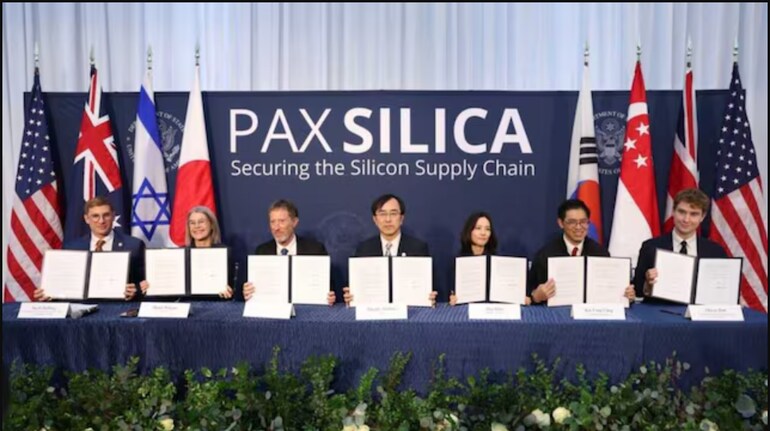

The United States has formally invited India to join Pax Silica, a US-led coalition aimed at securing the global silicon and artificial intelligence supply chain, signalling Washington’s intent to anchor New Delhi within a trusted technology bloc amid intensifying trade, tariff and geopolitical pressures.
The invitation was extended by US ambassador-designate to India Sergio Gor, as the US steps up efforts to build an alternative ecosystem to China’s dominance in critical minerals, semiconductors and AI infrastructure.
Led by US under secretary for economic affairs Jacob Helberg, Pax Silica has been positioned as an “economic security coalition built for the AI age”. Launched at its inaugural summit in December 2025, the grouping includes Australia, Israel, Japan, South Korea, Singapore, the UK, the Netherlands, the UAE and most recently Qatar.
Industry executives and analysts say India’s prospective entry could mark a strategic inflection point for the country’s semiconductor and AI ambitions, easing long-standing bottlenecks around technology access, critical minerals and advanced computing.
What Pax Silica offers and why India matters?
Pax Silica seeks to secure the full global technology stack among trusted partners — from critical minerals and chipmaking to digital infrastructure and AI compute.
For India, participation could translate into tangible gains across the semiconductor and AI value chain, at a time when geopolitical risk has become central to investment and supply-chain decisions.
Easing technology and manufacturing bottlenecks
An immediate benefit would be improved access to process know-how, equipment and intellectual property, SEMI India and India Electronics and Semiconductor Association (IESA) president Ashok Chandak told Moneycontrol.
India has emerged as a global hub for semiconductor design but manufacturing capabilities remain nascent.
“India is running a large semiconductor programme, but we remain dependent on countries such as the US, Taiwan, Japan and South Korea for intellectual property and process know-how, and on the Netherlands for advanced lithography,” Chandak said. “Being part of such an initiative could help bridge that gap.”
Closer integration with like-minded partners could also strengthen investor confidence in India’s fabrication and advanced packaging plans, particularly as global chipmakers reassess geographic concentration risks.
Critical minerals: reducing China risk
Another major lever is critical minerals, where India remains heavily import-dependent. Despite holding one of the world’s largest rare-earth reserves — estimated at 8.52 million tonnes — India’s domestic production remains limited.
In FY25, India imported around 54,000–57,000 tonnes of rare-earth materials, 93 percent of them sourced from China. China produced about 270,000 tonnes and India’s roughly 2,900 tonnes.
This dependence has already exposed India to supply shocks. A six-month halt in Chinese rare-earth exports last year disrupted domestic manufacturing, forcing automakers to cut output and drop features due to shortages of rare-earth magnets.
According to Chandak, Pax Silica’s consortium-based approach could help diversify sourcing —drawing minerals from Australia, the US and India — reducing reliance on China-dominated supply chains. “Individually, countries struggle, but collectively they are in a much stronger position to counter China’s dominance and supply restrictions,” he said.
While India has launched the National Critical Mineral Mission to boost domestic exploration, mining and refining, industry experts say meaningful scale will take time — making international partnerships critical in the interim.
Union IT minister Ashwini Vaishnaw is in Washington for discussions on critical minerals, underscoring India’s rising prominence in strategic technology and supply-chain policymaking.
Industry experts said India’s presence at such high-level forums is crucial, as the issue fundamentally revolves around securing critical mineral supply chains. For India, participation reflects not just economic necessity but growing international trust in its role as a long-term strategic partner.
Boost to India’s AI mission
Pax Silica could also support India’s national AI mission by easing access to GPUs and advanced AI infrastructure at a time when global demand for compute has surged and supply constraints have tightened.
“Access to GPUs and AI infrastructure, along with use-case development, could become easier with fewer restrictions,” Chandak said.
This comes as tech giants such as Google, Microsoft, Amazon and Nvidia have already committed significant investments in India. Inclusion in Pax Silica could further lower friction for future investments, especially as geopolitical pressures — particularly in the US — push companies to reconsider overseas expansion.
Strategic alignment, not isolation
Beyond economics, analysts see India’s inclusion as a geopolitical balancing move. Tarun Pathak, Research Director at Counterpoint Research, told Moneycontrol the initiative reflects a desire to ensure India remains closely aligned with existing strategic relationships.
“India has long been central to the China-plus-one strategy and remains one of the most attractive destinations, even as other alternatives exist,” Pathak said. “Its role in semiconductor design is significant because of the depth of its talent pool. At some point, these countries will inevitably need India.”
Keeping India away from such frameworks is neither practical nor realistic, he added. “The objective is to maintain alignment and continuity, rather than allowing India to move in a very different direction. India’s strength in resources, talent and scale makes it an important partner,” he said.
India’s growing strategic weight
Faisal Kawoosa, founder and analyst at TechArc, said India’s trajectory aligns closely with Pax Silica’s objectives. “India is graduating from being a supply-chain partner for relatively simple technologies, such as mobile phone assembly, to more complex areas like advanced semiconductor packaging,” he said.
A similar shift is underway in AI, where India has signalled its intent to play a larger global role. “With a proven electronics supply-chain track record over the past decade and a clear push to strengthen it further, India is well-positioned to emerge as a trusted alternative to China—one of the forum’s core objectives,” Kawoosa said.
The bigger picture
Taken together, India’s prospective entry into Pax Silica would anchor it more firmly within a trusted global silicon and AI ecosystem — one that combines technology access, supply-chain resilience and geopolitical alignment. For India’s chip and AI ambitions, the move could prove not just supportive, but transformative.



Discover the latest Business News, Sensex, and Nifty updates. Obtain Personal Finance insights, tax queries, and expert opinions on Moneycontrol or download the Moneycontrol App to stay updated!
Find the best of Al News in one place, specially curated for you every weekend.
Stay on top of the latest tech trends and biggest startup news.