







The United States’ decision to scrap the traditional H-1B visa lottery and overhaul the selection mechanism is unlikely to materially disrupt large Indian IT services companies, as the move largely formalises a transition that has been underway for years.
In one of the most consequential changes to the H-1B programme in decades, following the earlier $100,000 fee hike, the US is moving away from a purely random lottery to a wage-weighted selection system that gives higher-paid roles a better chance of selection. The lottery refers to the process used to select visa petitions when the number of applications exceeds the annual cap.
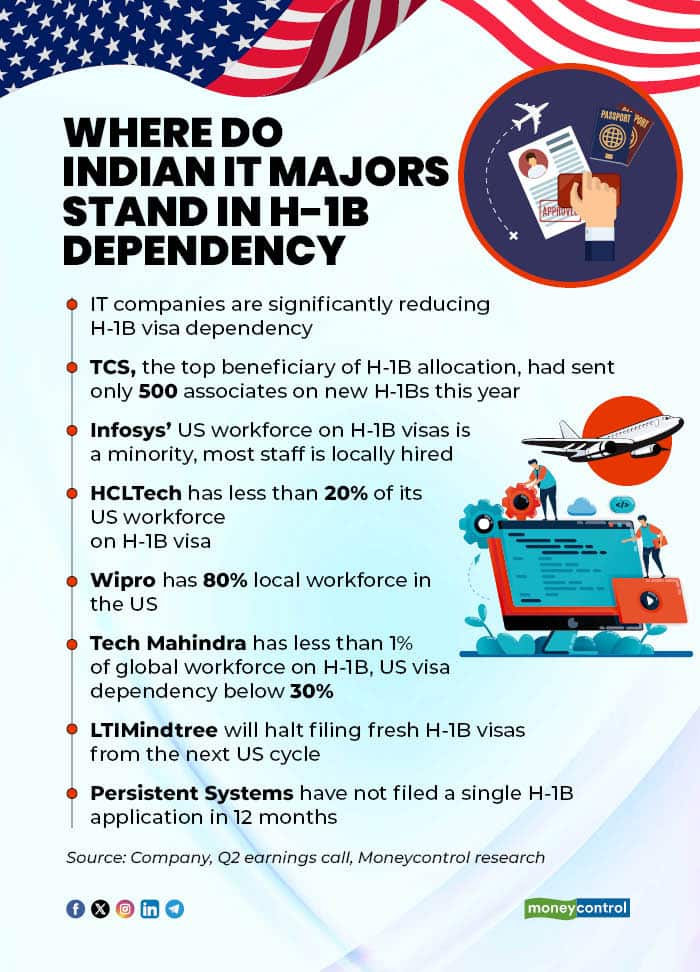
For large Indian IT services firms, the impact is expected to be limited. Analysts say that these companies have already reduced their dependence on deploying junior talent onsite, instead prioritising experienced, specialised and client-facing professionals in the US, while expanding offshore delivery from India.
As a result, the revised framework is seen as reinforcing existing staffing strategies rather than forcing a reset. The wage-weighted model also reduces incentives to flood the system with applications, encouraging more selective filings aligned with higher-value roles, analysts said.
Prashant Yadav, partner for digital and technology at leadership consultancy firm Amrop India, told Moneycontrol that large IT services companies were already pivoting toward keeping senior, specialised talent onshore, even before the latest announcement. “Absorbing a $100,000 fee for junior employees is commercially unviable. However, it will become easier to get visas for senior and specialised talent.”
From that standpoint, analysts say the wage-weighted lottery does not change behaviour beyond what the fee hike had already triggered. Instead, it reduces incentives to flood the system with applications, encouraging fewer but higher-quality filings.
Why are Indians most affected?
The change matters most for Indian professionals and employers because Indians account for roughly 70-75 percent of H-1B visas issued each year. In 2024 alone, Indians made up 71 percent of the approved H-1B visas, with China on a distant second spot.
With the lottery now tilted toward higher-paid roles, analysts expect the system to favour experienced professionals, senior engineers, and niche specialists, while making it harder for lower-paid, entry-level roles to clear the cap.
Analysts added that, as a practical matter, the wage-based model is likely to award visas for more niche, high-end roles and fewer mid-level and lower-level positions. Therefore, potentially reduces opportunities for Indian professionals in academia, research, and healthcare, where prevailing wage levels are often lower.
"Under the new wage‑weighted selection system, Level III and IV registrations receive multiple entries in the selection pool, while Level I candidates get only a single entry, which over time is likely to disadvantage students and junior professionals seeking their first H‑1B," said Gnanamookan Senthurjothi, immigration lawyer and founder, The Visa Code.
The troubles for early career professionals only compounds further with the imposition of the $100,000 visa application fee on new H-1B petitions, substantially increasing the cost of hiring first-time H-1B workers.
"In the long run, if U.S. graduates cannot secure H‑1B status and are forced to leave, employers who still wish to hire them may face both higher recurring fees and pressure to offer Level III/IV wage packages," added Senthurjothi.
Any Big tech company in India would apply for hundreds and thousands of candidates each year, but now to get their targets met they will have to offer level III salaries at least to getter better chances in the lottery system, said Varaprasad Srirangam, senior immigration manager, Aditi Consulting.
"On the hindsight, this could be a boon for highly skilled specialised talent as the companies would have to offer them Level III pay," he said.
Also read: Coforge, Tech Mahindra, other IT shares fall up to 1% as US scraps H-1B lottery
Offshore delivery gains momentum
As on-site hiring becomes more selective and expensive, offshore delivery from India is expected to gain further momentum.
“In the near term, we can expect the movement of some work offshore, as most contracts typically have flexible delivery clauses,” Akshat Vaid, partner at Everest Group, told Moneycontrol earlier.
Enterprises are likely to change the mix further toward offshore delivery, he added, even as governance and reporting costs increase.
Also read: H-1B fee hike unlikely to impact Indian IT as top firms reduce dependency
Margins under pressure, but manageable
Market intelligence firm UnearthInsight expects Indian IT companies to prioritise local hiring in the US, which could lead to short-term margin pressure. Founder and CEO Gaurav Vasu had told Moneycontrol earlier that the changes signal a clear preference for premium labour, with near-term margin impact that is likely to be neutralised over time through smarter workforce planning.
Analysts also point out that the White House’s clarification that the $100,000 fee is a one-time charge applicable only to new petitions, not renewals or existing visa holders, has significantly reduced fears of a sharp margin shock.
Some brokerages had earlier warned of margin squeezes of up to 7 percent under a worst-case scenario.
Also read: Indian IT cuts H-1B visa use by 56% in 8 years; US Big Tech emerges top sponsor
Big Tech vs Indian IT
The wage-weighted system could tilt the balance further in favour of US Big Tech firms, which typically pay much higher H-1B salaries than Indian IT services companies.
Data from MyVisaJobs shows average H-1B salaries at companies such as Google, Apple, and Meta are far higher than those at IT services firms like Infosys, Cognizant, and HCL America.
While Indian IT firms remain among the largest sponsors of H-1B visas by volume, their relatively lower wage levels could see them lose out under a system that prioritises compensation.
Ironically, however, Big Tech has also been ramping up investments in India, from major office leases in Hyderabad and Bengaluru to new engineering hubs and AI partnerships, signalling that global companies are already planning around tighter US immigration rules.
Also read: Big Tech Bets: Apple, Google, Meta, Microsoft and OpenAI expand in India amid Trump trade tensions
End-user firms see limited impact
For non-services firms and end-user companies, analysts expect only a moderate impact.
These companies typically do not rely heavily on importing very senior overseas talent and continue to have alternatives, such as the L-1 visa route, which allows them to hire in India and transfer employees after meeting tenure requirements.
Yadav said earlier that even large product firms may need to rethink their models. While they have deeper pockets, they are highly selective in the talent they hire and may also be forced to use more offshore resources over time.
The bottom line
Industry-wide, analysts agree that the H-1B reforms are unlikely to upend business models at large Indian IT firms. Instead, they accelerate trends already in motion: fewer junior roles onsite, more experienced talent in the US, greater offshore delivery from India, and continued localisation of hiring.
In that sense, the new H-1B regime does not represent a shock for big IT, but rather a formal recognition of how the industry has already adapted to a more restrictive and costlier visa environment.



Discover the latest Business News, Sensex, and Nifty updates. Obtain Personal Finance insights, tax queries, and expert opinions on Moneycontrol or download the Moneycontrol App to stay updated!
Find the best of Al News in one place, specially curated for you every weekend.
Stay on top of the latest tech trends and biggest startup news.







