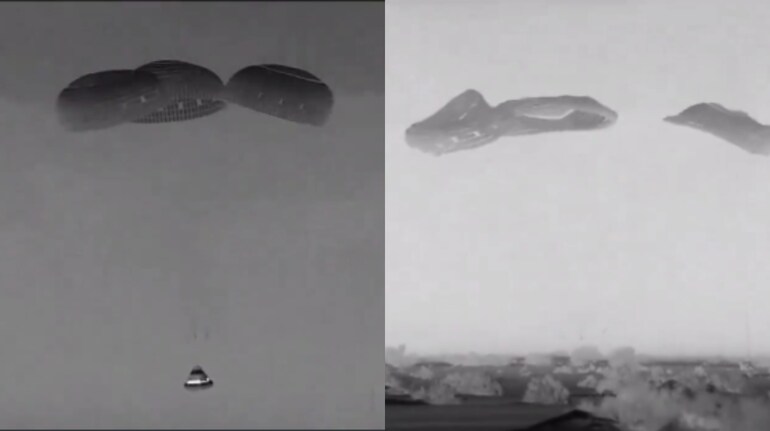
In a mission filled with anticipation and setbacks, Boeing’s Starliner spacecraft returned to Earth after an uncrewed journey from the International Space Station (ISS). The much-anticipated mission, originally intended to carry astronauts Sunita Williams and Barry E. Wilmore, concluded without the crew on board. This outcome highlights the ongoing difficulties Boeing faces in its quest for certification.
A Bumpy Road to Earth
The Starliner capsule, with its distinctive gumdrop shape, touched down gently at the White Sands Space Harbor in New Mexico at 0401 GMT (9:30 am), its descent slowed by parachutes and cushioned by airbags. The capsule's return followed its departure from the ISS roughly six hours earlier, marking the end of what was meant to be a straightforward test mission. However, unexpected thruster malfunctions and helium leaks during its ascent threw the mission off course. These technical difficulties ultimately led NASA to opt for the safer return of Wilmore and Williams aboard SpaceX's Crew Dragon, now delayed until February 2025.
The #Starliner spacecraft is back on Earth.At 12:01am ET Sept. 7, @BoeingSpaces uncrewed Starliner spacecraft landed in White Sands Space Harbor, New Mexico. pic.twitter.com/vTYvgPONVcNASA Commercial Crew (@Commercial_Crew) September 7, 2024
Technical Setbacks and High Stakes
Boeing had launched the Starliner in June for a weeklong test mission, hoping to finally certify the spacecraft for ferrying astronauts to and from the ISS. The mission was crucial for Boeing’s reputation, already tarnished by safety concerns affecting its passenger jets. Despite extensive ground testing to address the technical issues encountered, the spacecraft's performance raised red flags. Ground teams reported hearing sonic booms as the Starliner re-entered Earth’s atmosphere, enduring temperatures of 3,000 degrees Fahrenheit (1,650 degrees Celsius). NASA, still cautious, decided against having the astronauts aboard for the return journey, due to uncertainty about the thruster's reliability.
The Path Ahead for Boeing and Starliner
After executing a powerful "breakout burn" to safely distance the capsule from the ISS, the mission team conducted thorough checks before the crucial "deorbit burn," which guided the Starliner back to Earth. While the smooth landing was a relief, it was far from the mission’s original goals. NASA will now meticulously review the mission's performance before making any decisions on the future of the Starliner program. The delays and technical challenges stand in stark contrast to SpaceX's success, which has already ferried numerous astronauts to the ISS since 2020. As Boeing works to regain its footing, the path to certification for the Starliner remains uncertain, with much still to prove.
Discover the latest Business News, Sensex, and Nifty updates. Obtain Personal Finance insights, tax queries, and expert opinions on Moneycontrol or download the Moneycontrol App to stay updated!
Find the best of Al News in one place, specially curated for you every weekend.
Stay on top of the latest tech trends and biggest startup news.