






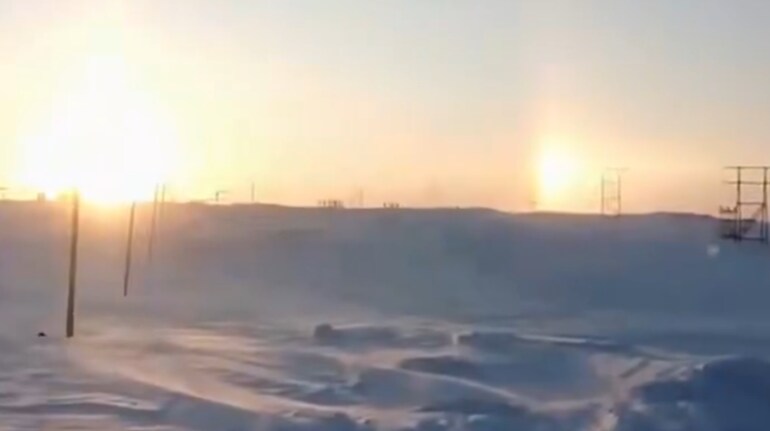

Residents in Russia’s Sakhalin region recently looked up to see what seemed like more than one sun climbing into the morning sky.
The spectacle wasn’t astronomical, but atmospheric. What people saw was a sundog, a rare-looking but well-understood optical effect produced by ice crystals suspended in cold air.
Sundogs, also known as mock suns or parhelia, are bright patches of light that appear to the left, right, or sometimes on both sides of the real sun. The word parhelia comes from Greek, meaning "with the sun," a description that fits the illusion perfectly.
According to the National Weather Service, sundogs belong to a wider family of light effects that also includes sun haloes and moon haloes, all created by the interaction of sunlight with ice crystals high in the atmosphere.
Why the sky sometimes plays tricks on us
At the heart of a sundog are tiny, hexagonal ice crystals. These are usually found in thin cirrus or cirrostratus clouds at heights of roughly 20,000 to 40,000 feet. In extremely cold regions, similar crystals can also form closer to the ground as “diamond dust,” when temperatures plunge below minus 30 degrees Celsius.
As these flat, plate-like crystals fall, they tend to orient themselves roughly horizontally, though they wobble slightly as they descend. Sunlight enters through one side face of a crystal and exits through another face angled at 60 degrees.
After undergoing two refractions, the light is bent by a minimum of 22 degrees. This geometry explains why sundogs sit at the same height above the horizon as the sun, separated from it by that characteristic angle, a detail described by the science site Atmospheric Optics.
When this refracted light concentrates into distinct bright spots instead of a full ring, the result is a pair of sundogs. In some cases, they are so intense that they can look like “false suns” flanking the real one.
Two suns rise over parts of RussiaSakhalin residents spot a rare sun dog caused by ice crystals in the air pic.twitter.com/U4vX2xNac4 — RT (@RT_com) January 24, 2026
Colour, shape, and the physics of light
Sundogs often show subtle colouring. The edges closest to the sun tend to glow red, while the outer edges fade into blue, with yellow or orange in between. This happens because white sunlight is made of many colours, each bent by a slightly different amount as it passes through ice.
Red light, with its longer wavelength, is refracted less strongly than blue light, which is pushed farther outward. The ordering echoes the familiar rainbow sequence remembered as ROY G.BIV, though here the colours are spread sideways rather than arcing across the sky.
Their shape can vary too. Larger crystals wobble more as they fall, stretching the sundogs vertically. In extreme cases, they blur into fragments of a full 22-degree halo around the sun, making them harder to distinguish.
Why are they called 'sun dogs'
The unusual name “sundog” is believed to trace back to ancient ideas rather than science. While there is no single confirmed origin, one commonly cited explanation links it to Greek mythology.
The bright spots were thought to resemble companions walking beside the sun, much like dogs following their master. In some tellings, Zeus, the god of the sky, was imagined moving across the heavens with his dogs, which appeared as two glowing 'false suns' flanking the real one.
The alternative name, parhelia, comes from Greek and literally means 'with the sun,' a more literal description of what observers see in the sky. Over time, 'sundog' stuck as a poetic way to describe these light companions that seem to trail the sun as it rises or sets.
When and where to spot them
Sundogs can appear anywhere in the world as long as the sun is above the horizon, but they are easiest to see when conditions line up just right.
A low sun, such as at sunrise or sunset, makes the effect more pronounced because light passes through the crystals more efficiently. Cold weather also helps, which is why winter mornings at higher latitudes offer prime viewing.
Long before myths gave way to measurements, such sights inspired stories. The belief that Zeus walked his dogs across the sky may be poetic, but our modern understanding owes much to the work of Isaac Newton, whose prism experiments in the 1600s revealed how light splits into colour.
Thanks to that science, what looks like two suns over Sakhalin today is no mystery, just a beautiful reminder of how light and ice can briefly reshape the sky.

Discover the latest Business News, Sensex, and Nifty updates. Obtain Personal Finance insights, tax queries, and expert opinions on Moneycontrol or download the Moneycontrol App to stay updated!
Find the best of Al News in one place, specially curated for you every weekend.
Stay on top of the latest tech trends and biggest startup news.





