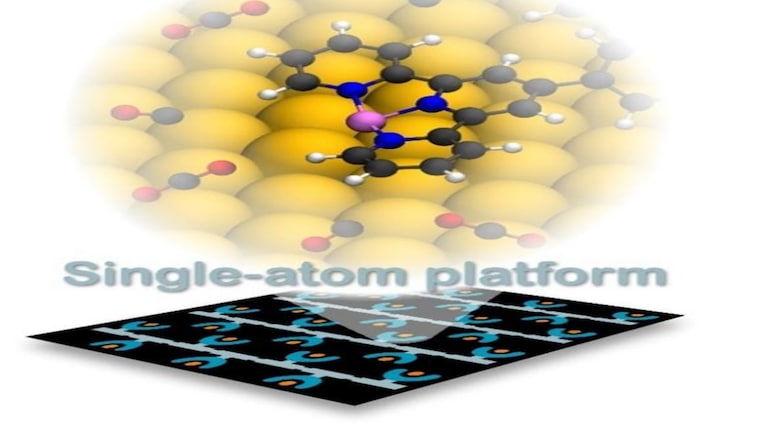
Scientists have developed a new platform for single-atom catalysis. The system isolates metal atoms on carefully designed polymer chains. It aims to boost efficiency and selectivity in chemical reactions. Researchers believe it could transform industrial processes and green chemistry.
What did scientists developed?
They created a new polymer-based platform for single-atom catalysis. Metal atoms are isolated at well-defined, tunable coordination sites. The design prevents clustering and improves stability above room temperature. Platform enhances catalytic efficiency, selectivity and accessibility of active atoms.
Who made this Discovery?
An international team of researchers led by CNR-ISM and OIST. Collaborators included Empa in Switzerland and University of Rome experts. Key researchers include Dr Marco Di Giovannantonio and Professor Narita. Funding came from PRIN 2022, OIST and bilateral CNR-JSPS projects.
When was the study conducted?
Research has progressed over several years using advanced synthesis techniques. Results were recently published in the journal Nature Communications. The breakthrough represents the first polymer-based architecture of this type. The study marks a major step forward in catalyst design.
Where was the study done?
Experiments were performed at CNR-ISM in Italy and OIST in Japan. Atomic-resolution microscopy enabled precise placement of atoms along polymer chains. Collaborators contributed theoretical models and analysis from Swiss and Italian labs. The platform’s design allows application in laboratories worldwide in future.
How did scientists conducted this?
Using on-surface synthesis (OSS) and atomic-resolution scanning probe microscopy. One-dimensional polymers with periodic side extensions were fabricated for metal atoms. Theoretical studies confirmed stronger gas binding compared with conventional structures. This method allows rational design of next-generation organometallic nanomaterials.
Why this study is Important?
Single atoms are highly reactive but normally aggregate in clusters. Enhanced binding of CO, O2 and H2 improves industrial reactions. It opens possibilities for CO2 conversion and sustainable chemical production. The platform mimics enzyme-like efficiency for industrially relevant catalysts.
Discover the latest Business News, Sensex, and Nifty updates. Obtain Personal Finance insights, tax queries, and expert opinions on Moneycontrol or download the Moneycontrol App to stay updated!
Find the best of Al News in one place, specially curated for you every weekend.
Stay on top of the latest tech trends and biggest startup news.