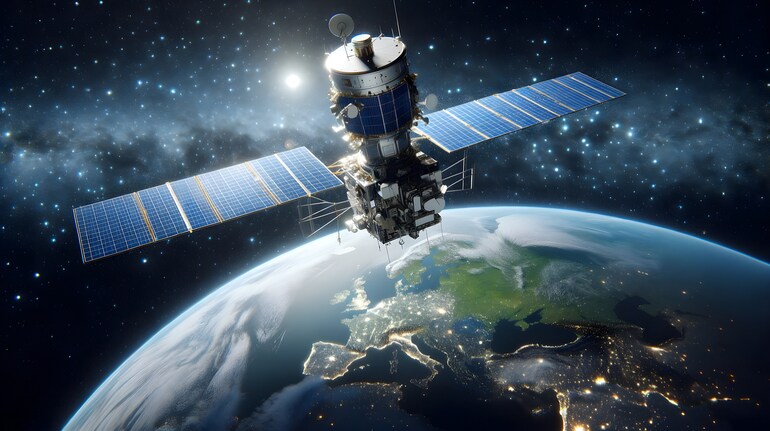

Scientists are warning that Earth’s crowded orbits may face serious risks soon, as a new study suggests satellites could begin colliding within days during a future emergency, potentially threatening the usability of low Earth orbit.
Researchers say the rapid growth of satellites circling Earth is sharply reducing the margin for error. A new scientific model shows how quickly disaster could unfold if a spacecraft suddenly became uncontrollable. The findings were shared in a study uploaded to the preprint server arXiv and reported by Live Science.
What is happening in low Earth orbit
Low Earth orbit is becoming increasingly crowded with operational spacecraft. As of May 2025, at least 11,700 active satellites orbited Earth. Most of these operate within low Earth orbit, extending roughly 2,000 kilometres above the planet. This marks a 485% rise since 2018, before large satellite networks expanded rapidly.
Much of this growth comes from satellite megaconstellations, including SpaceX’s Starlink network. Hundreds of launches now occur yearly, placing pressure on orbital environments. In 2025 alone, there were 324 orbital launches, according to SpaceNews, marking another record year.
What the CRASH Clock reveals
The study introduces a new risk indicator called the Collision Realisation And Significant Harm Clock. Known as the CRASH Clock, it estimates how quickly satellites could collide if operators lost control. Researchers modelled a worst case scenario involving technical failures, cyber attacks or severe solar storms.
By late 2025, the CRASH Clock value stood near 2.8 days. This means a collision could occur within days of widespread satellite failure. There is also a 30% chance of collision within 24 hours. In comparison, the estimated value in 2018 was 128 days.
Aaron Boley, an astronomer at the University of British Columbia, said the clock helps measure orbital stress. He told Live Science it offers a clear indicator of shrinking safety margins.
What it means for the future
Although the study has not been peer reviewed, researchers stress the trend matters most. The sharp decline in available response time concerns scientists monitoring orbital health. Boley said updated figures may appear later this year, refining current estimates.
Lead author Sarah Thiele of Princeton University said solar storms pose a major threat. Such events can disrupt satellite systems, making object tracking unreliable. If outages exceed the CRASH Clock timeframe, multiple collisions could follow.
This scenario could push Earth closer to the Kessler Syndrome threshold. That theory predicts cascading collisions could make low Earth orbit unsafe indefinitely. Researchers say predicting that tipping point remains difficult.
Still, scientists warn that continued satellite deployment without safeguards could accelerate risks. If densification continues, response windows may shrink further. The study suggests Earth’s orbital environment may already be under growing strain, with future consequences becoming harder to avoid.
Discover the latest Business News, Sensex, and Nifty updates. Obtain Personal Finance insights, tax queries, and expert opinions on Moneycontrol or download the Moneycontrol App to stay updated!
Find the best of Al News in one place, specially curated for you every weekend.
Stay on top of the latest tech trends and biggest startup news.