




A quiet icy visitor drew rare attention recently. A NASA spacecraft watched it almost without pause. The sky offered a small reminder of distance. For some scientists, this became an exciting moment. The comet moved slowly while cameras never rested.
NASA PUNCH Mission And Comet Tracking
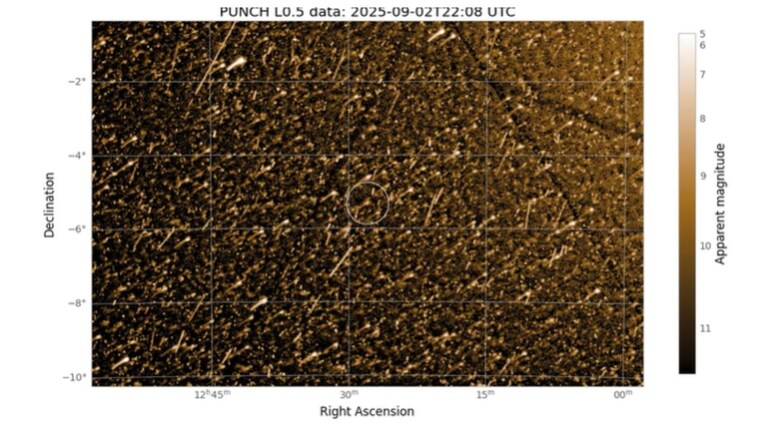
Why did NASA watch this comet so frequently? The PUNCH mission captured images every four minutes. This continued for almost 40 days without interruption. NASA said such cadence was likely unmatched before. Other comets were tracked once daily for years. Craig DeForest explained the new approach clearly. He leads the PUNCH mission in Colorado. His statement stressed the unusual speed of imaging.
What did the long sequence reveal to researchers? Hundreds of images were joined into one video. The comet passed between Mars and the star Spica. Thin black seams showed unprocessed borders between frames. NASA noted these gaps in its announcement publicly.
 This processed movie shows comet SWAN moving across the sky in PUNCH images taken from Sept. 11 to 22, 2025. The two bright objects that the comet passes between (roughly halfway through the movie) are the planet Mars (top) and the star Spica (bottom). (Image: NASA/Southwest Research Institute)
Which comet received this extensive observation from NASA? It was Comet C/2025 R2 known as SWAN. A Ukrainian amateur astronomer first spotted it. Vladimir Bezugly saw a bright blob near the Sun. He used open images from the SOHO spacecraft. The comet reached perihelion just one day later. It passed 46.74 million miles from the Sun.
Comet Features And Solar Wind Interaction
Why did the comet show a brightly coloured coma? Sunlight warmed its surface and caused sublimation. Ice turned to gas and lifted dust outward. The material formed a glowing tail behind SWAN. Early images showed a bluish green shape developing. By mid September the coma suddenly looked triangular. Astronomers link such shapes with fragmenting nuclei. Outgassing from pieces can distort a round coma.
How did its sky position compare with other objects? SWAN moved through the same region as 3I ATLAS. The interstellar visitor passed briefly under SWAN later. This appeared near the end of the PUNCH sequence.
Why did the comet appear to drift backward visually? The solar wind pushed the tail leftward strongly. NASA said comet tails trace solar wind flow. The charged particles shape space across our system.
Gina DiBraccio explained the importance of views. She works as acting director at NASA Goddard. She said multiple vantage points reveal space weather fully. Such tools help protect astronauts and technology on Earth.
Comet’s Approach And Visibility From Earth
How close did the comet pass to our planet? It reached 25.10 million miles from Earth. This happened in late October during its journey. The distance made it nearly visible to the naked eye. It became easy to find with binoculars or telescopes. The icy wanderer drifted onwards after this approach quietly.
Discover the latest Business News, Sensex, and Nifty updates. Obtain Personal Finance insights, tax queries, and expert opinions on Moneycontrol or download the Moneycontrol App to stay updated!
Find the best of Al News in one place, specially curated for you every weekend.
Stay on top of the latest tech trends and biggest startup news.




