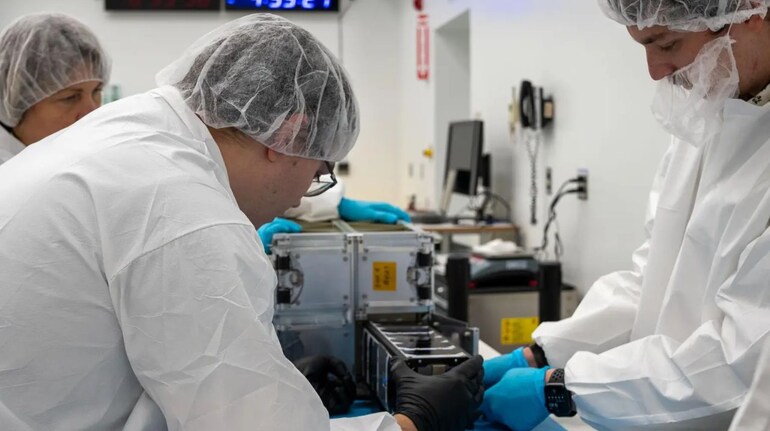
NASA has announced a new round of opportunities for CubeSat developers to create spacecraft for future launches through the CubeSat Launch Initiative (CSLI). CubeSats are small satellites known as nanosatellites.
Eligibility and Scope
The initiative provides launch opportunities to U.S. educational institutions, select non-profits, and informal educational institutions like museums and science centres. It also supports NASA centres focused on workforce development, including the Jet Propulsion Laboratory in California. Institutions serving minority communities are encouraged to participate.
“Engaging with CubeSats is a method to inspire students to pursue careers in the space industry,” stated Jeanie Hall, CSLI program executive at NASA Headquarters. “Annually, NASA reviews CubeSat mission applications and selects projects that feature educational components and enhance the agency’s understanding of education, science, exploration, and technology.”
Application Process
Proposals must be submitted by 5 p.m. EST on Nov. 15. NASA will announce selections by March 14, 2025, for flight opportunities between 2026 and 2029. However, selection does not guarantee a launch. Applicants are responsible for funding the development of their CubeSats.
Launch and Deployment
Selected CubeSats will be launched and deployed either from a rocket or from the International Space Station into low Earth orbit. NASA mission managers will advise the CubeSat teams to ensure technical, safety, and regulatory standards are met before launch. Those chosen will enhance their skills in hardware design and development and gain experience in operating CubeSats.
CubeSat Specifications
CubeSats are made up of standardised units called “U.” A 1-Unit (1U) CubeSat measures about 10 x 10 x 11 cm (3.9 x 3.9 x 4.5 inches). These units can be combined to form larger CubeSats, such as 3U or 6U sizes.
Recent Missions
Recently, eight CubeSat missions were launched on Firefly Aerospace’s Alpha rocket on July 3 from Vandenberg Space Force Base in California. One mission, CatSat, built by University of Arizona students, is testing a deployable antenna attached to a Mylar balloon. Another mission, KUbeSat-1, developed by the University of Kansas, is testing a new method of measuring cosmic rays that hit Earth. This launch marked the first CSLI missions from Kansas and Maine.
Additionally, four CubeSats were sent to the space station as cargo on a SpaceX Dragon capsule on March 21 as part of the agency’s 30th commercial resupply mission. Once on board, astronauts deployed these CubeSats into various orbits to test technologies aimed at improving solar power generation, detecting gamma-ray bursts, determining crop water usage, and measuring root-zone soil and snowpack moisture levels.
Since its inception, NASA has selected CubeSat missions from 45 states, Washington, D.C., and Puerto Rico, launching around 160 CubeSats.
The CubeSat Launch Initiative is managed by NASA’s Launch Services Program at Kennedy Space Center in Florida.
Discover the latest Business News, Sensex, and Nifty updates. Obtain Personal Finance insights, tax queries, and expert opinions on Moneycontrol or download the Moneycontrol App to stay updated!
Find the best of Al News in one place, specially curated for you every weekend.
Stay on top of the latest tech trends and biggest startup news.