






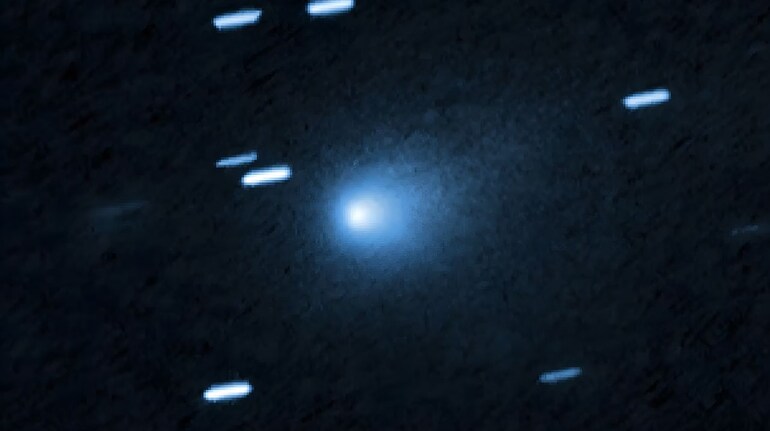

Astronomers have made a stunning discovery about a passing comet. 3I/ATLAS is an interstellar object entering our solar system. It is only the third such visitor ever confirmed. Its discovery challenges assumptions about the age of cosmic objects.
Scientists now study it to uncover clues about ancient space. The findings may rewrite what we know about cosmic history.
A mysterious comet from beyond
The comet is called 3I/ATLAS. It was first spotted in 2020 by the ATLAS survey. Astronomers immediately realised it was not bound to the Sun. It originated from outside the solar system entirely. This makes it a rare interstellar traveller in space. Only Oumuamua and Borisov came before it. Its trajectory and speed confirmed its interstellar origin.
A comet older than our own star?
3I/ATLAS could be between eight and fourteen billion years old. The Sun formed around 4.6 billion years ago. If true, this comet is older than the Sun. It preserves matter from a time long before our star. Scientists call it a cosmic messenger from the universe’s youth. Its material may reveal conditions shortly after the Big Bang.
Scientists captured some strange features
3I/ATLAS shows unusual wobbles in its jet streams. It also displays distinctive chemical markers in its coma. These features are unlike typical comets in our system. They indicate a unique formation history in another stellar system. Scientists continue monitoring its activity and brightness changes closely.
How did it survive billions of years?
The comet traveled through interstellar space for eons. It avoided destruction from stars, planets and cosmic collisions. Its frozen nucleus preserved chemical fingerprints from early space. This makes it an extraordinary natural time capsule. Tiny jets and unusual chemical markers hint at its age.
Why are scientists so captivated by this?
Observing the comet may reveal how early stars formed. It helps refine models of cosmic chemistry and evolution. The age estimates challenge previous ideas about small interstellar objects. It is a rare glimpse of primordial matter still intact. Each measurement may illuminate conditions before our solar system existed.
What comes next for 3I/ATLAS?
Observatories will continue monitoring 3I/ATLAS until it fades. Spectroscopic studies will examine its elements in greater detail. The findings may influence our understanding of star system evolution. Future interstellar visitors may be discovered with improved surveys. Every observation helps piece together the story of the universe. This interstellar traveller may hold secrets older than our Sun.
Discover the latest Business News, Sensex, and Nifty updates. Obtain Personal Finance insights, tax queries, and expert opinions on Moneycontrol or download the Moneycontrol App to stay updated!
Find the best of Al News in one place, specially curated for you every weekend.
Stay on top of the latest tech trends and biggest startup news.





