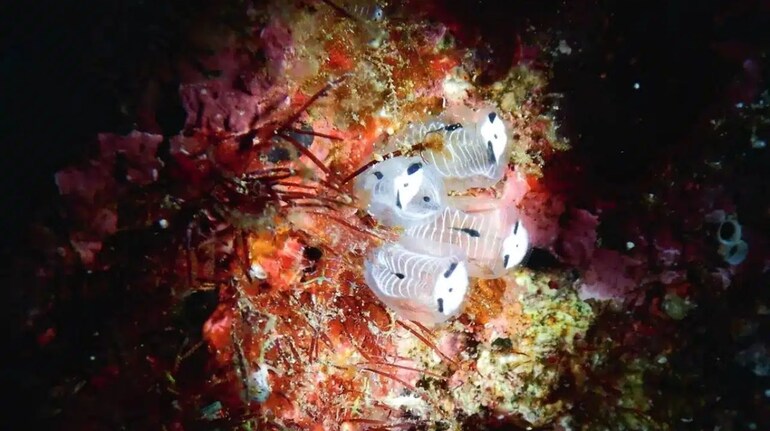

Scuba divers exploring the waters off Kumejima, Japan, shared images of a tiny marine creature resting on coral. It appeared to have a white body with black patches arranged like a panda’s eyes and nose.
Social media quickly embraced it as a “cute underwater panda.” But this was not a baby mammal lost at sea. It was something far stranger and far more scientifically exciting.
Not a Panda, But a Sea Squirt
Researchers later confirmed that the animal is a newly described species of sea squirt named Clavelina ossipandae. Sea squirts belong to a group of marine invertebrates known as tunicates. They may look simple and gelatinous, but they are biologically fascinating.
In fact, tunicates are considered distant relatives of vertebrates, meaning they share evolutionary roots with animals that have backbones. The species was formally described in 2024, though divers had been photographing it for years before scientists took a closer look.
The Skeleton Panda Sea Squirt (Clavelina Ossipandae) is a translucent reef-dwelling creature whose rib-like structures and panda-like markings give it a spooky, animated look. Found in Southeast Asia, it harmlessly filters seawater and helps keep coral ecosystems healthy. pic.twitter.com/ktTZyjjhwP— Massimo (@Rainmaker1973) February 19, 2026
Why Does It Look Like a Panda?
The resemblance is purely coincidental. The white “bone-like” markings inside its translucent body are actually visible blood vessels running through its gill structures. The black patches, which resemble panda eyes, are pigmentation patterns whose exact function remains unclear.
The nickname “skeleton panda sea squirt” stuck because of this unusual contrast of pale internal structures framed by bold dark spots.
Tiny, Transparent and Living in Shallow Waters
This small marine organism grows to less than an inch long. It attaches itself to hard surfaces such as coral reefs or rocky substrates and feeds by filtering plankton from seawater.
Like other members of the genus Clavelina, it lives in relatively shallow waters, typically within diving depth ranges. Its habitat near Japan’s reef ecosystems suggests that there may be more undiscovered micro-species hiding in plain sight beneath popular diving spots.
Is It Rare or Just Rarely Documented?
There is currently no clear data on how abundant Clavelina ossipandae is in the wild. It may be genuinely rare, restricted to specific reef systems near Japan. It is possible that the species has simply gone unnoticed for years. Scientists are trying to know about this unique species.
Discover the latest Business News, Sensex, and Nifty updates. Obtain Personal Finance insights, tax queries, and expert opinions on Moneycontrol or download the Moneycontrol App to stay updated!
Find the best of Al News in one place, specially curated for you every weekend.
Stay on top of the latest tech trends and biggest startup news.