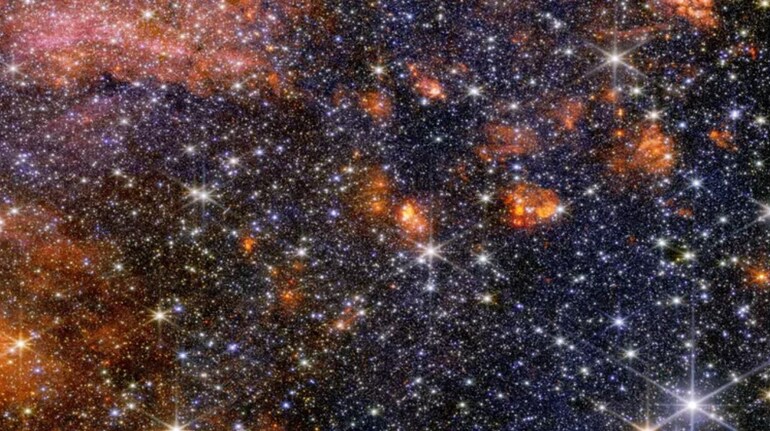
The centre of the Milky Way holds many cosmic secrets, but perhaps one of the most enigmatic lies in the gigantic cloud known as Sagittarius B2. The enormous nursery is churning out stars at a prodigious rate, far more than scientists would ever imagine. Now, new data from the James Webb Space Telescope (JWST) could at last shed light on why.
Why is Sagittarius B2 so unique?Stars across our galaxy are born in massive molecular clouds. Among them, Sagittarius B2 stands out as the largest, sitting just a few hundred light-years from Sagittarius A*, the Milky Way’s supermassive black hole. The region holds just 10% of the gas in the galactic centre, yet it is responsible for about half of all new stars forming there. Scientists have long struggled to understand why this cloud is so much more productive than others.
How has JWST informed us about the star nursery?To explore the enigma, astronomers consulted the JWST, which recently imaged Sagittarius B2 in unprecedented detail with two different instruments. Views in the Near-Infrared Camera (NIRCam) depict bright new stars shining through incandescent orange clouds of gas and dust. A second perspective, taken by the Mid-Infrared Instrument (MIRI), provides a very different image, with pink and purple dust features lit by nearby stars.
Despite infrared technology, JWST cannot penetrate the cloud's densest points. These dark, opaque regions are still invisible, holding within them the raw material for the stars that will form in the future.
Why is Sagittarius B2 star-forming so quickly?The question remains unanswered, but new clues are emerging. On the right side of the MIRI image, astronomers spotted a bright red region packed with molecular material. This dense pocket could explain why Sagittarius B2 is producing stars faster than the entire galactic centre combined.
Scientists now plan to analyse JWST’s data to learn how long this starburst has been active and whether a particular cosmic event triggered it. The findings could reshape our understanding of how galaxies evolve and why some regions are far more efficient at creating stars than others.
The results, researchers said, could also reveal whether similar star-forming zones exist elsewhere in the universe, offering a rare glimpse into the mechanisms that fuel galactic growth.
Discover the latest Business News, Sensex, and Nifty updates. Obtain Personal Finance insights, tax queries, and expert opinions on Moneycontrol or download the Moneycontrol App to stay updated!
Find the best of Al News in one place, specially curated for you every weekend.
Stay on top of the latest tech trends and biggest startup news.