






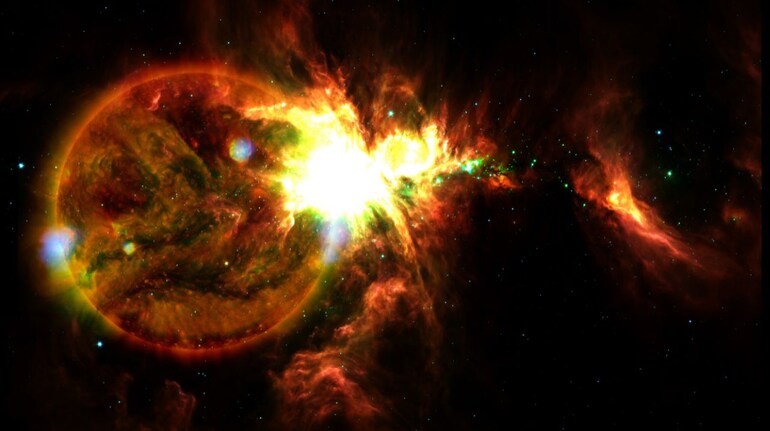

India’s space agencies are monitoring heightened solar activity after powerful flares from the Sun triggered concerns over possible radio blackouts and satellite disruption. The renewed solar unrest has prompted ISRO to place more than 50 operational satellites under constant observation, as intense space weather can interfere with communications, navigation systems, and power infrastructure across the region.
Solar storms occur when the Sun releases sudden bursts of energy and radiation. These events do not directly harm people on Earth, but they can severely disturb the ionosphere, which plays a vital role in radio communications. ISRO officials confirmed that ground stations have already issued alerts to mission control centres, while contingency measures remain ready to address any unexpected anomalies quickly.
|| CESSI FLARE ALERT + SPACE WEATHER ADVISORY ||CODE ♦️ SEVERE The Sun has launched multiple solar flares over the past 24 hours, the strongest one being an X8.1 flare at 2026/02/01 23:57 UT (flare light curve below). 1/n + pic.twitter.com/4RW89i5ysp — Center of Excellence in Space Sciences India (@cessi_iiserkol) February 2, 2026
Why the Sun Is Showing Intense Activity
Scientists say the current activity originates from a magnetically complex sunspot cluster called Active Region 14366. Over recent days, this region produced several strong flares, including an X8.1-class eruption, the most powerful recorded this year. NASA confirmed the flares were observed between February 1 and February 2, with instruments capturing repeated explosive activity on the solar surface.
Solar physicists explained that the Sun naturally enters periods of heightened activity during its solar maximum cycle. These cycles repeat roughly every eleven years, during which sunspots become more active and unpredictable. Experts said Indian scientists had anticipated increased activity and issued early space weather alerts after analysing the region’s magnetic behaviour.
An X1.0 Solar Flare Occurred from Region 4366 in the NE quadrant of the Sun. pic.twitter.com/Io8K1fPBQP — NOAA Space Weather Prediction Center (@NWSSWPC) February 1, 2026
What the Solar Storm Means for Earth
Flares of this strength release electromagnetic radiation that reaches Earth almost instantly. While the radiation poses no direct danger to people on the ground, it can disrupt high-frequency radio signals, affect navigation accuracy, and increase radiation exposure for satellites. Power grids and aviation systems at higher latitudes may also face elevated risks during intense solar events.
Experts noted that Earth has so far avoided the worst outcome, a strong Earth-directed coronal mass ejection. A weaker plasma cloud is being monitored, though scientists warned stronger activity remains possible as the sunspot rotates into a more direct alignment.
The Sun emitted a strong solar flare on Feb. 3, peaking at 9:08 a.m. ET. NASA’s Solar Dynamics Observatory captured images of the event, which was classified as X1.5. https://t.co/gHptBKDzqkpic.twitter.com/prkVqTWE8O— NASA Space Alerts (@NASASpaceAlerts) February 3, 2026
How India Is Preparing for What Comes Next
India’s Aditya-L1 mission is playing a critical role in monitoring the unfolding situation. Positioned about 1.5 million kilometres from Earth, the spacecraft provides early warnings of solar eruptions, allowing ISRO to safeguard satellites and communication networks. Scientists say data from Aditya-L1 is improving India’s ability to respond quickly to solar threats.
India also plans to strengthen long-term solar monitoring through the National Large Solar Telescope, proposed at Pangong Lake in Ladakh. The facility will support high-resolution solar studies from the ground, complementing space-based observations. Researchers stress that understanding solar behaviour is now essential for protecting modern infrastructure, as the Sun remains active and unpredictable.
Discover the latest Business News, Sensex, and Nifty updates. Obtain Personal Finance insights, tax queries, and expert opinions on Moneycontrol or download the Moneycontrol App to stay updated!
Find the best of Al News in one place, specially curated for you every weekend.
Stay on top of the latest tech trends and biggest startup news.





