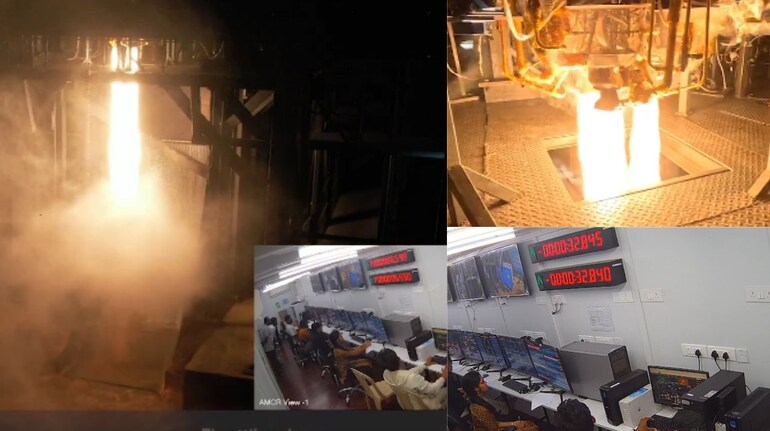

India’s private space industry has achieved a significant breakthrough. Chennai-based space start-up Agnikul Cosmos has successfully test-fired 3 semi-cryogenic rocket engines simultaneously in a clustered configuration. This test is a first for the country.
The engines were ignited together as an integrated propulsion system, marking a major step forward in indigenous rocket technology and advanced manufacturing. Officials confirmed that the test marked India’s first successful clustered semi-cryogenic engine firing conducted by a private company.
Unlike conventional tests where engines are evaluated individually, Agnikul’s engines were fired together in perfect synchronisation. Cluster testing is critical for increasing thrust in future orbital launch vehicles, enabling rockets to carry heavier payloads into space.
This milestone represents more than just a successful ignition. It demonstrates India’s growing capability to design, manufacture, and control complex propulsion systems within the private sector.
Humbled to share that we successfully test fired 3 semi-cryogenic rocket engines simultaneously, as a cluster. All the 3 engines are 3d printed as single pieces of hardware - designed and manufactured in-house at AgniKul Cosmos Rocket Factory - 1. As with all our propulsion… pic.twitter.com/yGv8nLZdia— AgniKul Cosmos (@AgnikulCosmos) February 23, 2026
Agnikul Cosmos operates from a facility linked to IIT Madras. The institutional support for India’s private space ecosystem has come from ISRO and regulatory oversight body IN-SPACe.
This collaboration has strengthened India’s emerging commercial launch capabilities. The engines tested are proudly labelled “Made in Bharat”, underscoring the focus on indigenous development.
One of the most striking aspects of the test is the engine design itself. Each engine was entirely 3D-printed as a single piece. This eliminated the need for assembling multiple complex components.
Cluster firing required precise calibration of six pumps, synchronised with six electric motors. Engineers carefully tuned the engines using advanced speed-control algorithms to ensure uniform ignition and stable performance throughout the test.
The company announced the successful milestone recently on social media platform X. The trial was conducted at its private facility following months of preparation, calibration and system checks.
This marks India’s first clustered semi-cryogenic engine test by a private firm. It is a notable development in the country’s rapidly evolving space landscape.
The engines are designed to power future launch vehicles capable of placing satellites into orbit. Semi-cryogenic engines typically use liquid oxygen as the oxidiser. This offers improved efficiency and higher performance compared to traditional solid propulsion systems. By clustering three engines together, engineers significantly increase total thrust.
Engineers will now analyse detailed test data, examining pressure levels, temperature readings and fuel flow behaviour. Every second of performance will be scrutinised to refine system reliability.
The journey from successful test firing to operational launch vehicle takes time. However, this milestone signals that India’s private space sector is moving beyond experimentation and into advanced propulsion capability.
Discover the latest Business News, Sensex, and Nifty updates. Obtain Personal Finance insights, tax queries, and expert opinions on Moneycontrol or download the Moneycontrol App to stay updated!





Find the best of Al News in one place, specially curated for you every weekend.
Stay on top of the latest tech trends and biggest startup news.