A new simulation offers a glimpse into Earth’s future. In 250 million years, the planet may face extreme conditions. A superheated supercontinent could push mammals, including humans, to extinction. The world could become uninhabitable, with unbearable heat and volcanic activity.
The University of Bristol led the simulation. It predicts that Earth’s landmasses will merge. A new supercontinent, Pangaea Ultima, will form. This massive landmass will experience extreme heat. Temperatures could reach 50°C (122°F) in many areas. This could make survival nearly impossible for mammals. A heat trap will be created by its landlocked interior. Without oceans to regulate climate, Earth’s surface will become inhospitable.
Environmental Catastrophe: The Triple Threat
Volcanic activity will increase, releasing carbon dioxide. This will further intensify the greenhouse effect. The Sun’s increased luminosity will add to the heat. With rising temperatures, survival will be even harder. These conditions will likely make Earth uninhabitable for mammals.
Humidity levels will rise, making cooling impossible. Mammals will overheat because sweat won’t evaporate. The study predicts that 92% of the land will become uninhabitable. Only the polar and coastal areas may remain habitable.
Dr. Alexander Farnsworth calls this a “triple whammy” for mammals. He says the heat, humidity, and volcanic activity will create deadly conditions. Adaptation may be the only chance for survival. Humans might evolve heat-resistant traits over millions of years. Alternatively, technology could help us survive.
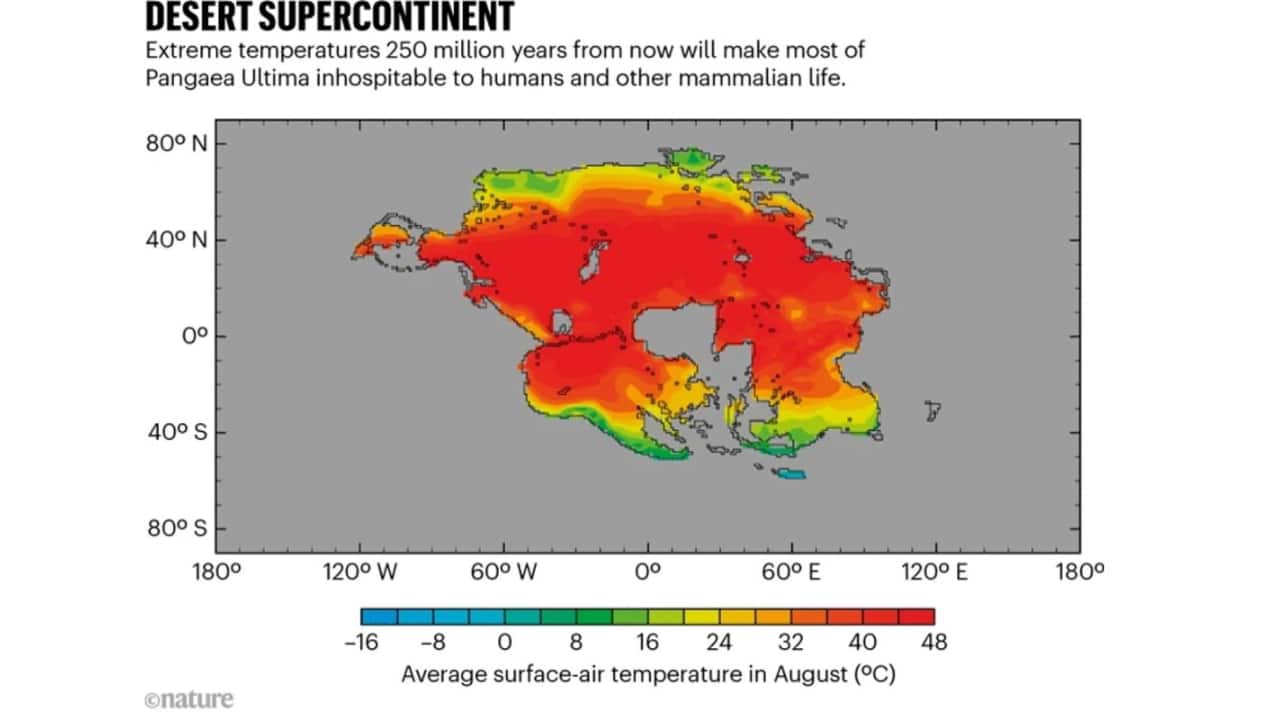 Pangaea Ultima will reach temperatures exceeding 40°C. (Image: Nature)
Human Adaptations and Survival Possibilities
Humans may develop underground cities to escape the heat. These cities would offer protection from the extreme surface conditions. In the future, humans could also become nocturnal, similar to desert creatures.
Some scientists believe humans may colonise other planets. If that happens, Pangaea Ultima’s catastrophe could be avoided. The survival of humanity may not depend on Earth.
Read Also: China creates ultra-hard 'super diamond,' 40% harder than natural diamonds
In the past, supercontinents contributed to mass extinctions. Tectonic shifts and volcanic activity caused severe climate changes. This pattern has occurred throughout Earth’s history.
Dr. Hannah Davies believes life will adapt, even in extreme conditions. While mass extinction is possible, life will find a way. Earth’s future remains uncertain, but life has always been resilient.
This study published in Nature reminds us that Earth’s climate is always changing. Climate change today could influence our distant future. While we won’t face this catastrophe now, the timeline of Earth’s history is vast. The future of humanity on Earth remains uncertain.
Discover the latest Business News, Sensex, and Nifty updates. Obtain Personal Finance insights, tax queries, and expert opinions on Moneycontrol or download the Moneycontrol App to stay updated!
Find the best of Al News in one place, specially curated for you every weekend.
Stay on top of the latest tech trends and biggest startup news.