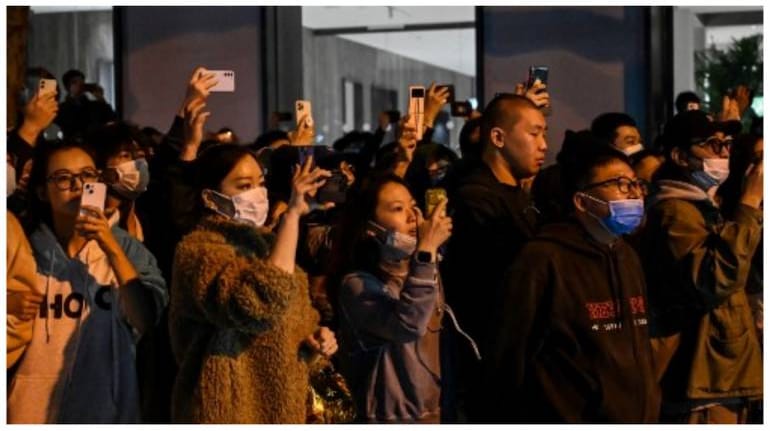
The United States backs the right of people to peacefully protest in China, the White House said on Monday, but stopped short of criticizing Beijing as protesters in multiple Chinese cities have demonstrated against heavy COVID-19 measures.
Chinese police on Monday tightened security at the sites of weekend protests in Shanghai and Beijing, after crowds there and in other Chinese cities and on dozens of university campuses made a show of civil disobedience unprecedented since leader Xi Jinping assumed power a decade ago.
"We've long said everyone has the right to peacefully protest, here in the United States and around the world. This includes in the PRC (People's Republic of China)," the White House National Security Council said in a statement.
It said the United States was focused on "what works" to combat the coronavirus, including by enhancing vaccination rates.
"We think it's going to be very difficult for the People's Republic of China to be able to contain this virus through their zero-COVID strategy," the NSC said.
Earlier this month, President Joe Biden held in-person talks with Xi in Bali, and the White House response appeared to indicate a desire to tread a careful path and avoid inflaming the situation.
Asked for Biden's reaction to protesters calling for Xi to step down, White House national security spokesman John Kirby later told a press briefing: "The president's not going to speak for protesters around the world. They're speaking for themselves."
Kirby said Biden was being kept up to date on what is going on inside China and "staying mindful of the protest activity." He said the administration was closely watching the demonstrations, and that China had not asked the United States for vaccines.
Beijing and Washington have dealt with the spread of the coronavirus pandemic in vastly different ways, a split that has reshaped the contest between the world's two leading economies.
Beijing's zero-COVID policy has kept China's official death toll in the thousands, against more than a million in the United States, but has come at the cost of confining many millions of people to long spells at home, inflicting extensive disruption and damage to China's economy.
Earlier in the pandemic, the two countries sought to burnish their geopolitical clout through vaccine distribution.
During his tenure, Xi has overseen the quashing of dissent and the expansion of a high-tech social surveillance system that has made protest more difficult, and riskier.
Some members of the U.S. Congress have condemned Xi, including Michael McCaul, the Republican lead on the House Foreign Affairs Committee, saying in a statement that the protests were a reminder that the Chinese Communist Party's "dystopian governance is neither popular nor unchallenged."
"I salute the bravery of those risking everything to make a stand against the CCP," McCaul said.
Discover the latest Business News, Sensex, and Nifty updates. Obtain Personal Finance insights, tax queries, and expert opinions on Moneycontrol or download the Moneycontrol App to stay updated!
Find the best of Al News in one place, specially curated for you every weekend.
Stay on top of the latest tech trends and biggest startup news.