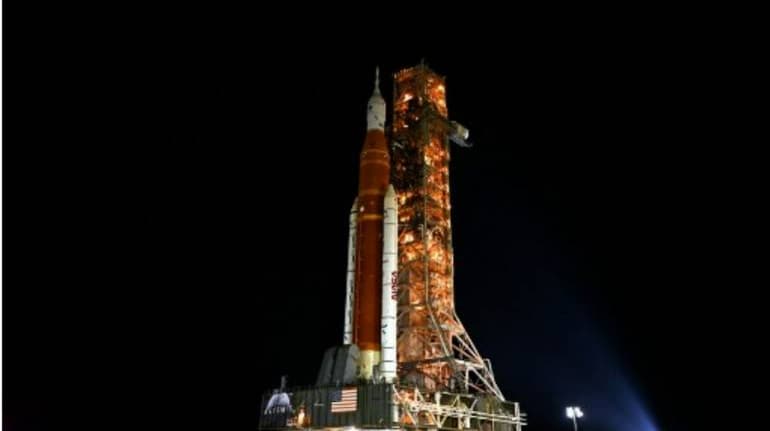
NASA, the US-based National Aeronautics and Space Administration, on September 3 aborted the launch of the Artemis I lunar rocket for the second time due to a technical fault. During tanking of the Artemis I mission, a leak developed in the supply side of the 8-inch quick disconnect while attempting to transfer fuel to the rocket.
Attempts to fix it have been unsuccessful, and the launch of the debut test flight of its giant, next-generation rocket from the Kennedy Space Center in Cape Canaveral, Florida, has been postponed.
There was no immediate word on a time frame for retrying to launch the mission.
The first launch attempt on August 29 was foiled by 11th-hour technical problems that surfaced during the countdown, including a different leaky fuel line, a faulty temperature sensor and some cracks in insulation foam.
The Artemis 1, an uncrewed lunar mission, includes Orion spacecraft and Space Launch System (SLS) rocket.
Objectives of the mission:- Artemis 1 to eventually put humans on the lunar surface by 2025.
- Voyage for NASA's new Space Launch Vehicle (SLS) and the Orion astronaut capsule
- Orion's ability to return from the Moon and operate in deep space where it is "much colder than in low Earth orbit," and to successfully recover the spacecraft.
- The mission also plans to study radiation and take selfies of the capsule with the Moon in the background.
- The Artemis program's eventual goal is to establish a long-term lunar base on the Earth's satellite, which will act as a stepping stone to more complex missions to Mars.
- The ultimate aim of the mission to let humans walk on the Moon for the first time since 1972.
Here’s a timeline of activities from preparation to announcement on October 23, 20221 to today (September 3) when the moon rocket launch was aborted for a second time.October 22, 2021:Announcement ahead of the launch- NASA said through a statement that it had achieved a major milestone when it stacked the Orion crew capsule atop the SLS mega-rocket just before midnight on October 21.
October 23, 2021:- Orion capsule's launch plan from atop the Space Launch System rocket from Kennedy Space Center’s paunch pad
- NASA announced on October 23 that it was targeting February 2022 for its uncrewed Artemis 1 mission.
- The agency said it had plans to launch the test flight by the end of 2021, with astronauts set to walk on the Moon by 2024.
- The mission duration was expected to be four to six weeks.
- The first woman and first person of color would step foot on the lunar surface. NASA planned to deploy small satellites, known as CubeSats, to perform experiments and technology demonstrations.
March 12, 2022:Send your name on a trip around the moon- NASA opened a portal where people could sign up to have their names included in a flash drive that will fly aboard Artemis 1.
March 17, 2022:First journey to a launchpad- The massive new rocket left the Kennedy Space Center's Vehicle Assembly Building and began an 11-hour journey on a crawler-transporter to the hallowed Launch Complex 39B, four miles (6.5 kilometers) away.
- With the Orion crew capsule fixed on top, the Space Launch System (SLS) Block 1 stands 322 feet (98 meters) high
- After reaching the launchpad, there were roughly two more weeks' worth of checks
- NASA's moon rocket moved to launch pad for 1st test flight
- It took nearly 10 hours for the rocket to make the four-mile trip to the pad
- No one will be inside the crew capsule atop the rocket, just three mannequins test dummies swarming with sensors to measure radiation and vibration.
- The capsule will fly around the moon in a distant orbit for a couple of weeks, before heading back for a splashdown in the Pacific. The entire flight should last six weeks.
August 17, 2022:NASA reveals the list of items it is sending- The items include 245 silver Snoopy pins, a Shaun the Sheep mascot, a Dead Sea pebble and 567 American flags – all items of cultural significance
- Snoopy, the beloved comic character, will ride along
- European Space Agency (ESA), which built the power-providing service module for the mission, arranged to include a Shaun the Sheep mascot.
- 90 Girl Scouts Space Science badges, Sycamore tree seeds, an Artemis program rubber stamp and a USB drive containing images, drawings and poems from students.
- A small piece of moon rock from the Apollo 11 mission will also go along for the lunar journey
August 17, 2022:Rocket's third trip to the pad- A countdown test in April was marred by fuel leaks and other equipment trouble, forcing NASA to return the rocket to the hangar for repairs.
- The dress rehearsal was repeated at the pad in June, with improved results.
- Then, it was the rocket's third trip to the pad.
August 29, 2022:First launch attempt scrubbed - Unexpected problems with one of the rocket engines- The countdown clock was halted about 40 minutes before the targeted launch time
- The U.S. space agency cited a problem detected on one of the rocket's main engines
- An unexpected snag with one of the RS-25 engines on the SLS.
- During the conditioning process to thermally insulate the four engines, one of them failed to maintain proper cooling.
- A cooling problem with one the rocket's main-stage engines forced a halt to the countdown
- The NASA mission director tried to troubleshoot the engine but eventually "scrubbed" the launch after it became apparent that it will not work as intended.
- NASA postpones debut test flight of next-generation mega-rocket.
August 31, 2022:NASA aims for a second attempt- NASA announced it would make second attempt at debut moon rocket launch on Sep 3
- The first voyage of the SLS-Orion, a mission dubbed Artemis I, aims to put the 5.75-million-pound vehicle through its paces in a rigorous demonstration flight pushing its design limits
September 3, 2022:NASA all set for second attempt- Tests indicated technicians had since fixed a leaky fuel line that contributed to its first canceled launch
- The 32-story tall Space Launch System (SLS) rocket and its Orion capsule were due for blastoff from Cape Canaveral, Florida
- Two other key issues on the rocket itself – a faulty engine temperature sensor and some cracks in insulation foam – resolved
- The latest forecast called for a 70% chance of favorable conditions during two-hour launch window
September 3, 2022:NASA again calls off moon rocket launch- NASA fuels new moon rocket in week's 2nd launch attempt
- NASA began fuelling its new moon rocket Saturday for lift-off on a test flight
- the launch team began loading nearly 1 million gallons of fuel into the 322-foot (98-meter)
- An over-pressure alarm sounded and the tanking operation was briefly halted, but no damage occurred, and the effort resumed
- Mission managers accepted the additional risk posed by the engine issue as well as a separate problem
- NASA calls off Artemis moon rocket launch for second time in 5 days
- The latest attempt to launch the 32-story-tall SLS rocket and its Orion capsule was scrubbed after repeated attempts to correct a leak of super-cooled liquid hydrogen propellant.
The mission to the MoonGetting the SLS-Orion spacecraft off the ground is a key first step. Its first voyage is intended to put the 5.75-million-pound vehicle through its paces in a rigorous test flight pushing its design limits and hopefully proving the spacecraft suitable to fly astronauts.
Artemis 1 is the first in series of missions to establish a long-term human presence on the Moon in the future.
SLS would first place Orion into a low Earth orbit, and then, using its upper stage, perform what's called a trans-lunar injection. This maneuver is necessary to send Orion 280,000 miles beyond Earth and 40,000 miles beyond the Moon -- further than any spaceship capable of carrying humans has ventured.
Billed as the most powerful, complex rocket in the world, the SLS represents the biggest new vertical launch system the U.S. space agency has built since the Saturn V of the Apollo era.
Artemis 1 was set to journey around the far side of the Moon in a mission lasting four to six weeks -- longer than any ship for astronauts has done without docking, before returning home faster and hotter than every vessel before.
On its three-week mission, Orion would deploy 10 shoebox size satellites known as CubeSats to gather information on the deep space environment.
Before the capsule returned from the Moon, it would have travelled about 24,500 miles an hour (39,400 kilometers per hour) and experienced temperatures half as hot as the Sun outside its heat shield.
More than a decade in development with years of delays and budget overruns, the SLS-Orion spacecraft has so far cost NASA least $37 billion, including design, construction, testing and ground facilities. NASA’s Office of Inspector General has projected total Artemis costs will run to $93 billion by 2025.
Artemis II will be the first crewed test, flying around the Moon but not landing, while Artemis III will see the first woman and first person of colour touch down on the lunar south pole.
The Artemis program seeks to eventually establish a long-term lunar base as a stepping stone to even more ambitious astronaut voyages to Mars, a goal that NASA officials have said will probably take until at least the late-2030s.
Artemis 1, the successor to the Apollo lunar missionsDuring six Apollo missions from 1969 to 1972, the only spaceflights yet to place humans on the lunar surface, twelve astronauts walked on the moon.
(With Inputs from Agencies)Discover the latest Business News, Sensex, and Nifty updates. Obtain Personal Finance insights, tax queries, and expert opinions on Moneycontrol or download the Moneycontrol App to stay updated!
Find the best of Al News in one place, specially curated for you every weekend.
Stay on top of the latest tech trends and biggest startup news.