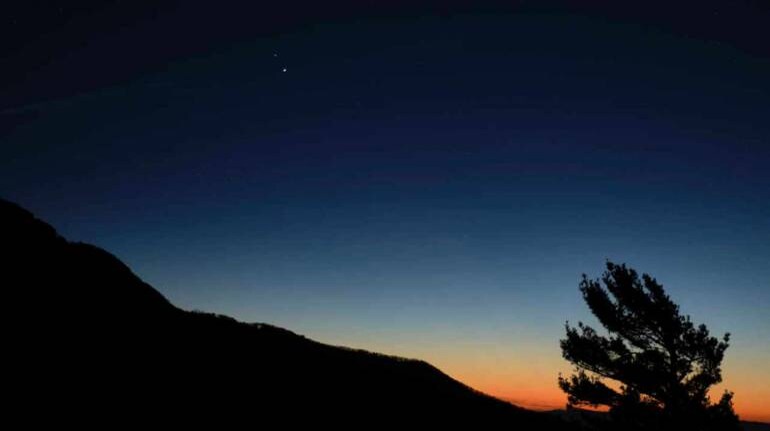
Jupiter and Saturn will merge in the night sky on December 21, appearing closer to one another. Skywatchers around the world can easily watch the rare phenomena a little after sunset.
According to astronomers, the so-called conjunctions between the two largest planets in the solar system aren't particularly rare. Jupiter passes its neighbour Saturn in their respective laps around the sun every 20 years.
But the one coming up is especially close: Jupiter and Saturn will be just one-tenth of a degree apart from our perspective or about one-fifth the width of a full moon.
It will be the closest Jupiter-Saturn pairing since July 1623, when the two planets appeared a little nearer. In the year, Jupiter caught up to and passed Saturn, in an astronomical event known as a “Great Conjunction,” according to the National Aeronautics and Space Administration (NASA).
This conjunction was almost impossible to see, however, because of its closeness to the sun.
Considerably closer and in plain view was the March 1226 conjunction of the two planets when Genghis Khan was conquering Asia. The conjunction of December 21 will be the closest pairing that is visible since way back then.
Saturn and Jupiter have been drawing closer in the south-southwest sky for weeks. Jupiter, bigger and closer to Earth, is much brighter.
Despite appearances, Jupiter and Saturn will actually be more than 450 million miles (730 million kilometres) apart. Earth, meanwhile, will be 550 million miles (890 million kilometres) from Jupiter.
> Find a spot with an unobstructed view of the sky, such as a field or park. Jupiter and Saturn are bright, so they can be seen even from most cities.
> The conjunction will be easily visible shortly after sunset at the southwest fairly low on the horizon on the day.
> Saturn will be slightly fainter and will appear slightly above and to the left of Jupiter until December 21, when Jupiter will overtake it and they will reverse positions in the sky.
> The phenomenon can be seen with the unaided eye.
> Binoculars will be needed to separate the two planets.
> A telescope will be able to capture Jupiter and Saturn in the same field of view.
> With the help of binoculars and telescope, one may be able to see Jupiter’s four large moons orbiting the giant planet.
The next super-close pairing of Jupiter and Saturn is expected to be seen on March 15, 2080.
(With inputs from agencies)Discover the latest Business News, Sensex, and Nifty updates. Obtain Personal Finance insights, tax queries, and expert opinions on Moneycontrol or download the Moneycontrol App to stay updated!
Find the best of Al News in one place, specially curated for you every weekend.
Stay on top of the latest tech trends and biggest startup news.