






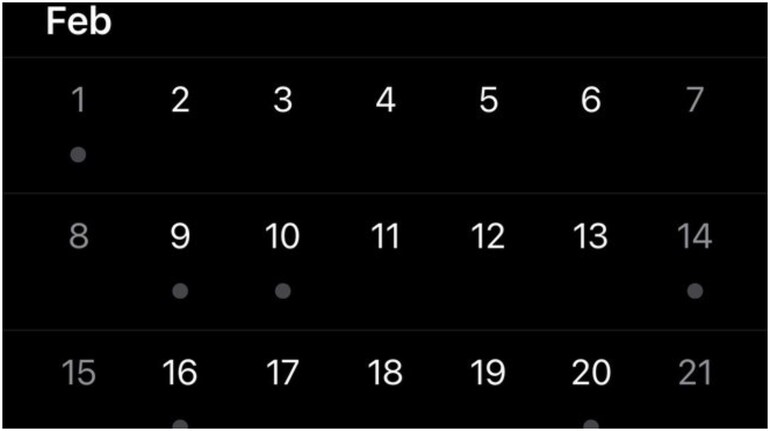
Discussion on social media platform X recently focused on an upcoming calendar event involving February 2026, which many users described as unusually symmetrical. The interest was not linked to public holidays or any extended weekends, but to the way the 28-day month aligned with the weekly calendar structure.
In 2026, February begins on a Sunday and ends on a Saturday. As a result, the month consists of exactly four weeks, with each weekday appearing four times and no dates extending into a fifth row on the calendar. Users pointed out that this produced a clean 4×7 grid, a layout some online communities described as visually satisfying.
The configuration meant that February 2026 contained four Sundays, four Mondays, four Tuesdays, four Wednesdays, four Thursdays, four Fridays and four Saturdays. This consistency led to the informal label “Perfect February”, which gained traction across posts, screenshots and memes shared on X.
Several users remarked that the alignment made the month appear unusually ordered. One wrote, “This year is gonna have the perfect month, and that is February. Everything balanced.” Another posted, “February 2026 is a perfect rectangle. This is the most satisfying calendar I’ve ever seen.” A third joked, “So if my New Year’s diet fails in January it’s okay because February is the perfect month to start.”
this year we get something that I like to call the perfect february pic.twitter.com/ZTz3g0NXri— ugh (@ughfinewhatever) January 5, 2026
February 2026 is a perfect rectangle. This is the most satisfying calendar I've ever seen pic.twitter.com/66mOYCT29w — Sachin (@sachinnxkr) January 5, 2026
This year's February is literally perfect. pic.twitter.com/Gt4WQbCwCe— Lifestyle Spicer (@lifestylspicer) January 7, 2026
The discussion also revived references to earlier instances of similar calendar arrangements. In 2015, an X user with the handle @smartereveryday had drawn attention to the same phenomenon. Sharing an image of February that year, the user wrote, “This month fits perfectly into 4 week rows on a calendar because Feb 1 is Sunday. This won’t happen again until 2026.” The post was widely shared at the time and resurfaced during recent discussions.
This month fits perfectly into 4 week rows on a calendar because Feb 1 is Sunday. This wont' happen again until 2026. pic.twitter.com/CMwVRTeuX5 — Smarter Every Day (@smartereveryday) February 1, 2015
The same user had noted that the calendar alignment would recur in 2026, which prompted renewed interest once users realised the date was approaching. According to online posts, the next comparable alignment after 2026 would occur in 2037, followed by another in 2043.
Further analysis of the pattern was credited to a Reddit user, u/dstaley, who examined the recurrence of such February layouts on the r/oddlysatisfying forum. The user outlined what was described as an “11–6” cycle, identifying alternating gaps of 11 years and six years between these symmetrical Februaries. According to the post, the sequence continued repeatedly between 2015 and 2100, producing intervals such as 11 years, 11 years, six years, and then repeating.
The Reddit post stated, “This happens in a pattern of 11 years twice, and then 6 years once, and then repeating. So that means that it will happen 11 years after 2015, 11 years after 2026, and then 6 years after 2037, and then the cycle repeats.”
While enthusiasm around February 2026 was widespread, not all users agreed on what constituted a “perfect” calendar month. Some argued that true symmetry should begin with Monday rather than Sunday. One user wrote, “I’m sorry, but the perfect February starts on a Monday, like this,” alongside an alternative calendar layout.
Im sorry, but the perfect February starts on a Monday, like this https://t.co/138kYIdiKgpic.twitter.com/ZPRujb2Ust— harry (@ITalk21) January 5, 2026
The disagreement highlighted differences in how weeks are structured globally. According to data from timeanddate.com, whether Sunday or Monday is displayed as the first day of the week varies by country. The website noted that around 67 countries, representing more than four billion people, treat Sunday as the start of the week. Approximately 160 countries, accounting for roughly 3.3 billion people, observe Monday as the first day.
Timeanddate.com stated, “Whether the Gregorian calendar shows Sunday or Monday as the first day of the week depends on where you live. Most countries start the week on Monday, but most people start on Sunday.” It added that the global split was relatively even.
Because of these regional differences, the symmetrical appearance of February 2026 would only be visible in calendars used in countries where Sunday appeared in the first column. Users in the United States, Canada, India, Pakistan, Bangladesh, Japan, South Africa, Nigeria, Egypt and the United Arab Emirates would see the full four-week alignment. By contrast, users in countries such as Germany, France, Australia, New Zealand and Turkey would not, as their calendars begin the week on Monday.
Despite this limitation, online interest continued to build as users shared screenshots and comments expressing anticipation. One post read, “Perfect February: something magical is on the way.” Another stated, “This year we get something that I like to call the perfect February.”
Discover the latest Business News, Sensex, and Nifty updates. Obtain Personal Finance insights, tax queries, and expert opinions on Moneycontrol or download the Moneycontrol App to stay updated!
Find the best of Al News in one place, specially curated for you every weekend.
Stay on top of the latest tech trends and biggest startup news.




