Moneycontrol PRO
Loans
Loans
HomeNewsTrendsUnion Cabinet approves nutrient-based subsidy for financial year 2021-22

Union Cabinet approves nutrient-based subsidy for financial year 2021-22

The cabinet has also increased the subsidy for diammonium phosphate (DAP) fertilizer by Rs 700 to Rs 2,400 per bag.

June 16, 2021 / 16:37 IST
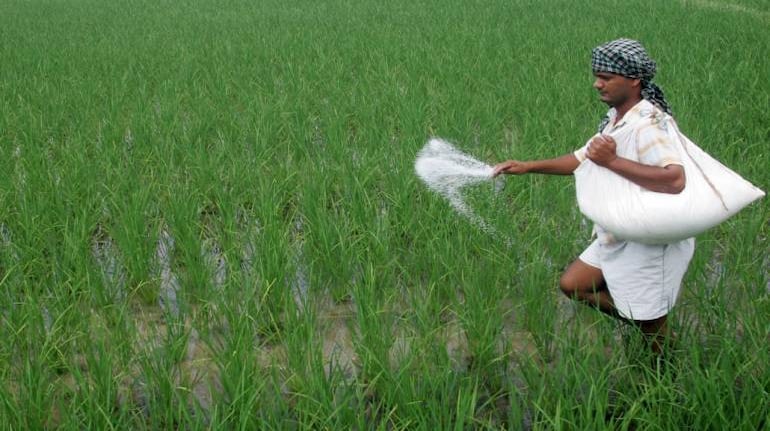
A farmer spreads fertilisers on his rice plants in Patra village in the northern Indian state of Punjab.

The Union Cabinet on June 16 approved the proposal of the Department of Fertilizers for fixation of 'Nutrient Based Subsidy Rates' for Phosphatic and Potassic Fertilizers for the year 2021-22 (Apr-Mar), Minister of Chemicals and Fertilizers Mansukh Mandaviya said at a press conference.

As part of the nutrient-based subsidy, the cabinet has approved nitrogen subsidy at the rate of Rs 18.789 per kilogram from Rs 18.90 per kilogram earlier, the government said in a press release.

Furthermore, Phosphorus subsidy has been approved at Rs 45.323 per kilogram, Potash subsidy has been approved at Rs 10.116 per kilogram and Sulphur subsidy at Rs 2.374 per kilogram.  In 2019-20 (Apr-Mar) the subsidy for Phosphorous was set at Rs 15.21 per kg, Potash at Rs 11.12 per kg and Sulphur at Rs 3.56 per kg.

The cabinet has also increased the subsidy for diammonium phosphate (DAP) fertilizer by Rs 700 to Rs 2,400 per bag.

The union government had in May announced that it would increase the fertilizer subsidy outlay for the year by Rs 14,775 crore, taking the fertilizer subsidy outlay for 2021-22 to Rs 94,305 crore from a budgeted outlay of Rs 79,530 crore.

COVID-19 Vaccine

Frequently Asked Questions

View more
How does a vaccine work?

A vaccine works by mimicking a natural infection. A vaccine not only induces immune response to protect people from any future COVID-19 infection, but also helps quickly build herd immunity to put an end to the pandemic. Herd immunity occurs when a sufficient percentage of a population becomes immune to a disease, making the spread of disease from person to person unlikely. The good news is that SARS-CoV-2 virus has been fairly stable, which increases the viability of a vaccine.

How many types of vaccines are there?

There are broadly four types of vaccine — one, a vaccine based on the whole virus (this could be either inactivated, or an attenuated [weakened] virus vaccine); two, a non-replicating viral vector vaccine that uses a benign virus as vector that carries the antigen of SARS-CoV; three, nucleic-acid vaccines that have genetic material like DNA and RNA of antigens like spike protein given to a person, helping human cells decode genetic material and produce the vaccine; and four, protein subunit vaccine wherein the recombinant proteins of SARS-COV-2 along with an adjuvant (booster) is given as a vaccine.

What does it take to develop a vaccine of this kind?

Vaccine development is a long, complex process. Unlike drugs that are given to people with a diseased, vaccines are given to healthy people and also vulnerable sections such as children, pregnant women and the elderly. So rigorous tests are compulsory. History says that the fastest time it took to develop a vaccine is five years, but it usually takes double or sometimes triple that time.

View more
Show

However, the move to reduce subsidies on non-urea fertilizers is expected to reduce the burden of increasing the subsidy on DAP fertilizers.

 The decision by the government comes at a time when it had asked the fertiliser industry to maintain retail prices of fertilizers at “reasonable” levels, as the cost of their raw materials and imports surged due to an uptick in global commodity prices.
The move by the government is expected to help bring down the cost of DAP fertilizers. While the government has already asked all the fertilizer companies to sell their old stocks of DAP fertilizer at the old prices only.
The new subsidies announced are expected to keep the maximum retal prices of DAP and other fertilizers at last year's level till the present Kharif season, the government siad.
  Apart from this, the Union Cabinet also gave its approval to the proposal by the Ministry of Earth Sciences on 'Deep Ocean Mission', aiming to explore deep ocean for resources and develop deep-sea technologies for sustainable use of ocean resources.

The cabinet also approved the Inland Vessel Bill.

first published: Jun 16, 2021 04:37 pm

Discover the latest Business News, Sensex, and Nifty updates. Obtain Personal Finance insights, tax queries, and expert opinions on Moneycontrol or download the Moneycontrol App to stay updated!

Subscribe to Tech Newsletters

  • On Saturdays

    Find the best of Al News in one place, specially curated for you every weekend.

  • Daily-Weekdays

    Stay on top of the latest tech trends and biggest startup news.

Advisory Alert: It has come to our attention that certain individuals are representing themselves as affiliates of Moneycontrol and soliciting funds on the false promise of assured returns on their investments. We wish to reiterate that Moneycontrol does not solicit funds from investors and neither does it promise any assured returns. In case you are approached by anyone making such claims, please write to us at grievanceofficer@nw18.com or call on 02268882347