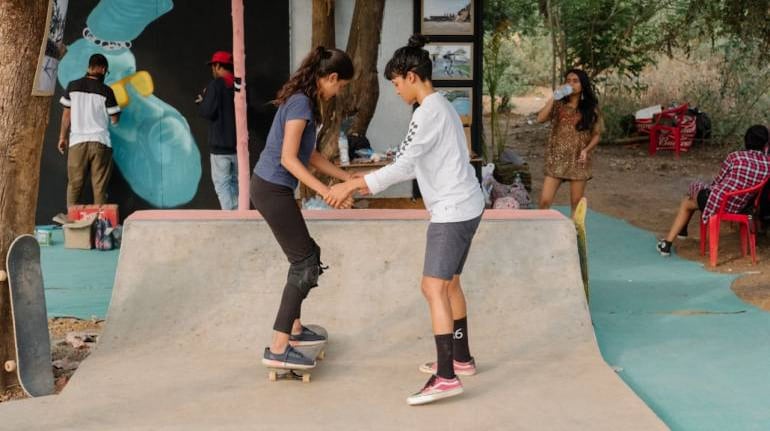
Atita Verghese breaks into a little laughter when I tell her why I am calling. “You are not the first one to ask me if I know about this film,” she says about Skater Girl, which follows the life of a village girl in Rajasthan as she discovers skateboarding and fights gender norms and poverty to go, compete at a national tournament.
Just released on Netflix, Skater Girl is touted as India’s first feature film on skateboarding, a freestyle sport that is played by 3,000-4,000 children and young adults in the country today, a coach tells Moneycontrol.
Skater Girl is not Verghese’s story (“I am doing a cameo in the film alongside other skateboarders from India,” she says). Yet it is difficult to not think of her as you watch the trailer. The 27-year-old from Bengaluru is the face of girls and women skateboarding in India.
Verghese was 19 when she first stepped on to the deck of a skateboard, which her friend had lent her. This was 2012, when there were no more than 10 skateboarders in India, and surely no female skateboarders.
Thereon, Verghese has co-built four skate parks and a handful of other skate spots in India. She has taught the newbies, and played a part to bring this underground sport out in the open. By 2018, she became the first Indian to join American skateboarding brand Vans' team of athletes.
Since 2015, Verghese has been running an online platform called Girl Skate India, which holds skateboarding workshops and tours for girls and women from all backgrounds. She has taught in the IT city of Bengaluru as also in Janwar, a village of thatched huts and dusty roads in Madhya Pradesh - the challenge of bringing girls into a ‘boy’s sport’ apply everywhere.
“In Bengaluru, parents send their girls to skate parks easily but they may not want them to stay outside for long hours. And without practice, they can’t make progress in the sport,” Verghese says over a call from Goa, where she is currently staying.
“On the other hand, in Janwar, we had to go door-to-door to convince, actually beg, the parents to send their girls to the skate park, which is just down the road in their own village," Verghese says. "Male members were a big obstacle. ‘Who will make rotis?’ they would ask us. But we did not take ‘no’ for an answer and managed to get 40 girls to play in the skate park for two hours.” A few parents followed and stood at the edge of the park, watching their girls, “even the shy ones”, go down the slope on a plank of wood and fly in the air with abandon.

It was the same euphoria at the Kovalam skate club in Kerala, where she had gone to teach young girls as part of India’s first all-female skateboarding tour in 2015. “They were smiling ear-to-ear. It was hard to stop them,” Verghese remembers. In a heartening development, two teenage girls, who come to this club from a fishing community nearby, have won gold medals at the national level. They even feature in Skater Girl, their coach Vineeth Vijayan says.
Vijayan is concerned, though. He isn't sure about how long the girls' parents might let them skate - their national level gold medals notwithstanding. “'The girls have hit puberty, and now they are expected to stay at home and help in the kitchen or they won’t find a husband easily',” is what the parents tell him.
Verghese, on the other hand, was fortunate to have the support of her feminist mother, who loves sports herself. She let her fall, get up and embrace skateboarding over other games.
If you haven't heard of Verghese competing in tournaments despite nine years on the skateboard, the reasons were beyond her control. “When I started out, skateboarding wasn’t even a thing in India. So I never thought of being a contest skater. I am into this for the joy of it and I want to develop the skateboarding scene,” Verghese says.
Skateboarding is making its debut at the Summer Olympics in Tokyo this year. Verghese points out that the Olympics are highly competitive, and “India doesn’t have the infrastructure to match what some Asian countries have.”
“I would like to organise more skateboarding workshops, and for free. But either the cities and towns don’t have skate parks, or they are expensive to rent, which I can’t afford without sponsorship,” Verghese adds.
In a major upset, the Roller Skating Federation of India (RSFI) could not send its skateboarding athletes for Olympic qualifiers in Iowa and Rome because of the pandemic.
Skateboarding coach Anubhav Vijayvargiya, who served as a judge for the national qualifiers held in Chandigarh in April 2021, says, “Around 120 skateboarders from nine to 26 years of age had come, but then the second wave had started peaking and flights were called off.”
On the upside, Vijayvargiya says, “The ratio of boys to girls was 60:40 at the 2018 national level games. This year, it was 70:30.”
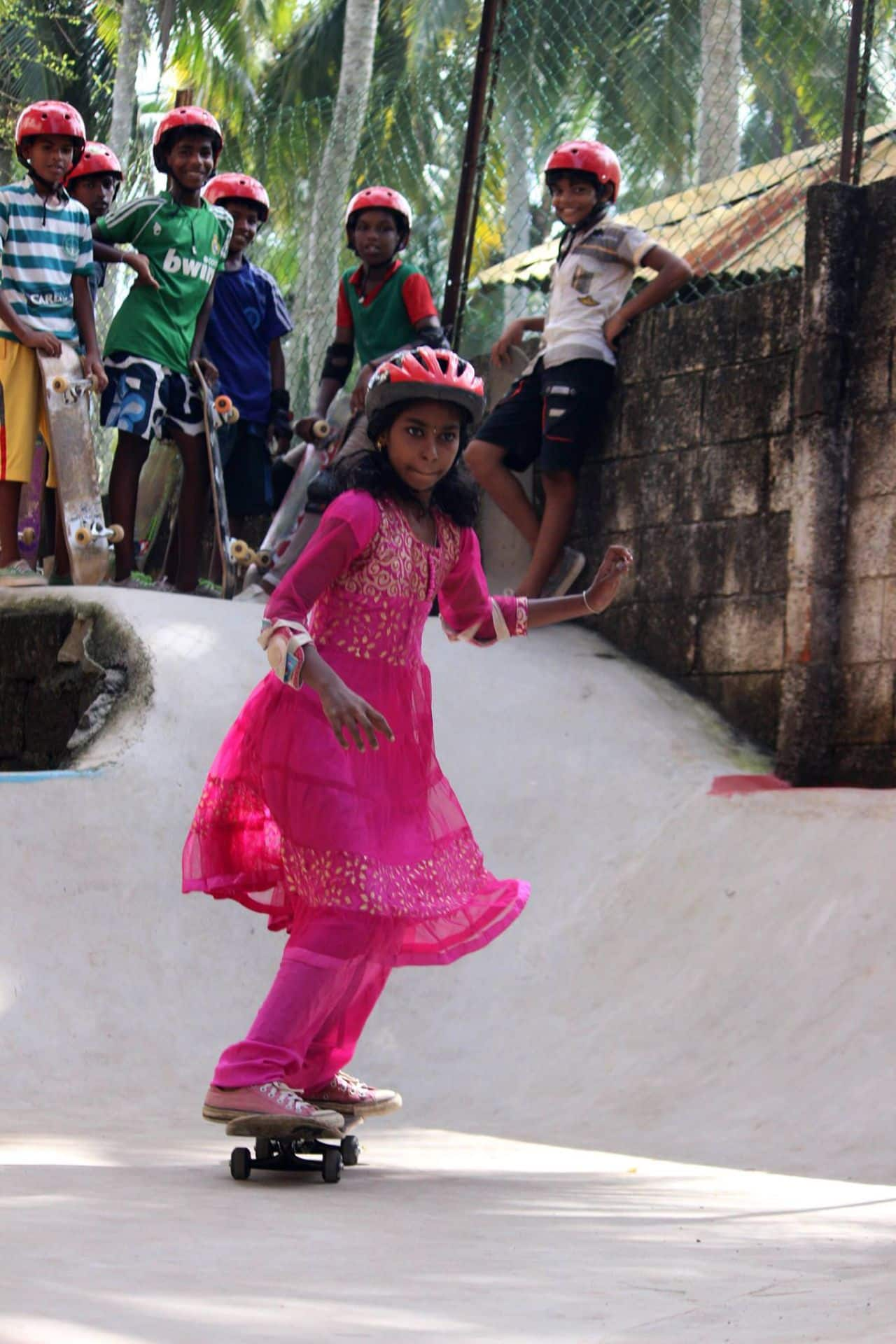 2015 photo of a girl during an all-female skateboarding tour in Kovalam. Verghese was one of the trainers on this tour.
The pandemic has put the brakes on outdoor sports in India, and the skateboarding community is concerned. “We have opened our (Kovalam) skate club for only two months or three since the coronavirus hit,” Vijayvargiya explains.
Verghese concurs. “To get better at skateboarding, you need to do it often, you need to travel to different spots to try out different spaces and elements, and you need to skate with different skateboarders,” she says.
She is “itching” to go skateboarding too but is making her peace with surfing in Goa at the moment. “I am happy as long as I am on some board,” she says as she pivots our chat back to the beauty of skateboarding.
“You can do it all by yourself. You need to be physically and mentally present in the moment to execute a trick. And when that happens, it makes you confident. Confidence is a valuable skill set to have in anything. Nobody will serve that to you on a platter," Verghese says.
"I want girls to believe in themselves,” Verghese says.
Girls in sportsA 2020 BBC survey showed that fewer than 30% of Indian women in the survey played any sports, 69% gave up sports after school, and married and divorced women played even less than those who were single. The top reasons cited in the survey were
Other findings of concern were: 18% had watched women’s sports in person (versus 24% for men’s sports), 30% felt women's sports were not entertaining to watch, and 80% could not name an international female player.
More girls can be brought into sports when families start believing in the value of sports itself, says Krish Iyengar, head of Sportz Village Schools, which imparts physical education to a thousand government schools in India and 500 private ones.
“Instead of asking your child ‘Did you win the tournament?’ ask ‘Did you have fun?’, and this can build their interest in that activity,” Iyengar says.
But for this to take off, India needs to invest in sports infrastructure at the school level and drive more gender-neutral programmes like Khelo India Youth Games, Iyengar adds. Above all, he emphasises, “we need to have more female coaches to train with and look up to as role models."
And Verghese is one such coach and role model for Indian skateboarding.
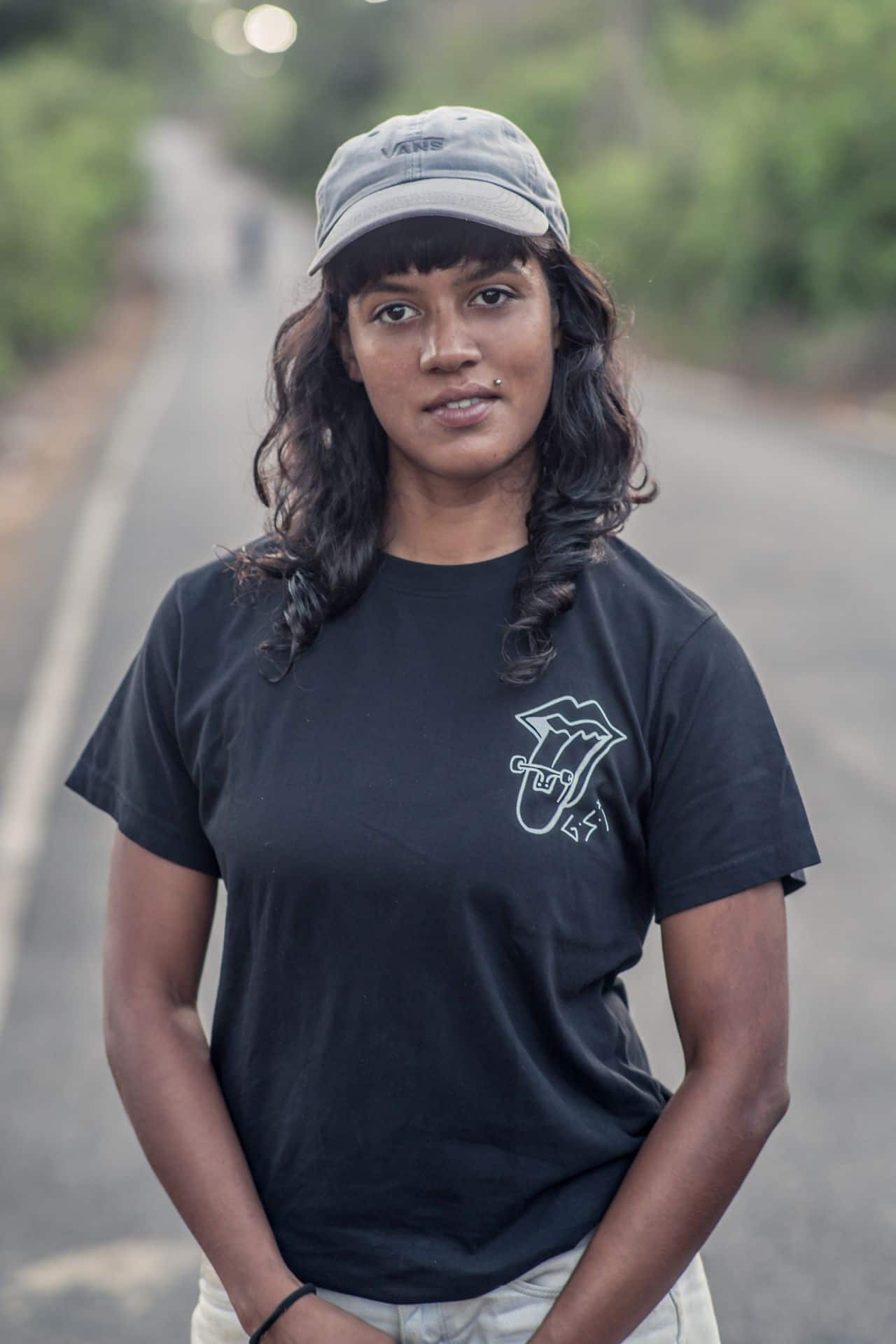 Atita Verghese started Girl Skate India to encourage more females to take up this - now Olympic - sport.
 Discover the latest Business News, Sensex, and Nifty updates. Obtain Personal Finance insights, tax queries, and expert opinions on Moneycontrol or download the Moneycontrol App to stay updated!
Find the best of Al News in one place, specially curated for you every weekend.
Stay on top of the latest tech trends and biggest startup news.