






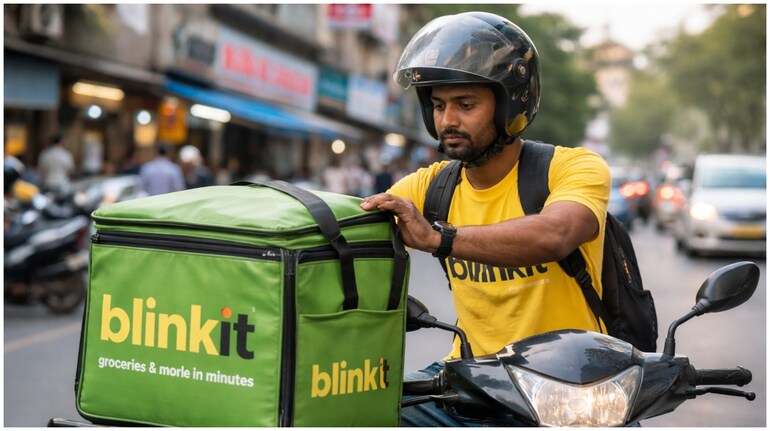
Quick-commerce services have become an everyday fixture for many urban Indians, reshaping how groceries and household essentials are bought and reducing the need for advance planning. For marketing professional and YouTuber Saloni Srivastava, however, being cut off from these platforms for several months prompted a deeper reflection on how instant delivery has altered daily behaviour, labour dynamics and expectations of convenience.
In a detailed Instagram post, Srivastava recounted her experience of living without platforms such as Blinkit and Zepto for nearly five months after moving from India to France. She made it clear that the shift was not ideological. “This wasn't because I am a cool person with an impressive moral backbone,” she wrote, adding that such services were simply unavailable in her new environment.
Before relocating, Srivastava said ultra-fast delivery had blended so seamlessly into her routine that it felt indispensable. Groceries, snacks and last-minute items could be ordered at any hour, removing the need to anticipate future needs. “It felt normal — necessary even,” she noted, adding that she had never paused to question the system while using it.
That changed after her move to France, where retail follows strict operating hours and most shops shut entirely on Sundays. As a result, she was forced to plan meals in advance, prepare shopping lists and adjust to a slower pace of consumption. Initially, she said, the prospect felt daunting. However, over time, the routine became manageable. What she thought would be exhausting turned out to be perfectly fine, she wrote.
The absence of instant delivery led her to reconsider the role such platforms play in shaping consumer habits. She argued that quick-commerce does more than offer convenience — it removes the need for foresight altogether. According to her, the promise of ten-minute delivery encourages impulsive decisions and eliminates planning from everyday life.
With distance, Srivastava also became more conscious of the labour required to sustain such speed. At the same time, she acknowledged that these platforms did not emerge in India without reason. Poor walkability, traffic congestion, broken footpaths and long working hours make even basic errands difficult in Indian cities, she said, allowing quick-commerce services to fill a genuine gap.
She rejected simplistic narratives that portray such companies as inherently exploitative, noting that they have created employment on a scale the state has failed to match. What was initially promoted as flexible, part-time gig work, she argued, has become a primary source of income for millions of households. “For many delivery workers, this is not one option among many — it is the only option,” she wrote.
Srivastava drew attention to working conditions faced by delivery partners, including the lack of access to clean toilets, upfront payments for uniforms, and intense pressure to meet rigid delivery timelines for modest pay. She contrasted this with white-collar gig work, arguing that similar demands would be immediately flagged as unacceptable if imposed on corporate employees.
She also questioned comparisons with gig economies in developed countries, where delivery work is often taken up by students or salaried workers seeking additional income. In India, she said, such work is rarely supplementary and instead reflects deeper structural failures in employment and urban planning.
According to Srivastava, these platforms appeared impressive and necessary while she lived in India because they addressed problems consumers encountered daily. “They seemed modern and efficient because they filled gaps created by weak infrastructure and limited job opportunities,” she wrote, adding that proximity had made it difficult to see the broader costs.
Now living without quick commerce, she said her life has become slower but not harder. Planning meals, adapting when ingredients run out, and accepting minor inconveniences no longer feel like sacrifices. Instead, she argued that ultra-fast delivery creates a false urgency, the burden of which is carried by delivery workers navigating unsafe roads, pollution and tight deadlines for minimal compensation.
While she said she was not opposed to delivery services altogether, Srivastava questioned whether extreme speed was truly necessary. She pointed out that consumers managed with next-day delivery until recently and argued that emergency response — not groceries — should be the domain of ten-minute timelines.
She concluded by urging consumers to reflect on what has been normalised in the name of convenience, suggesting that small changes in behaviour, such as planning ahead, could reduce pressure on workers without significantly affecting daily life. “The real question,” she wrote, “is who pays the price when convenience becomes non-negotiable.”
Discover the latest Business News, Sensex, and Nifty updates. Obtain Personal Finance insights, tax queries, and expert opinions on Moneycontrol or download the Moneycontrol App to stay updated!
Find the best of Al News in one place, specially curated for you every weekend.
Stay on top of the latest tech trends and biggest startup news.




