






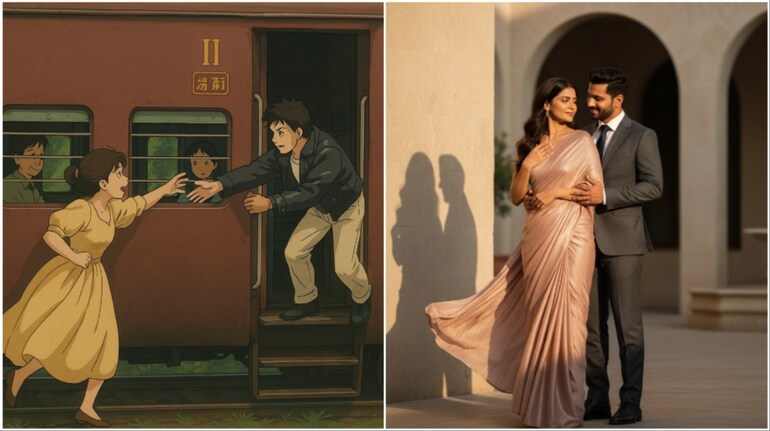
OpenAI’s GPT‑4o image generator “broke the internet” this year as social feeds flooded with hand‑painted, Studio Ghibli‑style portraits; Google’s Gemini “Nano Banana” edits then pushed glossy retro saree looks and 3D figurine aesthetics into the mainstream. South Asia—and India in particular—was at the heart of this shift. Here’s how the twin trends took over, and why privacy and provenance now dominate the conversation.
Ghibli goes global
OpenAI’s native image generation in GPT‑4o sparked the “Ghiblification” wave after its March 25 roll‑out, with users simply uploading a picture and prompting ChatGPT to “turn this into a Studio Ghibli version.” Sam Altman’s public posts about surging demand—and a temporary cap for free users—underscored the scale.
New OpenAI image generation has no celebrity filter!! pic.twitter.com/IWEC1mQjOF— Deedy (@deedydas) March 26, 2025
The moment: Social platforms were awash with dreamy, watercolor backgrounds and expressive, anime‑like characters; Indian timelines saw weddings, childhood photos and even Bollywood scenes reimagined in soft pastels.
Nobody asked for Bollywood movie scenes in Ghibli style — but here they are. pic.twitter.com/umiDAA7LNu — Vivek Choudhary (@ivivekch) March 26, 2025
Ghibli's strain on OpenAI
During this time, Altman told users “our GPUs are melting,” and hinted at rate limits as ChatGPT images eclipsed expectations. Moreover, reports indicated ChatGPT began refusing some Studio Ghibli‑style prompts amid copyright and living‑artist concerns—even as OpenAI said it permits “broader studio styles.”
Context, not invention
Studio Ghibli’s signature look—hand‑drawn warmth, soft light and magical realism—comes from decades of work by Hayao Miyazaki and Isao Takahata. Fans resurfaced Miyazaki’s long‑standing criticism of AI art as an “insult to life itself,” intensifying ethical scrutiny even as the trend grew.
Nano Banana and India's retro saree moment
Google’s Gemini “Nano Banana” turned selfies into cinematic portraits—black chiffon against moody shadows, translucent polka dots with sunset glow—propelled by detailed prompts and quick local edits. The model also kept facial features consistent across edits, enabling seamless 90s‑style transformations that dominated Instagram.
Grace in every glanceGoogle Nano Banana on Google AI studio for you { "Objective": "Create an elegant romantic editorial image of a couple posing together — the woman in a modern saree showing midriff tastefully, and the man in a formal suit — exuding connection and… pic.twitter.com/Fvn64dYUJF — Smiling Khan (@AIwithkhan) November 9, 2025
How it works and why it clicked
Users accessed Gemini’s image editor, uploaded a solo photo, and applied richly descriptive prompts; recent updates added draw‑to‑edit markup and expanded SynthID verification to videos. The tool blended nostalgia with personalisation—reliable character consistency, style transfers, and pro‑grade controls (lighting, angles, legible text) in Nano Banana Pro.
Safety and copyright: What changed in 2025
Gemini embeds an invisible SynthID watermark into images and now checks videos for the same, aiming to signal AI provenance. Experts warn watermarking can be removed, forged, or bypassed; the consensus is clear—use watermarks, but don’t rely on them alone.
Reality Defender CEO Ben Colman has cautioned that real‑world watermarking “fails from the onset” without broad adoption and complementary detection. UC Berkeley’s Hany Farid argues watermarking must be paired with forensic methods; “Nobody thinks watermarking alone will be sufficient.”
Data rights go mainstream
Privacy groups and security analysts say uploads to AI tools can feed training datasets or be repurposed beyond user expectations. Proton’s guidance highlights risks—from re‑identification to third‑party sharing—and urges minimising sensitive uploads, stripping metadata, and using official platforms.
India’s cautionary notes
As the saree edits surged, Indian authorities and cyber experts warned about fake Gemini clone sites harvesting data. IPS officer VC Sajjanar posted a public alert, urging users to avoid third‑party apps and reminding that “with just one click” money can be siphoned by criminals.
Breaking:Google Gemini Nano Banana AI saree images: prompts to create retro saree looks. •Prompt Convert the uploaded image into a stunning 4K HD portrait. The subject should have long, dark, wavy hair cascading over her shoulders. pic.twitter.com/Xdfxb9Y0LT — AIGeniusHub (@satyam_jha_07) September 15, 2025
The cultural takeaway: accessibility drove the wave
Both GPT‑4o and Nano Banana removed friction—no design training needed; a prompt (or a quick sketch) delivered cinematic outputs. That accessibility turned casual experimentation into mass participation, from boxed action‑figure edits to soft‑focus saree portraits and Ghibli‑style family albums.
After Google’s Gemini upgrades—including draw‑to‑edit and video SynthID—OpenAI responded with faster, more controllable ChatGPT Images (GPT‑Image‑1.5) and a dedicated image workspace, signaling an arms race in consumer‑friendly editing and provenance.
Practical checklist for users
1.) Use official apps (ChatGPT, Gemini); avoid clone sites and unverified third‑party tools.
2.) Limit sensitive uploads; remove EXIF/location metadata before sharing.
3.) Verify provenance when possible (SynthID in Gemini; C2PA labels where supported). Treat watermarks as signals, not guarantees.
4.) Respect creators & rights: Avoid prompts that explicitly mimic living artists; expect moderation variance as platforms navigate style boundaries.
The bottom line
2025’s viral images weren’t only about aesthetics—they marked a mainstream shift in how people author, edit and authenticate visuals. The Ghibli and Nano Banana waves proved that AI‑assisted styles can be joyful, personal, and culturally resonant; they also forced a reckoning with data consent and the limits of technical labels. Expect more tools, better guardrails—and continued pressure to make creativity safer without dimming the magic that drew users in.
Discover the latest Business News, Sensex, and Nifty updates. Obtain Personal Finance insights, tax queries, and expert opinions on Moneycontrol or download the Moneycontrol App to stay updated!
Find the best of Al News in one place, specially curated for you every weekend.
Stay on top of the latest tech trends and biggest startup news.




