"No one came out of their homes, everybody was afraid," says Smitha G.S. about the virus outbreak that sent waves of panic in her village, forcing people to lock the doors and stay inside for weeks. "Buses stopped plying and life was paralyzed," she adds.
An emerging artist, Smitha is talking about the Nipah virus outbreak in Kozhikode district of Kerala in 2018 that forced the state government to undertake an unprecedented health emergency response. The virus affected Kozhikode and Malappuram districts, leading to 17 deaths. The highest number of cases was reported from Perambra village in Kozhikode.
"Perambra lies close to the Atholi village where I lived," says Smitha. "The only thing everybody was thinking about then was death. The government didn't have to announce a lockdown because no one was willing to come out of their homes."
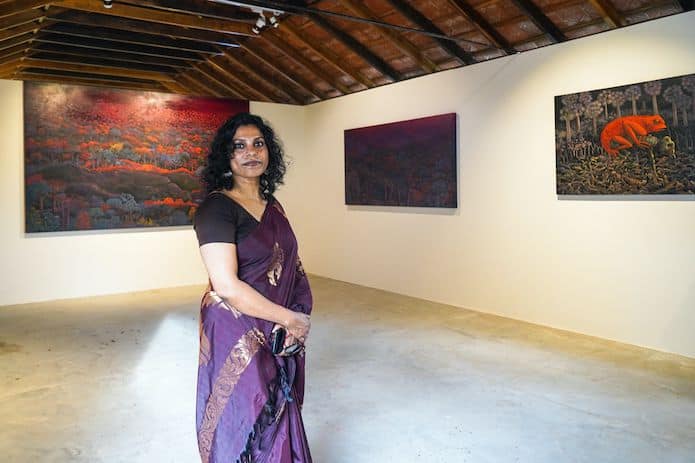 Smitha G.S. with her paintings at the Lokame Tharavadu (The World is One Family) exhibition.
Three years later, participating in Lokame Tharavadu (The World is One Family), an ongoing contemporary art exhibition organised by the Kochi Biennale Foundation (KBF) in Alappuzha, Kerala, Smitha finds striking similarities between the way the society has responded to the 2018 Nipah virus outbreak and the current coronavirus pandemic. The two virus attacks have also changed the way she works as an artist, a fact reflected in her paintings at the Port Museum venue of the KBF exhibition.
Small creatures like insects and cockroaches have a bigger focus in the artist's works, four of which are mounted at the Alappuzha exhibition. There is a dash of bright colours in the paintings, one of them ten feet long and six feet high.
"My recent works are about my village and its surroundings, forests, hills, and creatures nobody notices," says Smitha. "When we are not able to go out, images of nature come to us. Nature became more colourful when we were locked inside."
In one of her paintings, bats are seen flying through creepers. "There was a mango tree near my home and people were afraid to eat the mangoes fearing bats may have nibbled them," she says, referring to the origin of Nipah virus from fruit bats. In another, there are chameleons surrounded by trees.
During the Nipah virus outbreak, Smitha was invited to Thiruvananthapuram to participate in an event where 20 artists painted portraits of former Kerala chief minister V.S. Achuthanandan.
"The event happened at his home and he sat in a chair modelling for us," recalls Smitha. "Other artists were scared when they realised I had come from Kozhikode," she adds about the panic created by the virus outbreak in her home district.
Nearly two years later when Covid-19 came, Smitha wasn't afraid. "I wasn't afraid this time. I wasn't even listening to the news. I just immersed myself in work," she says.
The series of paintings she did about nature and the little creatures immediately drew the attention of Lokame Tharavadu curator and KBF president Bose Krishnamachari when he was selecting artists for the show. "He (Krishnamachari) came to my studio and saw the works. Later, he invited me to participate in the exhibition."
 Lokame Tharavadu is on till September 30.
"I am happy to participate in the exhibition with so many artists," says Smitha about the Alappuzha exhibition that has 267 participating artists, including famous names like Jitish Kallat, Gigi Scaria, Jalaja P.S., Parvathi Nair and K.M. Madhusudhanan.
Lokame Tharavadu, which was suspended only 12 days after its opening on April 18, resumed for public viewing on Saturday after the state government relaxed the restrictions last week. The show, which will run up to September 30, is held in colonial-era coir godowns transformed into exhibition venues.
"Smitha is a prolific and consistent artist who brings her own inventions and interpretations as a self-taught artist," says Krishnamachari. "There is a kind of magical realism and a certain surrealism in her works. There is a distinct language developed by her," he adds.
While she is soaking in all the attention from the exhibition, considered the biggest contemporary art show ever in India, it hasn't been an easy journey for Smitha. A self-taught artist, her plans of a career as an artist hit a wall after her marriage.
"My husband's family wasn't interested in art," she says. For the next seven years she didn't paint. "I wasn't sitting idle though during this time. For many years I was preparing myself in the mind to start working again."
That opportunity came when she started earning enough to buy brushes, canvas and colours. She did odd jobs, designed dresses and took drawing classes for children. A two-year diploma in painting too was achieved in the meantime. Once she relaunched her career, Smitha soon began to encourage others like her. She started a crafts school for women, training young girls to learn skills and display their talents.
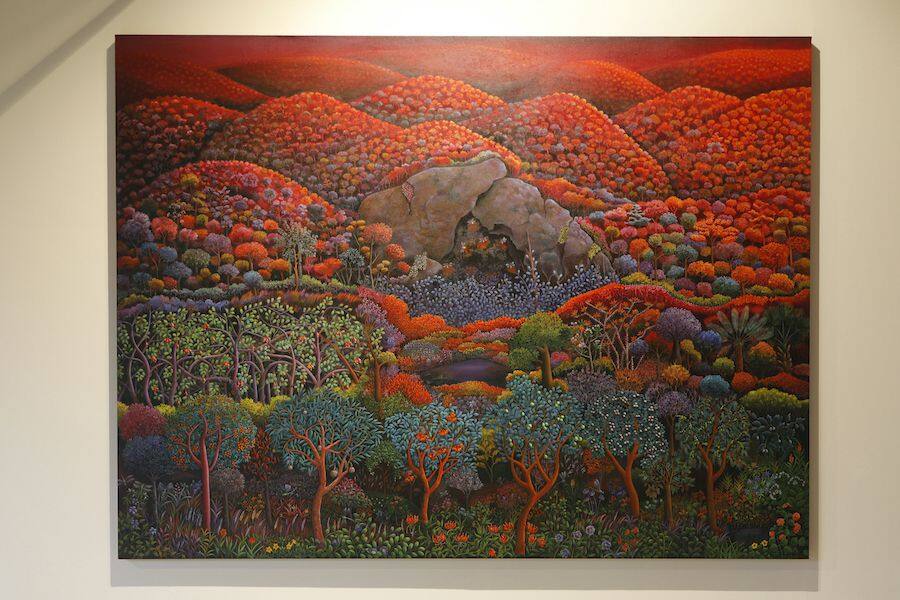
Smitha, who now has a bigger studio in Kozhikode town, is looking at continuing the spell of creativity induced by two punishing outbreaks. There has been a keen interest in her works at Lokame Tharavadu from galleries and buyers and her larger work at the show has already been sold.
"Enquiries are coming in," beams the artist. After years of locking her up inside the studio, Smitha's world has been further opened up by Alappuzha's centuries-old coir warehouses-turned-galleries.
Discover the latest Business News, Sensex, and Nifty updates. Obtain Personal Finance insights, tax queries, and expert opinions on Moneycontrol or download the Moneycontrol App to stay updated!

Find the best of Al News in one place, specially curated for you every weekend.
Stay on top of the latest tech trends and biggest startup news.