
A few weeks before the first wave of coronavirus hit India, an art gallery in one of the country's mega cities received a curious intruder: a drone with a paintbrush.
Parts of the drone and the painting brush found near one of the artworks. From this, the gallery owners concluded it was an attempted vandalism incident.
"No case was filed," says prominent art and antiquities lawyer Siddharth Mehta. "The drone with the brush was apparently sent to paint on a large sized sculpture of a human form. The brush fell off the drone during the alleged act," adds Mehta, the managing partner of the Mumbai-based law firm Mehta & Padamsey.
The Indian drone case is obviously not the first attempt - or even the most recent attempt - at art vandalism. About a month ago, a bored security guard at a gallery in Russia painted eyes onto a million-dollar art work, giving an interesting insight into the complex world of art. In December, visitors to the Yeltsin Centre in the Russian city of Yekaterinburg found eyes added to the eyeless works of Soviet avant-garde artist Anna Leporskaya's Three Figures.
Coined during the French Revolution following destruction of works of art during the late 18th century, the term vandalism is viewed as an undesired attack on creativity and freedom of expression. They can raise eyebrows and sometimes even an occasional nod, even from artists whose works have become the target.
In January this year, a decade-old mural with the words 'YOU'RE MY BUTTER HALF' commissioned by a community project in Texas, US, was vandalised by painting off the last two letters from BUTTER and improvising on HALF. Artist John Rockwell, who led the mural work, responded by rating the quality of art by the vandals on a scale of 1-10 and agreed it is in line with its original "whimsical spirit".
In 2014, British street art practitioner Greg Matcalfe sprayed a blue line over a Banksy work on Mona Lisa in London because someone dared him to. A decade earlier, Banksy, the famous British street artist, had teasingly titled his new exhibition, Crude Oils: A Gallery of Remixed Masterpieces, Vandalism and Vermin. One of his twists of the masters was a work called Show Me the Monet. A year ago, Show Me the Monet, which showed shopping trolleys and a traffic cone in Claude Monet's original The Japanese Bridge (1899), fetched $9.9 million at an auction by Sotheby's London.
"Yes, art and vandalism co-exist," says celebrated artist Ranbir Kaleka. "There are various reasons for committing vandalism. It is undesired unless it is in the form of ideas, a revolution," he adds. "If there is an act of that kind, then it is meaningful."
Kaleka remembers the story of an artist in the West who was given a grant by a museum to produce a work. "The artist thought the money wasn't sufficient. He put a blank canvas in the gallery under the title, The Artist Took the Money and Ran Away," he adds.

Last year, in North Carolina, US, some unknown people, who didn't like the quality of an ongoing art project, pitched a signboard outside. The board said: Vandalism in Progress. Kaleka also recalls the loss of a sculpture by Indian-origin British artist Anish Kapoor after it was probably mistaken for waste material while being kept in a warehouse a decade ago.
Mumbai-born Kapoor, whose Decension at the 2014 Kochi-Muziris Biennale had won huge praise, is no stranger to vandalism.
In 2015, Kapoor's 60-metre-long steel sculpture titled Dirty Corner, exhibited at the Versailles Palace near Paris, was sprayed with yellow paint by vandals. Shaped like a giant funnel, the work, dubbed 'queen's vagina', encountered vandalism twice at the same venue. Four years later, another work of the artist, this time the famous Cloud Gate in Chicago, one of the most photographed artworks, was vandalised with spray paint.
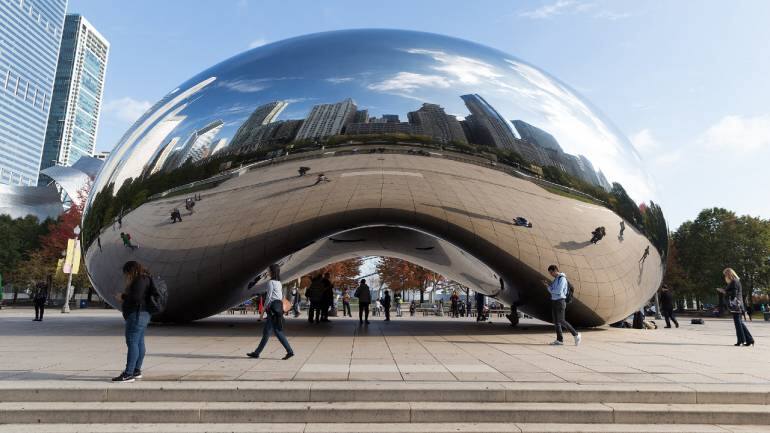 Anish Kapoor's Cloud Gate. (Photo: Mack Male via Wikimedia Commons 2.0)
Art and antiquities lawyer Mehta traces the origin of vandalism to a Germanic tribe, called Vandals, notorious for pilfering Rome in the fifth century. "This tribe always tried to chip away or destroy properties after their conquests," he says. In modern times, a teenaged boy from China did a conquest of his own in Egypt when visiting as a tourist a few years ago. He carved the words, Ding Jinhao was here, in Mandarin on an artefact at a 3,500-year-old temple in Luxor.
Delhi-based artist Gigi Scaria says the incident involving a security guard at the gallery in Russia offers sarcasm and can be considered a reflection of the society. "There is a possibility of cultural spaces becoming boring spaces," says Scaria. "While we elevate this space for cultural discourse by some, we also alienate some others," he adds. "In a literal sense, vandalism is extremely devastating for an artist."
Discover the latest Business News, Sensex, and Nifty updates. Obtain Personal Finance insights, tax queries, and expert opinions on Moneycontrol or download the Moneycontrol App to stay updated!
Find the best of Al News in one place, specially curated for you every weekend.
Stay on top of the latest tech trends and biggest startup news.