The one thing Prawin Ganeshan had in abundance when he came back to India after his masters in business management from Manchester Metropolitan University, UK, was an appetite for big risks.
Hailing from a business family in Tamil Nadu’s Tirupur, a place known for its cotton knitwear exports, Ganeshan wanted to do something unique. So in 2013, at the age of 26, just four years after India banned sex education, he opened what is arguably the country’s first brick-and-mortar sexual wellness and toys shop in the busy commercial hub of Tirupur.
“I was prepared for all kinds of backlash,” says Ganeshan, founder and CEO of Kamakart.com. Instead, the reaction he received was overwhelmingly positive. His shop became so successful that in less than two years, he opened a branch in Chennai and then another in Bengaluru. “It was rocket speed growth,” says Ganeshan who now runs a chain of 10 sexual wellness shops all over South India and one in Sri Lanka under the name Kamakart.com, selling everything from condoms to long distance app-controlled vibrators.
(He was also a co-partner in Kama Gizmos, the sexual wellness shop in Goa that was recently shuttered, allegedly over lack of a trading licence.)
His 10 sexual wellness shops now boast a combined client base of three lakh (with over a lakh repeat customers) and receive a daily footfall of 10 to 30 customers per shop. But his biggest windfall came last year, when sales reportedly spiked anywhere between 100% and 300% during the Covid-19 pandemic.
The spike in demand for sexual wellness products post-pandemic was also the highlight of a survey conducted by Thatspersonal, a sexual wellness company, last year. According to its report, sale of sex toys rose by 65% during the lockdown.
But how representative are these figures and surveys of the general population?
Of course, there are no agencies to track the sale or use of sex toys in the way that coronavirus cases are being monitored by the health ministry. Neither do we have any peer-reviewed studies to suggest that vibrators have become as common as idli makers in Indian households.
Nonetheless, what the data does tell us for sure is that if you are enlisting the service of a special friend to “take the self-guided tour”, “pet the cat”, “poach the egg”, “polish the banister”, or any other euphemism of your choice, you are not alone.
Sexual attitudes in this country are in a state of flux. According to a pan-India survey published by the Union health ministry in 2015-16, more than 90% of Indians had their first sexual experience before the age of 30. In other words, if you're over 30 when you have sex for the first time, then you belong to a minority in India.

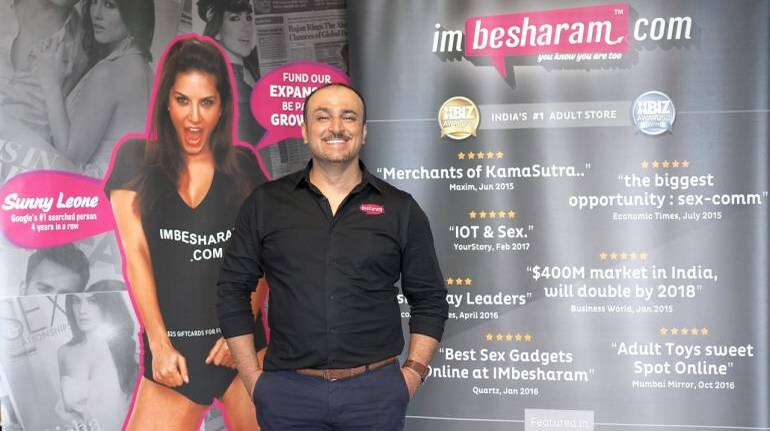
“Public perception of sex and obscenity has transitioned from the days when (actor) Aamir Khan’s kiss in Raja Hindustani was a national conversation to acceptance of pleasure as a fundamental right,” says Raj Armani, the Indian-American co-founder and chief operations officer of IMbesharam, an online adult store.
This view is also shared by Rahber Nazir, co-founder and CEO, Kaamastra, an online adult store. “Buying a sex toy is no longer scandalous in India,” says Nazir. “Customers are now looking for simpler and customised products that can cater to their needs,” he says.
IMbesharam data shows that the percentage of females among its customers has increased from 20% to 39% in the last three years. Its order totals from women too have gone up from 18% to 44% during the same period.
“More and more women are now shopping for themselves or asking their partners to shop for them,” says Armani, adding that he gets requests from couples for special gold-plated vibrators as wedding gifts.
While it’s true that movies like Veere Di Wedding (known for actor Swara Bhaskar’s masturbation scene) and Lust Stories (showing actor Kiara Advani, climaxing under the effect of a vibrator), have played a role in the growing popularity and acceptance of sex toys, doctors too are now contributing to the mainstreaming of sexual wellness products.
“Some of the sexual wellness products sold by sex toy companies like premature ejaculation sprays, lubricants and suction devices for erectile dysfunction are actually medical products,” says Dr Ajit Saxena, senior consultant and uro-andrologist at Indraprastha Appollo Hospitals, New Delhi, who specialises in treating erectile dysfunction and prostate disease. “The good thing is that they are now easily available, encouraging many young doctors to prescribe them.”
But how effective are they?
“There are cases where sprays and suction devices have worked like magic where medicine has failed,” says Dr Saxena.
The pandemic has also triggered an interest in sexuality research among Indian researchers. Articles published in various scientific journals now regularly explore the sexuality-related implications of Covid-19. For example, the Journal of Psychosexual Health, the official publication of the Karnataka Academy of Sexual Sciences, published an article on ‘Sexual Behaviour during the Times of Covid-19 Lockdown in India’, recently.
The study, based on an online survey, confirmed the claims made by sex toy entrepreneurs. That people have started adopting virtual methods, including the use of remote-controlled sex toys, for sexual gratification, due to the fear of infection from kissing and touching. The Indian Institute of Sexology, Odisha, too brought out a report on ‘The Changing Scenes of Sexuality during Pandemic’ in its India Journal of Health, Sexuality and Culture. ‘Sexuality, sexual wellbeing and intimacy...’ was the focus of another article published in the Indian Journal of Psychiatry, a peer-reviewed journal from the Indian Psychiatric Society.
Ironically, all this pandemic-induced interest in sex would have come as a surprise to many living in third century India, a period when sexual health and wellness played an integral role in people’s lives.
According to the Hindu philosophy, the pursuit of Kama (desire/pleasure) is one of the three goals of life; the other two being Dharma (religion) and Artha (money). Kamasutra, the erotic sex manual, compiled by Vatsyayana Mallanaga, a third century sexologist, philosopher and sage, is a culmination of this philosophy.
There are detailed references to sex toys in the Kamasutra, right from the materials to be used in its manufacture (gold, copper, ivory, buffalo horn, though Vatsyayana’s own preference is for wood as it “closely resembles the original”) to how it should be used, apart from acrobatic sex-positions, for which the book is famous for.
Here is what Vatsyayana had to say about sex toys:
“The sex tools should be the size of the penis, and it should be thick, with raised bumps on the outside to make it rough...When you twine around one single string of beads as much as the size allows, it is a single top knot... In the absence of these, attach to your hips, with a string... or use a smooth garland of wood, knotted and strung with many gooseberry kernels.”
Vatsyayana also dedicates an entire section to address a very modern male anxiety: how to increase the size of the penis. While you will never get to know if his methods actually worked, the fact that the Kamasutra chooses to address it, shows that the demand was high.
But then as they say, the past is a foreign country. They do things differently there.
A permissive past is of little cheer to a 21st century sex toy seller who often finds himself caught between a moralising customs officer, (intent on “saving Indian culture” from Western decadence) and an ambiguous law that can put an end to the enthusiasm of even the most determined entrepreneur.
Section 292 of the Indian Penal Code, for instance, bans the sale, advertisement, distribution and public exhibition of a book, pamphlet, painting or any other object that may deem obscene.
“Even a t-shirt with a graphical image can be illegal in India, if that image is regarded as obscene,” says Samir Saraiya, founder and CEO of Thatspersonal.
But then what constitutes obscenity? The answer to that is entirely subjective and tied to an abstract concept called morality. This means, many a time, an entrepreneur will find himself at the mercy of customs officers who have the power to determine the fate of their ‘unsanskari’ consignments.
Ganeshan of Kamakart says he loses two out of every 10 shipments to authorities that confiscate and destroys them. “Even when we follow the law, we face regular issues.”
The logistical challenges have encouraged some to explore the possibility of manufacturing sex toys in India, though not everyone seems to be gung-ho about it.
“Manufacturing sex toys in India will allow us to customise our products to the requirements of Indian consumers,” says Nazir of Kaamastra. “Some of the products which we sell currently - like adult board games and dildos - are designed to meet the sensibilities and requirements of Western customers,” he says.
For Saraiya, the challenge is not so much about setting up a manufacturing unit in India as much as the practicalities involved in making it work. “Right now it’s easier to pay import duty than doing this in India due to the sheer volume international companies can provide,” he explains.
Quality is another area of concern. “We have many suppliers for raw materials (polyurethane, silicone) in India, but the art of constructing it and the tech that will be used in operating the products, that’s a hill we have to cross,” says Armani. “We are scouting for experienced local manufacturers and are hopeful that our ambition will see the light of day soon,” he says.
That’s indeed a giant leap for someone whose only prayer, 10 years ago, was not to get arrested when he landed at the Mumbai airport for the ‘crime’ of running a sex toy business.
Discover the latest Business News, Sensex, and Nifty updates. Obtain Personal Finance insights, tax queries, and expert opinions on Moneycontrol or download the Moneycontrol App to stay updated!
Find the best of Al News in one place, specially curated for you every weekend.
Stay on top of the latest tech trends and biggest startup news.