
Richard Rumelt, an influential thinker on strategy and management who taught at Harvard Business School and INSEAD in France, is now the Harry and Elsa Kunin Chair Emeritus at the UCLA Anderson School of Management.
His latest book titled The Crux: How Leaders Become Strategists (2022) is about the importance of determining “which issues are truly important and which are secondary”, assessing the difficulties involved in tackling these issues, and then focusing one’s resources on challenges that are most “addressable”, having a good chance of being solved through “decisive, coherent action”.
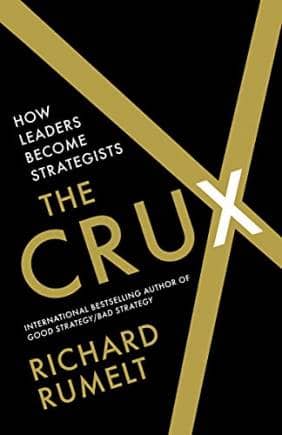 We bring you five key takeaways from this book, demonstrating how this process works.
According to Rumelt, a clear-headed diagnosis of issues within an organization is often hindered by a strong belief that “leadership means emphasizing the positive and hiding the negative”. What can help fix such a situation is asking elementary, non-judgemental questions such as “Why is this difficult?” to understand the fundamentals that might be overlooked. This approach draws out areas in which people require support. Sometimes, they open up only to outsiders who promise confidentiality. Rumelt notes, “Diagnosis is basically a process of focusing on challenges and asking ‘what’ and ‘why’ over and over again.”
2. Don’t start with goals.Rumelt points out that “misunderstanding the relationship between goals and strategy” can cause frustration in strategy retreats. When a value is expressed as a goal, it demands a set of actions. Decisions made without a proper diagnosis, only on the basis of a goal that is proclaimed, lack a solid foundation. According to Rumelt, an arbitrary goal is disconnected from reality. It is not in tune with challenges and opportunities. A “good goal” must resolve ambiguity. It may not be agreeable to all but should be “one the organization knows how to achieve or can be expected to work out how to achieve” by making well-defined choices.
3. Create a strategy instead of picking one.The author believes that leaders who are skilled at strategizing tend to have a “nose” for what is vital, and they like to channelize their energy in that direction. They do examine data, and go through the analysis that is available, but they prioritize critical challenges without getting side-tracked. This focus keeps them from squandering their time looking up “some popular list or consultants’ matrix”. They do not see strategy as “a fixed description” of the future. They see strategizing as being attentive to challenges and opportunities arising on the ground.
4. Understand the difference between strategy and management.This book cautions us that getting employees to meet their targets is “management work, not strategy work.” Managers work on execution, on ensuring that things are done. Strategists come in before that. Neither of them is more or less important but we must acknowledge that strategizing must precede the work of driving results. As Rumelt explains, “A collection of goals or metrics is not a strategy. A strategy is a reasoned argument about the forces at work in a situation and how to deal with them. Don’t let the metrics drown out thought.”
 (Image via Twitter/RichardRumelt)5. Don’t confuse current financial results with strategy.
Rumelt draws attention to the fact that “current earnings are the harvest of investments and actions taken in the past, sometimes by generations long gone” and it is, therefore, unwise to think that profits being made are “simply the result of hard work by today’s managers and employees”. While this sounds like common sense, it is also quite easily ignored. The author wants to drive home the point that excessive dependence on short-term performance metrics can be misleading. They take away from time and energy that could be devoted to strategy.
Discover the latest Business News, Sensex, and Nifty updates. Obtain Personal Finance insights, tax queries, and expert opinions on Moneycontrol or download the Moneycontrol App to stay updated!
Find the best of Al News in one place, specially curated for you every weekend.
Stay on top of the latest tech trends and biggest startup news.