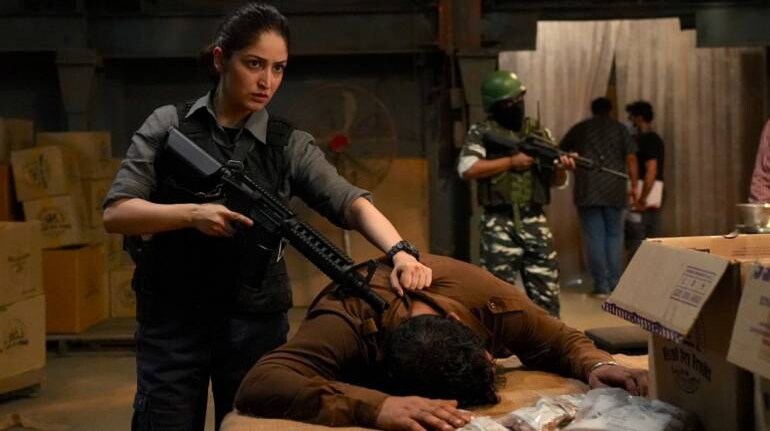
“This terrorism isn’t about freedom. It’s about money,” Zooni, the defamed intelligence officer put on a punishment posting, screams through the thick air of bureaucracy, in a scene from Article 370. Played emphatically by Yami Gautam, Zooni is more than just a committed officer trying to champion an unlikely political mission. She is also a Kashmiri, stung by the tentacles of what is consistently positioned as a crippling systematic contraption. The film reads it as a law so unequivocally against the good of the state’s people, it has practically held back development, progress and maybe even intellectual enlightenment. Regardless of political interpretation, the abrogation of just about any 70-year-old law represents a monumental occasion. And though large parts of that moment transpired in the Parliament, this film makes a convincing effort of representing it on the streets and in the violent alleyways of Kashmir.
Yami Gautam is Zooni, a no-nonsense intelligence operative on the heels of popular local leader Burhan Wani. Zooni is nursing valley-induced wounds of her own. Her father was wrongfully framed for a bank scam that he was actually trying to expose. His subsequent suicide, a local politician holds against her as a sinister method of intimidation. Zooni thus doesn’t believe in social correction as much as she believes in directly intercepting threats. She doesn’t have time nor the diction, for politeness. Everything she is trying to doing on the streets of Kashmir, is somewhat echoed by her bureaucratic echo, Rajeshwari, played by an equally steadfast Priyamani. Though Rajeshwari doesn’t get a backstory of her own, she represents the bureaucracy’s unwavering, unsentimental gaze. Little is spoken between the two, but a lot is implied. Rajeshwari gives Zooni a second lease of life.
Zooni’s rush to catch Wani has unleashed a wave of unrest that culminates in the Pulwama incident. An incident that has now been adapted to cinema in a variety of ways. Here it becomes the pivot of a film that though it starts out as a nifty military thriller, expands into a bureaucratic game of chess and myth-busting. Without the stamp of authority, no bullet fired, calculated or in haste, can ever translate to anything other than noise. Scrapping Article 370 is thus billed as this moment of liberation, that a trapped valley has been seeking for one of the longest grieving periods in history.
Both women - Zooni and Rajeshwari - take the lead on either side of a socio-political battle that we know will culminate in the obvious. In terms of premise, at least, it sounds like an unenviable task, turning the purging of a debatable provision into cinema but Gautam, Priyamani and co just about collate enough fictional catalysts and performances to pull you into a story that is essentially, an act of clearing the wreckage of years past.
Directed by Aditya Suhas Jambhale and co-written by Aditya Dhar (director of URI and Gautam’s husband) Article 370 is as its finest when it behaves like an actioner. Dhar’s precise handling of battle sequences, gun-fighting and combat are reproduced with equal detailing, conviction and visual flair here. There is, however, a fair amount of verbal juggling, before the trigger is actually pulled because unlike URI, this film has a somewhat sobering commitment to also explain itself. Presentations are therefore summoned, history annotated and voiceovers (by Ajay Devgn) lay the groundwork for a narrative that can also feel bogged down by its own analytical obsessions.
The way through the constitutional puzzle box, is therefore turned into a bit of an excavation which though impressive as a creative feat, belongs in a more sophisticated film (maybe even a documentary). It’s this jarring inequality between the nerve-wrecking action on the streets and the laidback bureau-ticking within parliamentary offices that both holds the bag and unexpectedly lets it drop. Considering we know how it ends, at almost three hours long, the film’s a bit of a slog to follow.
As a rousing love letter to a political moment that the creators obviously feel for, the film is a terrific, if somewhat overlong tribute. As a cinematic experience, it’s somewhat overstuffed by the need to show, tell and also explain. The performances are impressive, with Yami Gautam given the length and breadth of the screen to settle into. And though she delivers as an opaque but vulnerable hook, maybe more could have been done by limiting this exercise in equipping an event with its origin story by focusing on her alone. In fact, you wouldn’t mind seeing a lot more of Zooni in a film that tasks itself with one mission too many.
Article 370 is a technical accomplishment, a dazzling visual spectacle when it’s on the move (with a great score) and often a frustrating bureaucratic jog. It can be credited with trying to engineer a thriller out of languid political whispering and withholding ecstasy. The patriotism is served with precision, through eloquent minor triumphs as opposed to noisy cross-border victories. For that lightly held camera, grammar, tone and cinematic aesthetic at least, this is a film worth absorbing, studying and riding home with. For its stance, its devotion to a precise moment, it can and will be debated.
Discover the latest Business News, Sensex, and Nifty updates. Obtain Personal Finance insights, tax queries, and expert opinions on Moneycontrol or download the Moneycontrol App to stay updated!
Find the best of Al News in one place, specially curated for you every weekend.
Stay on top of the latest tech trends and biggest startup news.