The mists turned red as the shattered remnants of the East India Company’s armies fled Afghanistan across the snows of the Hindu Kush. Far from his home in Tiloi, near Amethi, Havildar Sitaram chronicled the downfall. “What dreadful signs I saw along the road—legs and arms protruding through the snow, Europeans and Hindoostanees half-buried, horses and camels all dead”, he wrote of the winter of 1842. “We went on fighting, and losing men at every step: we were attacked in front, in the rear, and from the tops of the hills: in truth, it was hell itself”.
“But alas, alas, what is predestined by fate, who can withstand”?
This week, the contours of the United States’ plans for its own retreat from Afghanistan—ending a war that began almost 20 years ago, after 9/11—have begun to emerge.
In a draft revealed by Tolo News, the United States has called for the creation of a new interim government, with representatives of the Taliban embedded in both the administration and in the two Houses of Parliament. This Parliament shall draft a new Constitution, which, in turn, will be the basis of a future election.
In return, the draft agreement mandates, the Taliban shall cease fighting, freeze recruitment, and “remove their military structures and offices from neighbouring countries”, a reference to Pakistan.
The draft hasn’t thrilled Afghanistan’s politicians, who see in it risk that the fragile gains of democracy after 9/11 could be dismantled. Fears run especially high among India’s long-standing allies in Afghanistan’s north, where the Taliban butchered ethnic minorities in the build-up to 9/11. To make a deal like this stick, then, will need muscle.

Ever since its murderous experiences of peacekeeping in Sri Lanka, New Delhi has studiously avoided entanglement in external conflicts, other than as a part of United Nations peacekeeping efforts—even declining participation in the coalition against the Islamic State.
Now, the time might be approaching for New Delhi to put muscles where its mouth has been.
Few doubt President Joseph Biden is serious about attempting to push the plan through. In a leaked letter to Afghanistan President Ashraf Ghani, Secretary of State Anthony Blinken has threatened to unilaterally withdraw US forces from Afghanistan on May 1 and cut funding for the country, should its government reject the draft. The deadline was set by former President Donald Trump, in a peace agreement negotiated with the Taliban.
The United States is painfully aware, though, that there’s a catch. Following the deal signed in Doha last year, the Taliban escalated violence, seeking to seize as much territory as possible. It has also failed to deliver on promises to evict transnational jihadist groups, like al-Qaeda, from its ranks.
Afghanis worry, with reason, that Pakistan’s military could resile on the deal once United States troop withdrawal is complete, and seize power through the Taliban and other jihadist proxies.
That’s where a key element of Blinken’s letter comes in: a regional conference involving the United States, along with Russia, China, Pakistan, Iran and India, under the umbrella of the United Nations. Negotiators from these countries have already been in touch in New York. Although Russia has been cautious about Indian involvement—and China and Pakistan are likely to follow suit—it is probable that Afghan pressure will ensure New Delhi has a seat at the table.
Islamabad has, for its part, sought to assure the world it will back peace in Afghanistan. The Pakistan Army public relations chief Major General Babar Iftekhar has publicly vowed his country would not allow “Kabul to be recaptured by the Taliban”.
From bitter experience, though, the world knows that no deal that emerges from peace talks, however virtuous it might seem, will hold unless there is a military force to underwrite it.
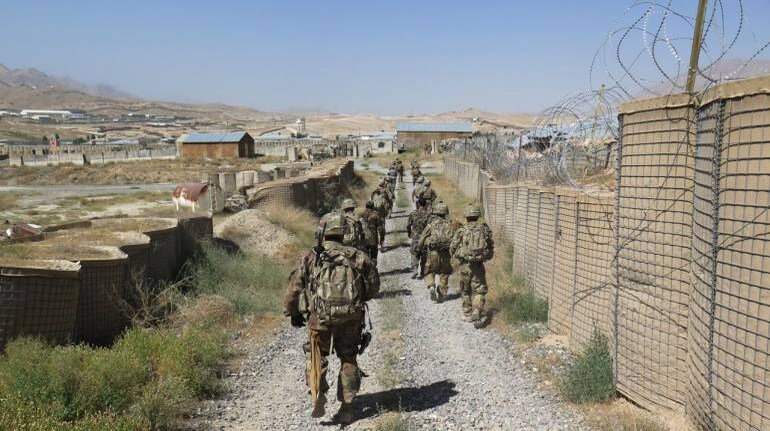
Lloyd Austin, the United States’ Secretary of Defence, will be bringing several proposals with him to New Delhi next week, intended to guarantee that a peace agreement holds. The proposals, government sources have told Moneycontrol, include building a multinational peacekeeping force, possibly under the United Nations flag. The draft agreement, interestingly, has a clause for a national ceasefire commission, backed by an “international monitoring mission”, to flag violations of the ceasefire. This mechanism, for obvious reasons, would also need an enforcement instrument.
Ever since Afghan National Security Advisor Hamdullah Mohib discussed the idea with his Indian counterpart, Ajit Doval, last year, it’s been clear Afghanistan would welcome an Indian military presence.
There’s no clarity, yet, on New Delhi’s thinking—let alone granular decisions on a command structure, financing, and logistics. From New Delhi’s point of view, the case against is formidable. The country has no land route to Afghanistan, and very limited military capacities to sustain out-of-theatre troop deployments. In addition, New Delhi has concerns about its troops being singled out for targeting by Pakistan’s proxies in Afghanistan.
“Experience teaches us”, military analyst Vivek Chadha has argued, “that missions like these tend to snowball. We’ll send troops; they’ll be attacked by Pakistan’s proxies, and we’ll have to send more troops to protect them”.
Yet, Indian involvement in a peacekeeping mission would go a long way reassuring the anti-Taliban axis in Afghanistan, represented by President Ghani and Vice-President Amrullah Saleh.
As early as June 1988, declassified diplomatic cables show that Prime Minister Rajiv Gandhi had warned against military dictator General Muhammad Zia-ul-Haq’s efforts to impose “Islamic fundamentalists” on Kabul, following the withdrawal of the Soviet Union. The US rejected Indian concerns, instead relying on Pakistan to stitch together an Islamist coalition.
In September 1996, the bloodied body of President Muhammad Najibullah—forced to take refuge at the United Nations’ premises in Kabul after Soviet Union’s financial assistance was terminated—was dragged behind a truck, and then hung from a traffic light for the edification of the passing public. The new Taliban order had risen.
Glyn Davies, the then US spokesman, described the violation of the United Nations' sovereign protections in Kabul, and Najibullah’s murder, as merely “regrettable”. The new Shari’a-based regime was, he promised, only “anti-modern”, not “anti-Western”.
President Bill Clinton’s administration pushed forward this thinking, hoping to leverage the Taliban for energy giant Unocal's efforts to build an ambitious pipeline linking Central Asia's vast energy fields with the Indian Ocean. In April 1996, Robin Raphel—then Assistant Secretary of State for South Asia, and later Barack Obama’s ambassador for non-military aid to Pakistan, proclaimed: “The Taliban does not seek to export Islam, only to liberate Afghanistan”.
Muhammad Ghaus, the Taliban’s foreign minister, even led an expenses-paid delegation to Unocal's headquarters in Sugarland, Texas, at the end of 1997. The clerics, housed at a five-star hotel, were taken to see the NASA museum, several supermarkets and the local zoo.
Few in the United States cared that the Taliban was sheltering al-Qaeda—which in turn, was attacking its own troops. “The truth”, former secretary of state Madeleine Albright later wrote, “was that those [attacks before 9/11] were happening overseas and, while there were Americans who died, they were not thousands and it did not happen on US soil”.
India has a clear interest in ensuring the United States isn’t, once again, seduced by the Big Prize—withdrawing its troops from an expensive and apparently endless war—and ignoring the fallout. But is the cost worth it?
Enslaved by his captors, and then put to work in the home of nobleman Osman Beg preparing his master’s hookah, Sita Ram spent three years in Kabul. Even when Major General George Pollock’s Army of Retribution set light to the city in 1842, fearing the inevitable punishment for risking escape: “I should be made a eunuch, and sold for a large sum to attend some harem”. He returned home only in 1845, travelling with a trader’s convoy to Peshawar, where he was ransomed.
New Delhi has the opportunity here to bring something genuinely new to the table on what multinational state-building efforts should look like in insurgency-torn regions across Asia, and what the global order to govern them should be.
Discover the latest Business News, Sensex, and Nifty updates. Obtain Personal Finance insights, tax queries, and expert opinions on Moneycontrol or download the Moneycontrol App to stay updated!

Find the best of Al News in one place, specially curated for you every weekend.
Stay on top of the latest tech trends and biggest startup news.