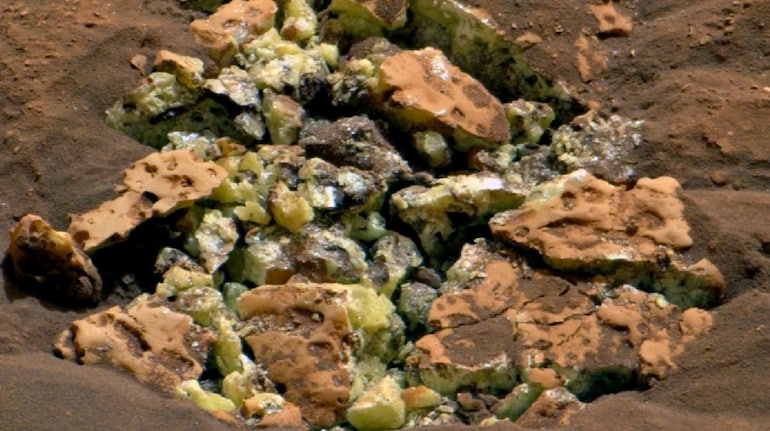
NASA’s Curiosity rover accidentally cracked open a Martian rock recently. The rock revealed yellow crystals previously hidden beneath its surface. Scientists confirmed these crystals are pure elemental sulfur for the first time. The find occurred in Gediz Vallis Channel on Mars’ surface.
Where And How It Happened?
The rover rolled over a rock while exploring the valley channel. Pressure from the rover caused the rock to fracture revealing the crystals. Curiosity’s instruments identified the elemental sulfur and measured its chemical composition. The event shows that accidental findings can yield important scientific insights.
What Surprised the Scientists?
Sulfur-bearing minerals were known on Mars, but not pure sulfur. Elemental sulfur forms under rare conditions not expected in this area. The discovery challenges assumptions about chemical processes in Martian geology. Similar rocks nearby suggest sulfur deposits may be widespread on Mars.
Significance for Space Exploration
This discovery demonstrates the importance of mobile planetary laboratories. Study on this continues to reveal unexpected surprises more than a decade after landing. Elemental sulfur may provide clues about Martian environmental conditions and evolution.
What this means for Mars Research?
Sulfur is critical for life chemistry on Earth and astrobiology studies. Its presence raises questions about past volcanic and water activity happened at Mars. The find may reshape theories of the planet’s geological and chemical history. Future missions may target these areas for further investigation of habitability.
Discover the latest Business News, Sensex, and Nifty updates. Obtain Personal Finance insights, tax queries, and expert opinions on Moneycontrol or download the Moneycontrol App to stay updated!
Find the best of Al News in one place, specially curated for you every weekend.
Stay on top of the latest tech trends and biggest startup news.