India’s telecom sector might be bleeding money, but foreign investors are increasingly optimistic of the opportunities lurking in the country’s airwaves. Two years after the inception of Reliance Jio, the industry has undergone a transformation of sorts, with smaller players falling to the wayside in light of narrowing margins.
Service providers have had to sacrifice their profits to remain competitive. Consumers have been the biggest beneficiaries, with better speeds available at lower costs. A rise in internet penetration has also bolstered the government’s push at digitizing essential public services.
Here is a look at how the telecom sector has evolved over the past couple of years.
Foreign investment
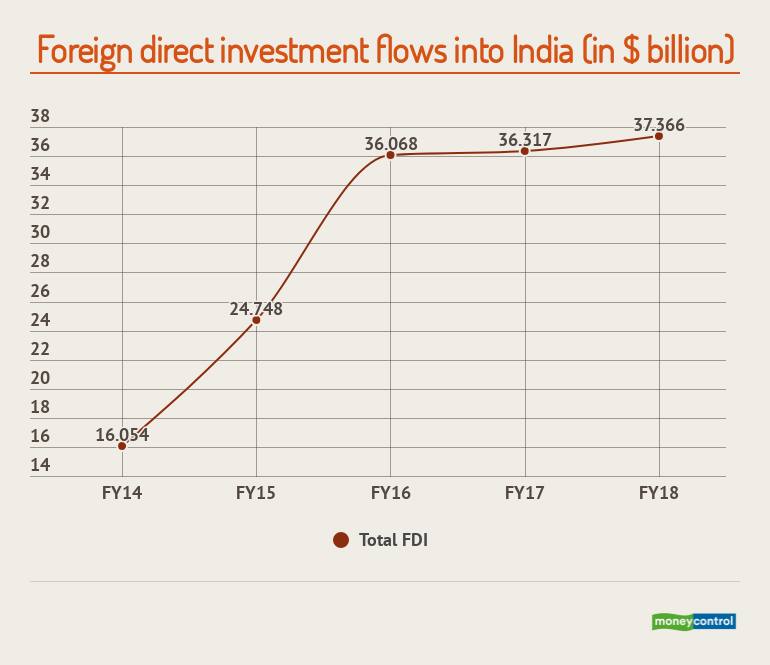
Telecom companies have benefitted from large overseas investments. Foreign direct investment (FDI) into the telecom space stood at $1.25 billion in FY14, accounting for 7.82 percent of the total pool of foreign funds.
According to the Reserve Bank of India’s (RBI) Annual Report for FY18, telecom has shed its laggard status, cornering $8.8 billion (Rs 63,066 crore) in FDI inflows.
 Source: RBI
In the space of four years, telecom has cornered a large chunk of the inflows, bagging 23.57 percent of the pie. This is the highest among all sectors. Foreign capital flowed into telecom after the government raised 74 percent cap on FDI in the sector in 2013.
Market share
The rise of Jio has undeniably dented the fortunes of established telecos. Smaller rivals shut shop, while bigger players were forced to merger to consolidate their market position.
Tata Docomo and Telenor have discontinued their services while Aircel is locked up in bankruptcy proceedings. Vodafone and Idea Cellular completed their merger formalities last week. Bharti Airtel is the last man standing.
Jio has chipped away at data tariffs, adding to the onslaught on cash-strapped rivals. Bharti Airtel has managed to incrementally raise its market share in the past three years, as have Vodafone and Idea.
The combined entity - Vodafone Idea - will become the largest operator in the country with 38.67 percent market share.
Bringing people together since 2016. ❤️@VodafoneIN@Idea#WithLoveFromJiohttps://t.co/A7iDw6awvK— Reliance Jio (@reliancejio) August 31, 2018
According to the Telecom Regulatory Authority of India (TRAI), the market share of Reliance Jio stood at 18.78 percent as on June 30. In the space of two years, it has built a robust subscriber base by significantly lowering tariffs from the prevailing rates and promoting its services by coupling it with affordable handsets. The price war triggered by Jio’s entry has not abated. Data tariffs have gone down significantly over the past couple of years.
"Tariff has been brought down by 93% in Telecom sector "said Ms Aruna Sundararajan @Secretary_DoT during Seminar on “Empowering India Digitally: Enhancing Broadband Quality & Enabling Consumer Choice" held in New Delhi today. pic.twitter.com/3Av7wATPyP — DoT India (@DoT_India) July 18, 2018Internet speed

Source: TRAI
As the number of access points to the internet has gone up over the years, so has the speed. According to TRAI’s MySpeed portal, Jio offers the fastest internet connection among Indian service providers, with an average speed of 17.23 mbps. In contrast, Airtel’s network clocked an average speed of 9.66 mbps across the country. Vodafone and Idea Cellular recorded similar performance metrics vis-à-vis speed at 7.23 mbps and 7 mbps, respectively.
Disclaimer: Reliance Industries Ltd. is the sole beneficiary of Independent Media Trust which controls Network18 Media & Investments Ltd.
Discover the latest Business News, Sensex, and Nifty updates. Obtain Personal Finance insights, tax queries, and expert opinions on Moneycontrol or download the Moneycontrol App to stay updated!
Find the best of Al News in one place, specially curated for you every weekend.
Stay on top of the latest tech trends and biggest startup news.